

Wyłączniki nadprądowe DC do zastosowań w fotowoltaice i magazynowaniu energii
Seria wyłączników nadprądowych DC JUTRION do instalacji solarnych i magazynowania energii stanowi szczytowe osiągnięcie w dziedzinie bezpieczeństwa elektrycznego dla nowoczesnej infrastruktury odnawialnej. Zaprojektowane specjalnie z myślą o wytrzymywaniu intensywnych cykli termicznych oraz trwałych łuków prądu stałego występujących w panelach słonecznych i bateriach akumulatorów o dużej pojemności, nasze wyłączniki zapewniają precyzyjne wyzwalanie termiczno-magnetyczne. Od kompaktowych wyłączników modułowych MCB na szynę DIN do domowych łańcuchów solarnych po przemysłowe wyłączniki kompaktowe MCCB do komercyjnych pętli magazynowania energii, JUTRION zapewnia ciągłość pracy systemu i absolutną ochronę zasobów.
Elastyczne konfiguracje od 1P do 4P
Dostępne w strukturach biegunowych 1P, 2P, 3P i 4P, aby bezproblemowo dopasować się do różnorodnych architektur okablowania, od lokalnych linii niskonapięciowych DC po wysokonapięciowe izolowane sieci uziemiające instalacji solarnych.
Uniwersalny zakres od 6 A do 125 A
Oferuje precyzyjny wybór prądu znamionowego od 6 A do 125 A, zapewniając dopasowaną, wysoce dokładną ochronę nadprądową zarówno dla linii monitorujących małe łańcuchy solarne, jak i dużych komercyjnych zestawów akumulatorów.
Zaawansowane tłumienie łuku elektrycznego DC
Wyposażone w specjalistyczne wewnętrzne struktury wydmuchu magnetycznego oraz wzmocnione komory gaszeniowe, które skutecznie rozciągają i bezpiecznie gaszą intensywne, ciągłe łuki elektryczne prądu stałego, zanim spowodują uszkodzenia.
Bezpieczeństwo instalacji solarnych i magazynowania energii
Zaprojektowane specjalnie z myślą o wytrzymywaniu intensywnych wysokoenergetycznych cykli termicznych oraz dwukierunkowych przepływów prądu podczas szybkich faz ładowania i rozładowywania w panelach słonecznych i obudowach akumulatorów.
Katalog wyłączników nadprądowych miniaturowych prądu stałego JUTRION
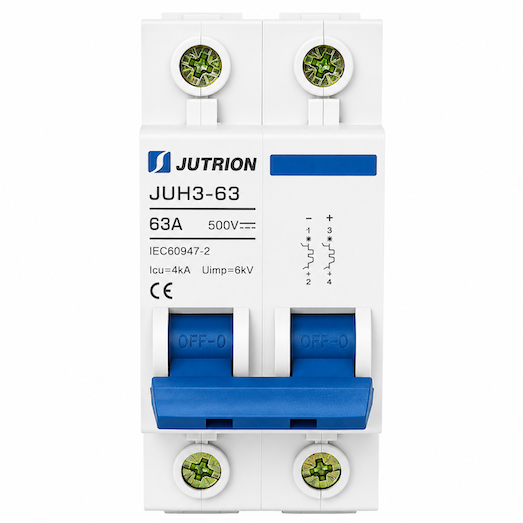
Wyłącznik nadprądowy miniaturowy serii JUTRION JUH3
Parametry techniczne
Seria modelu:JUH3
Prąd znamionowy:6 A, 10 A, 16 A, 20 A, 25 A, 32 A, 40 A, 50 A, 63 A
Liczba biegunów:1P, 2P, 3P, 4P
Typ montażu:Montaż na standardowej szynie DIN 35 mm
Precyzyjna kalibracja obwodów odgałęźnych:Zaprojektowane z wysoce czułymi wewnętrznymi elementami termiczno-magnetycznymi, aby zapewnić dokładną i niezawodną kalibrację nadprądową dla niskonapięciowych pętli sterowniczych i mniejszych obciążeń odgałęźnych terminali.
Kompaktowa modułowa konstrukcja:Charakteryzuje się standardową szerokością modułową, która bezproblemowo integruje się ze standardowymi tablicami rozdzielczymi, maksymalizując przestrzeń na szynie w wysoko zagęszczonych obudowach mieszkaniowych lub komercyjnych.
Długa mechaniczna żywotność:Zbudowane z wysoce odpornych na zużycie mechanizmów przełączających, aby zapewnić niezawodne wielobiegunowe operacje otwierania i zamykania przez lata ciągłej pracy infrastrukturalnej.
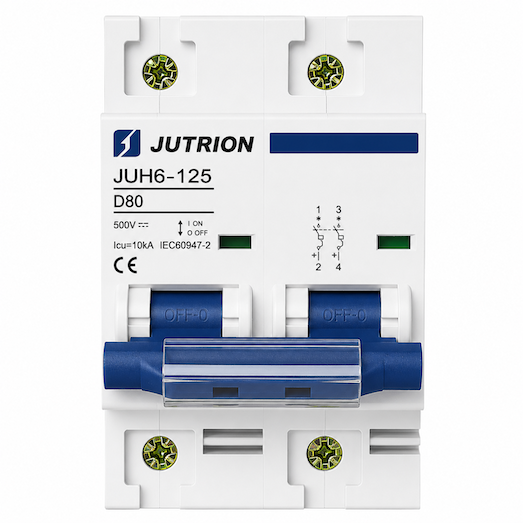
Wyłącznik nadprądowy miniaturowy serii JUTRION JUH6
Parametry techniczne
Seria modelu:JUH6
Prąd znamionowy:80 A, 100 A, 125 A
Liczba biegunów:1P, 2P, 3P, 4P
Typ montażu:Montaż na standardowej szynie DIN 35 mm
Obsługa wysokoprądowa o dużej wytrzymałości:Zaprojektowane specjalnie ze wzmocnionymi wewnętrznymi szynoprzewodami miedzianymi i strukturami styków, aby bezpiecznie przewodzić i przełączać duże obciążenia elektryczne do 125 A bez nadmiernego nagrzewania.
Wzmocnione przerywanie zwarć:Wyposażone w powiększone komory gaszeniowe i wytrzymałe płyty siatkowe, aby skutecznie tłumić i usuwać wysokoenergetyczne prądy zwarciowe w głównych liniach zasilających.
Solidna obudowa do środowisk przemysłowych:Wykonane z wysokiej jakości grubych materiałów obudowy o właściwościach trudnopalnych, które zachowują integralność strukturalną i precyzyjną kalibrację w trudnych warunkach ciągłej pracy przemysłowej.
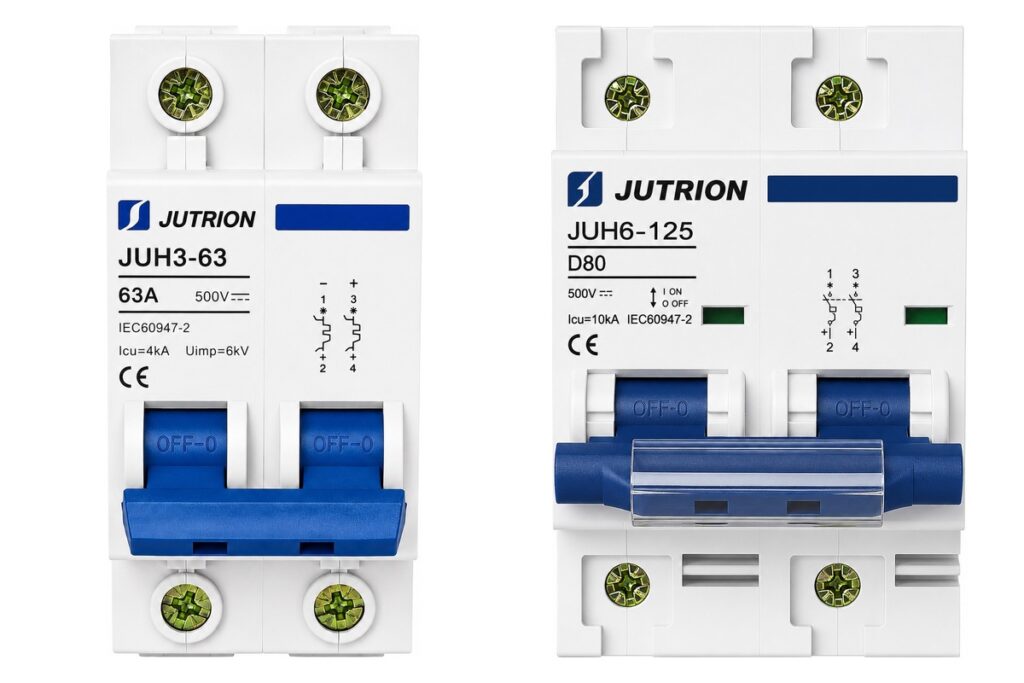
Seria JUTRION JUH3 kontra seria JUH6
| Parametry techniczne | Seria JUTRION JUH3 | Seria JUTRION JUH6 |
|---|---|---|
| Zakres prądu znamionowego | 6 A do 63 A | 80 A do 125 A |
| Dostępna liczba biegunów | 1P, 2P, 3P, 4P | 1P, 2P, 3P, 4P |
| Główny obszar zastosowań | Obwody odgałęźne, obwody sterownicze, małe łańcuchy solarne i systemy mieszkaniowe | Główne obwody zasilające, dystrybucja do ciężkich maszyn i komercyjne systemy magazynowania energii |
| Wewnętrzna konstrukcja strukturalna | Kompaktowa modułowa konstrukcja z precyzyjnymi elementami wyzwalania termiczno-magnetycznego | Wzmocniona rama o dużej wytrzymałości ze wzmocnionymi przewodami miedzianymi i powiększonymi komorami gaszenia łuku |
| Sposób montażu | Standardowy montaż na szynie DIN 35 mm | Standardowy montaż na szynie DIN 35 mm |
| Główna korzyść inżynieryjna | Maksymalizuje przestrzeń na szynie DIN w obudowach rozdzielczych o dużej gęstości zabudowy | Safely switches higher currents while reducing abnormal internal heat buildup |
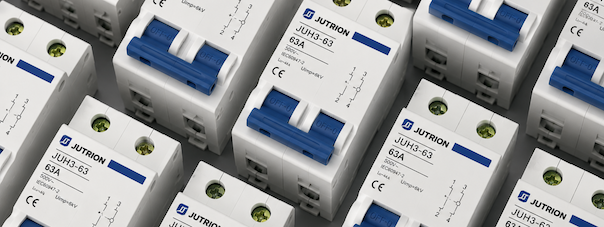
JUTRION – A HIGH-QUALITY DC MCB SUPPLIER
JUTRION DC MCB Selection Guide and Ordering Criteria
To ensure optimal safety, system uptime, and complete code compliance for your direct current infrastructure, please follow these four critical technical criteria when selecting your JUTRION miniature circuit breaker series:
Determine System Operating Voltage
Criteria: The rated operational voltage of the breaker must be equal to or greater than the maximum open circuit voltage of your DC system.
Selection: For low voltage control loops, use standard configurations. For solar PV strings or high voltage battery networks approaching 1000V DC, select multi pole series designed specifically for high voltage arc suppression.
Match the Continuous Rated Current
Criteria: Select a rated current that handles continuous full load operation without nuisance tripping, while providing rapid thermal protection during genuine overcurrent events.
Selection: For light branch circuits, instruments, and monitoring lines, select the JUH3 Series (6A to 63A). For heavy incoming lines, main battery feeds, and large power distribution panel tracking, deploy the JUH6 Series (80A to 125A).
Select the Correct Pole Configuration for Grounding
Criteria: The number of poles determines the total voltage handling capacity and physical isolation method of the positive and negative lines.
Selection: Use 1P or 2P configurations for lower voltage systems or single pole grounded networks. Deploy 3P or 4P configurations for ungrounded floating systems and high voltage renewable loops to simultaneously break both polarities for maximum safety during maintenance.
Confirm Ordering Codes and Certifications
Criteria: Standardize your procurement by specifying exact model parameters, terminal tunnel dimensions, and required international low voltage compliance certificates.
Selection: Provide our sales engineering desk with your specific trip curves, accessories requirements (such as shunt trips or auxiliary contacts), and mounting dimensions to receive a finalized technical drawing and formal batch quotation.
FREQUENTLY ASKED QUESTIONS ABOUT DC MCBS
What is a DC MCB, and what is the difference between a DC MCB and an AC MCB?
A DC MCB is a specialized miniature circuit breaker engineered safely to interrupt overcurrents and short circuits in direct current networks. The critical difference lies in arc suppression. Alternating current naturally passes through a zero-voltage crossing point fifty or sixty times a second, which helps extinguish the electrical arc. Direct current stays at a constant, persistent voltage, meaning the arc never crosses zero and is exceptionally difficult to put out. Because of this, a DC MCB must contain intensive internal magnets and dedicated cooling structures to forcefully pull and extinguish the continuous direct current arc, whereas a standard AC MCB lacks these strong magnetic blowing elements and will fail catastrophically if applied to high-voltage DC lines.
How do I choose between the JUTRION JUH3 and JUH6 series for my project?
Selection depends entirely on your system current load requirements. The JUH3 series is rated from 6A to 63A, making it ideal for lighter localized terminal distribution, monitoring lines, control loops, and small residential solar strings. The JUH6 series handles larger heavy duty power paths from 80A up to 125A, incorporating beefier copper busbars and deeper frames to manage main incoming feeds and industrial machinery cabinets without dangerous thermal buildup.
Can I mix different wire sizes or copper types in the breaker connection terminals?
No, doing so introduces major electrical risks in high-power direct current setups. The tunnel connection terminals on our JUH3 and JUH6 series are precision engineered to apply even mechanical pressure across a uniform conductor cross-section. Mixing wires of different diameters or combining rigid solid wires with flexible stranded copper wires inside a single tunnel will create uneven contact pressure. This leads to loose gaps, high contact resistance, localized heating, and eventually terminal burnouts under continuous direct current loads. For total safety, always use identical wire sizes and apply proper crimped ferrule terminals to stranded copper lines.
What causes a DC MCB to trip normally, and how can I troubleshoot it?
A JUTRION DC MCB will trip for two standard safety reasons: thermal overload or a magnetic short circuit. A thermal trip happens slowly when downstream equipment draws slightly more current than the breaker rating over time, often caused by adding too many battery modules or load changes. A magnetic trip happens instantly due to a massive short circuit fault. To troubleshoot, always turn off the main power loop first. Inspect the line cables for insulation wear or loose connection terminals, check if the actual equipment power matches the rated continuous current of the breaker, and let the unit cool down for a few minutes before attempting a reset.
NEED THE RIGHT DC MCB FOR YOUR APPLICATION?
Tell us your system voltage, rated current, number of poles and application requirements. JUTRION will help you select a reliable and cost-effective DC MCB solution for solar PV, energy storage, DC distribution and other direct-current systems, with flexible OEM/ODM support for your market and project needs.