

Trong mạng lưới phân phối điện hạ thế, các máy cắt khối (MCCB) lắp trên các mạch nhánh chịu trách nhiệm bảo vệ quá tải và ngắn mạch cho từng mạch của chúng. Ngược lại, máy cắt không khí (ACB), trong ngành còn thường được gọi là máy cắt vạn năng, lắp ở phía đầu vào của tủ phân phối chính (MDB), đóng vai trò cốt lõi trong điều khiển nguồn vào chính, phối hợp bảo vệ hệ thống và quản lý phân phối điện chính dòng điện lớn.
Nhiều kỹ sư mới vào nghề hoặc người mua hàng không có nền tảng điện thường hiểu đơn giản ACB là “một MCCB lớn hơn với dòng định mức cao hơn.” Tuy nhiên, tại các công trường công nghiệp thực tế và tòa nhà thương mại lớn, giá trị của máy cắt nguồn vào chính không bao giờ chỉ giới hạn ở dòng định mức cao hơn. Tầm quan trọng thực sự của nó nằm ở khả năng cung cấp khả năng chịu dòng ngắn hạn mạnh hơn, logic cài đặt bảo vệ hoàn chỉnh hơn và hỗ trợ đáng tin cậy cho tính chọn lọc của hệ thống cũng như tính liên tục cấp điện khi xảy ra sự cố.
Lý do ACB từ lâu đã được sử dụng trong các mạch nguồn vào chính và mạch phân phối chính dòng điện lớn không đơn giản chỉ vì chúng có kích thước lớn hơn. Quan trọng hơn, ACB mang lại những ưu điểm ở cấp hệ thống khác biệt rõ ràng so với các máy cắt hạ thế thông thường về khả năng bảo trì kết cấu, dòng chịu ngắn hạn (Icw), khả năng mở rộng phụ kiện và các chức năng bảo vệ thông minh.
Máy cắt không khí (ACB) là gì?
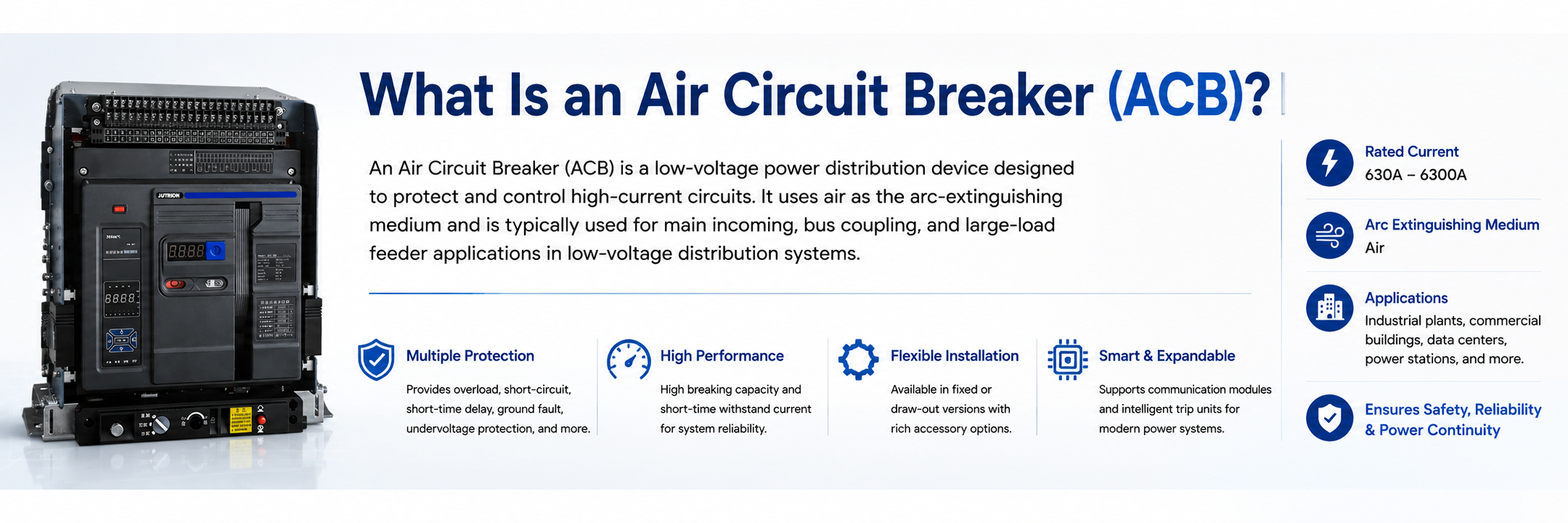
Các tính năng cốt lõi của Máy cắt không khí (ACB) hiện đại. Khả năng cắt cao và thiết kế kéo ra linh hoạt khiến nó trở thành trái tim không thể tranh cãi của Tủ phân phối chính (MDB).
ACB, hay Máy cắt không khí, là thiết bị bảo vệ và điều khiển quan trọng được sử dụng trong các hệ thống phân phối điện hạ thế. Nó đặc biệt phù hợp cho các feeder nguồn vào chính, máy cắt liên lạc thanh cái và các mạch phân phối chính dòng điện lớn. Nó sử dụng không khí làm môi trường dập hồ quang và thường có dải dòng định mức từ 630A đến 6300A. Khác với các máy cắt nhánh thông thường, ACB được thiết kế tập trung nhiều hơn vào phối hợp bảo vệ cấp hệ thống, khả năng chịu dòng ngắn hạn và tính liên tục cấp điện.
Đối với máy cắt hạ thế, IEC 60947-2 là một trong những tiêu chuẩn tham chiếu quốc tế chính được sử dụng để xác định các yêu cầu về hiệu suất như khả năng cắt, khả năng chịu dòng ngắn hạn và phối hợp bảo vệ.
Các tính năng chính và thông số thường gặp của ACB
- ACB có dải dòng định mức rộng, thường bao phủ 630A đến 6300A, đáp ứng yêu cầu mang tải của các mạch phân phối chính lớn.
- Nó có khả năng cắt ngắn mạch mạnh, với khả năng cắt ngắn mạch tới hạn đạt tới 50–150kA, cho phép nhanh chóng ngắt dòng sự cố ngắn mạch.
- Nó cung cấp nhiều chức năng bảo vệ có thể điều chỉnh, bao gồm bảo vệ quá tải thời gian dài, bảo vệ ngắn mạch trễ thời gian ngắn, bảo vệ ngắn mạch tức thời và bảo vệ thấp áp. Các thông số bảo vệ có thể được điều chỉnh tại hiện trường.
- Nó hỗ trợ nhiều chế độ vận hành, bao gồm đóng cắt bằng tay, vận hành nạp lò xo bằng động cơ và điều khiển tự động từ xa qua kết nối PLC.
- Kết cấu kéo ra cung cấp các vị trí kết nối, thử nghiệm và cách ly, giúp việc kiểm tra và thay thế thuận tiện hơn mà không cần tháo tủ điện.
- Nó thường phù hợp cho 400V và 690V hệ thống phân phối điện xoay chiều hạ thế.
Các thành phần chính của Máy cắt không khí (ACB)
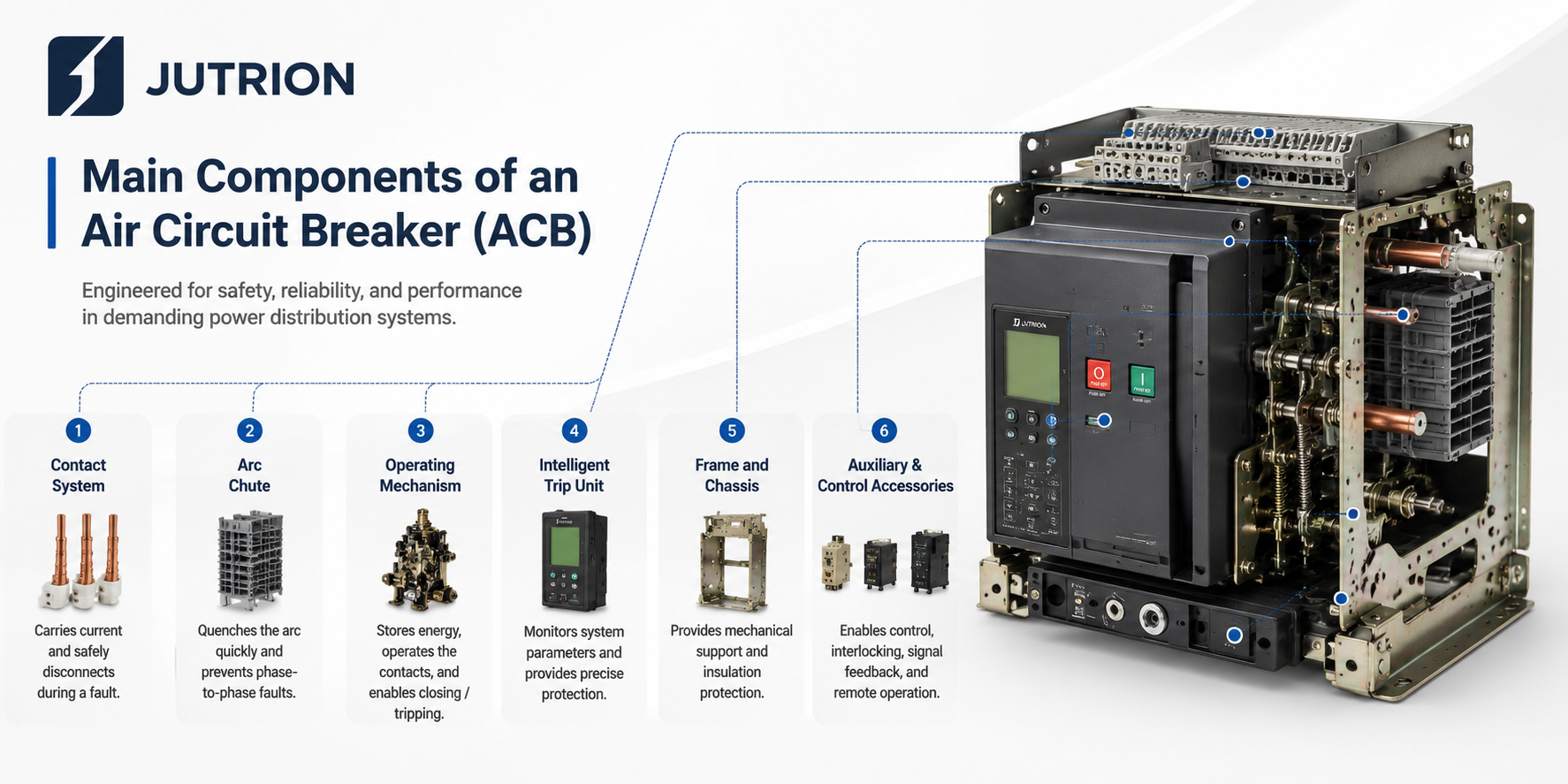
Cấu trúc mô-đun của một ACB hiện đại. Khác với MCCB kín, khung mở cho phép các kỹ sư độc lập kiểm tra, bảo trì hoặc thay thế các bộ phận lõi—chẳng hạn như buồng dập hồ quang và cơ cấu vận hành—giúp giảm đáng kể thời gian ngừng bảo trì tại các cơ sở quan trọng.
Cấu trúc của ACB được thiết kế xoay quanh ba mục tiêu cốt lõi: dẫn dòng tin cậy, ngắt sự cố nhanh và điều khiển bảo vệ ổn định. Nó thường bao gồm các bộ phận chính sau:
Hệ thống tiếp điểm
- Bao gồm tiếp điểm chính và tiếp điểm hồ quang, là các bộ phận lõi chịu trách nhiệm dẫn và ngắt dòng điện.
- Hạng mục tiếp điểm chính dẫn dòng định mức trong quá trình vận hành lâu dài, trong khi tiếp điểm hồ quang được thiết kế để chịu sự ăn mòn hồ quang trước và bảo vệ tiếp điểm chính.
- Cấu trúc tiếp điểm nhiều cấp thường được sử dụng cùng với cơ cấu lò xo nhanh để đạt được sự tách tiếp điểm chính không hồ quang và tuổi thọ điện dài.
Buồng dập hồ quang
- Buồng dập hồ quang sử dụng không khí làm môi trường dập hồ quang, và cấu trúc bên trong thường chứa các tấm chia kim loại hoặc buồng hồ quang kiểu mê cung.
- Sau khi hồ quang đi vào buồng dập hồ quang, nó bị chia tách, làm nguội, kéo dài và nhanh chóng bị dập tắt, giúp ngăn ngừa ngắn mạch giữa các pha.
- Đây là bộ phận then chốt quyết định khả năng cắt tối đa của ACB.
Cơ cấu vận hành
- Bao gồm cơ cấu tích năng, cơ cấu truyền động và cơ cấu cắt.
- Hỗ trợ vận hành bằng tay, nạp lò xo / đóng bằng động cơ, và có thể thực hiện cả điều khiển tại chỗ và từ xa.
- Cấu trúc cơ khí liên kết bốn thanh hoặc năm thanh thường được sử dụng để đảm bảo các thao tác đóng cắt nhanh, ổn định và êm ái.
Bộ cắt thông minh / Bộ bảo vệ
- Đây là “bộ não” của ACB và tích hợp nhiều chức năng bảo vệ, chẳng hạn như bảo vệ quá tải thời gian dài, bảo vệ ngắn mạch trễ thời gian ngắn, bảo vệ ngắn mạch tức thời và bảo vệ thấp áp / mất áp.
- It supports the collection of multiple parameters such as current, voltage, and temperature. The protection curve can be adjusted locally or remotely.
- Some models are equipped with communication interfaces and can be connected to PLCs or power monitoring systems to realize remote communication, remote measurement, and remote control.
5. Frame and Chassis
- It provides mechanical support and insulation protection. Draw-out structures are widely used in mainstream ACB designs.
- It includes three positions: connected position, test position, and isolated position, making online inspection, maintenance, and breaker replacement more convenient.
- Internal insulation barriers and phase-to-phase insulation components are integrated to prevent internal short circuits.
6. Auxiliary and Control Accessories
- Common accessories include auxiliary contacts, shunt releases, undervoltage releases, motor operating mechanisms, energy storage motors, and other control components.
- These accessories enable signal feedback, interlocking control, automatic opening and closing, and compatibility with power distribution automation systems.
How Does an Air Circuit Breaker Work?
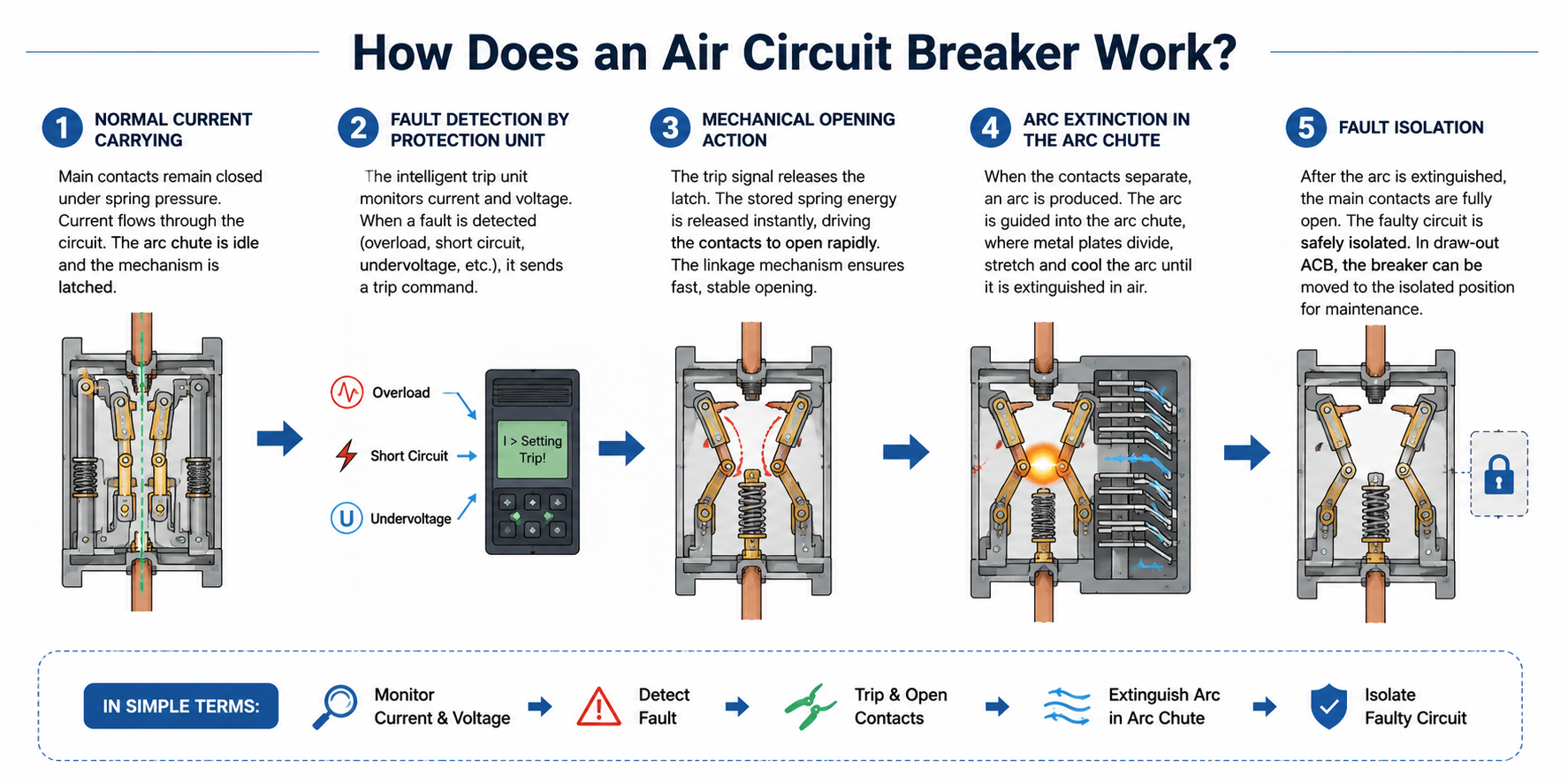
How an Air Circuit Breaker (ACB) works during fault interruption
In simple terms, an ACB works like an “intelligent main safety switch” in a low-voltage main distribution system. During normal operation, it carries high current continuously. When faults such as overload, short circuit, undervoltage, or loss of voltage occur, it can quickly and reliably disconnect the circuit to prevent the fault from spreading.
1. Normal Current Carrying
During normal operation, the main contacts remain tightly closed under spring pressure, allowing current to flow through the contact system and conductor path. At this stage, the arc chute does not operate. The operating mechanism remains in the charged and latched position, keeping the breaker closed.
2. Fault Detection by the Protection Unit
The intelligent trip unit continuously monitors current and voltage signals. When an abnormal condition is detected, it decides whether the breaker should trip according to the preset protection settings.
For overload faults, the current exceeds the preset value, and the trip unit sends a trip command according to the long-time delay protection curve.
For short-circuit faults, the current rises sharply, and the trip unit responds through short-time delay or instantaneous protection.
For undervoltage or loss-of-voltage conditions, the undervoltage release can trigger the breaker to open.
3. Mechanical Opening Action
After the trip signal is issued, the latch inside the operating mechanism is released. The stored spring energy is discharged instantly, driving the contact system to open rapidly. A four-bar or five-bar linkage mechanism helps ensure fast, stable, and smooth opening action.
4. Arc Extinction in the Arc Chute
When the contacts separate under load or fault current, a high-temperature arc is generated between the contacts. This arc is guided into the arc chute, where metal splitter plates divide, stretch, and cool the arc. The arc is then extinguished in air, preventing phase-to-phase faults or equipment damage.
5. Fault Isolation
After the opening action is completed, the main contacts are fully separated and the arc is extinguished. The faulty circuit is safely isolated. In some draw-out ACB designs, the breaker can also be moved to the isolated position, providing physical separation for inspection and maintenance.
One-sentence summary:
An ACB safely interrupts a faulty circuit through the complete process of protection unit fault detection → rapid opening by the operating mechanism → arc extinction in the arc chute, helping protect the distribution system and electrical equipment.
ACB Protection Functions: Understanding LSI and LSIG Protection
The protection functions of an ACB are like an “intelligent safety firewall” for a low-voltage main distribution system. It can continuously monitor current and voltage conditions, and when abnormal conditions such as overload, short circuit, or undervoltage occur, it automatically disconnects the power supply according to the preset protection logic, preventing equipment damage or the fault from spreading.
1. Long-Time Overload Protection (L Protection)
- Function: Prevents long-term overload from causing cable overheating, equipment overheating, and insulation aging.
- Principle: When the current exceeds the preset value, the trip unit trips according to the inverse-time characteristic. The higher the current, the shorter the delay time.
2. Short-Time Short-Circuit Protection (S Protection)
- Function: Achieves selective coordination between upstream and downstream circuit breakers, avoiding large-area power outages during a fault.
- Principle: When the short-circuit current reaches the preset value, the ACB delays tripping for a short period, allowing the downstream breaker to clear the fault first. If the fault is not cleared, the ACB trips afterward.
3. Instantaneous Short-Circuit Protection (I Protection)
- Function: Responds to severe short-circuit faults by quickly interrupting high fault current to protect equipment and busbars.
- Principle: When the current exceeds the instantaneous setting value, the breaker trips immediately with no intentional delay or with an extremely short delay.
4. Undervoltage / Loss-of-Voltage Protection (U Protection)
- Function: Prevents equipment damage or power system impact caused by automatic motor restart when voltage is too low or power is restored after an outage.
- Principle: When the system voltage drops below the preset threshold, such as 70% Ue, the undervoltage release operates and forces the breaker to open.
5. Ground Fault / Leakage Protection (G Protection, Optional)
- Function: Detects ground faults or leakage current to reduce the risk of electric shock and equipment damage.
- Principle: It monitors three-phase unbalanced current through a zero-sequence current transformer. When the ground fault current exceeds the preset value, the protection function is triggered.
Supplementary note: The protection parameters of an ACB, such as current, time delay, and protection curves, can usually be adjusted locally or remotely. With multiple protection combinations, the ACB becomes a key device for achieving selective protection in low-voltage main distribution systems.
Typical Applications of ACBs
In real projects, ACBs are usually installed inside low-voltage switchboards or main distribution boards. In addition to selecting the correct breaker rating, the complete switchboard design should also consider the requirements of IEC 61439 low-voltage switchgear assemblies, including insulation coordination, temperature rise, short-circuit withstand capability, and internal layout safety.
- Low-Voltage Main Incoming / Outgoing Circuits (LVMDP)
Used as the main switch on the low-voltage side of transformers or in main distribution boards. It carries high currents from 630A đến 6300A and meets IEC requirements for short-time withstand capability and selective protection. - Bus Coupler Circuits
Installed between two busbar sections in dual-power systems to achieve sectionalized or parallel operation, ensuring power supply continuity while preventing fault expansion. - Generator / Emergency Power Outgoing Circuits
Used to protect backup power sources such as low-voltage generators and UPS systems, enabling grid-connection / islanding control and meeting coordination requirements for power-side protection. - Large-Capacity Industrial Load Circuits
Used as the main protection device for Motor Control Centers (MCC) and Power Control Centers (PCC), suitable for high-power motors, pump groups, and other heavy-load applications. - Critical Distribution Zone Feeders
Used for main feeders in commercial buildings, data centers, and other large facilities, providing reliable protection and easier maintenance.
Draw-Out ACB vs Fixed ACB: What Is the Main Difference?
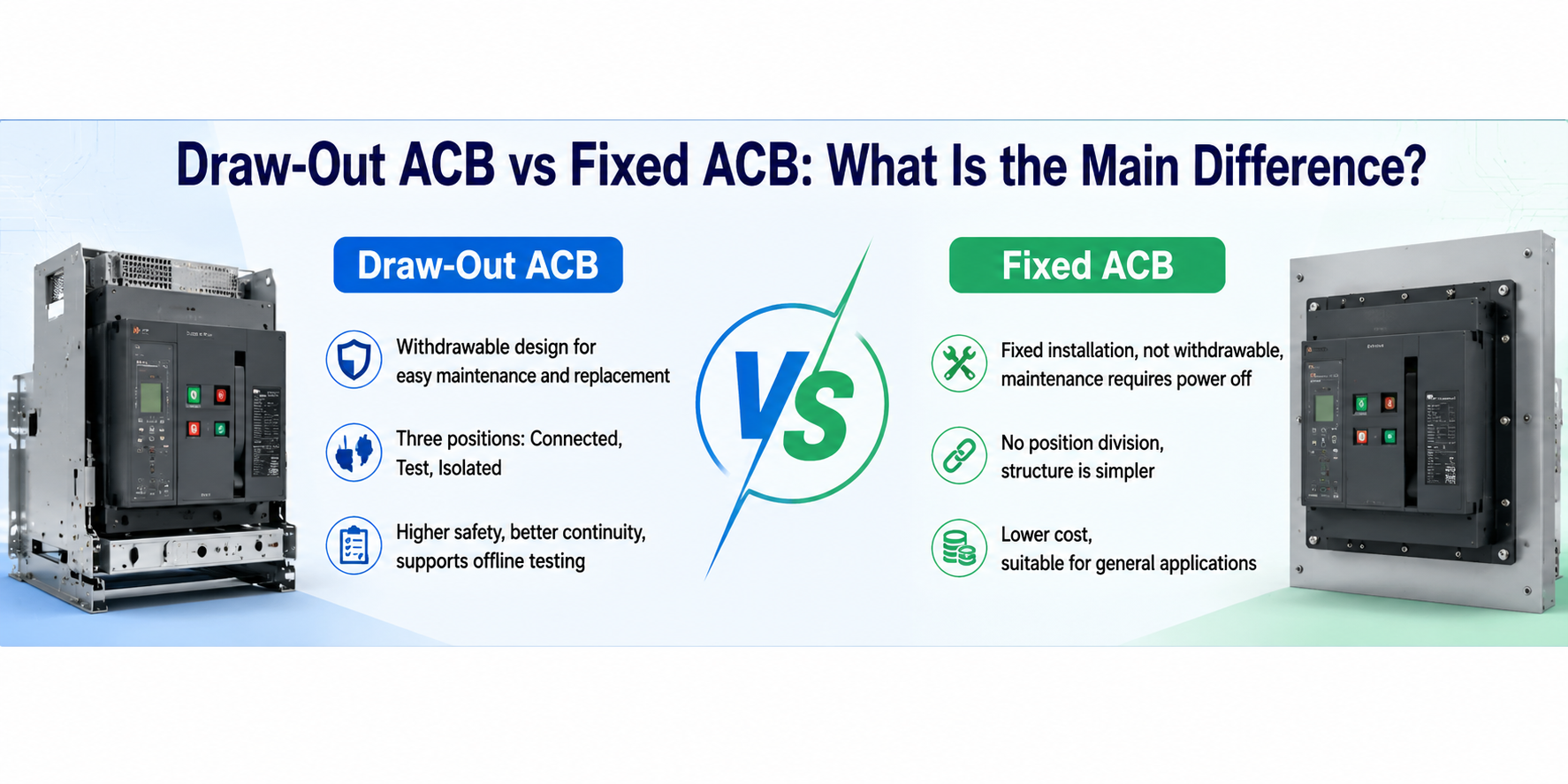
Draw-Out vs. Fixed ACB. Draw-out models feature a 3-position cradle for safe, offline maintenance, while fixed models offer a cost-effective alternative.
Quick Comparison Table
| Comparison Item | Draw-Out ACB | Fixed ACB |
| Installation Structure | Removable draw-out chassis, separate breaker body and base structure | Bolted fixed installation, integrated breaker body structure |
| Standard Positions | Three positions: connected, test, and isolated | No position division |
| Busbar Status During Maintenance | The busbar can remain energized; only the breaker body is disconnected | The busbar must be de-energized before maintenance |
| Testing Method | Can be tested offline or without energizing the main circuit, safer and more reliable | Can only be tested online with power, higher risk |
| Maintenance Difficulty | Easy to maintain, and the spare breaker body can be replaced quickly | More complicated to dismantle, requiring cable disconnection and re-tightening |
| Power Supply Continuity | High, suitable for applications where power interruption is not allowed | Low, maintenance usually requires power shutdown |
What Is a Draw-Out ACB?
A draw-out ACB is an air circuit breaker installed inside a dedicated draw-out chassis. The breaker can be racked in or racked out from the switchboard without fully dismantling the main cabinet structure.
Both the main circuit and the secondary control circuit use separable plug-in connections, allowing the breaker body to be quickly connected to or disconnected from the busbar and control wiring. During maintenance, the switchboard busbar can remain energized, while the breaker is moved to a safe isolated position for inspection, commissioning, maintenance, or replacement.
A draw-out ACB also supports offline testing, so technicians do not need to perform load testing on the main circuit. This greatly reduces the risks of short circuits, electric shock, and incorrect operation.
Advantages: high safety, easy maintenance, quick replacement, and strong power supply continuity.
Disadvantages: more complex structure, higher cost, and larger overall size.
What Is a Fixed ACB?
A fixed ACB is an air circuit breaker that is directly installed and bolted inside the switchboard. Unlike a draw-out ACB, the breaker body cannot be racked in or racked out from a dedicated chassis.
The main circuit and secondary control circuit are usually connected by fixed terminals, busbars, or control wiring. During inspection, maintenance, or replacement, the main power supply usually needs to be shut down, and some wiring or busbar connections may need to be removed.
A fixed ACB has a simpler structure and lower cost, making it suitable for general low-voltage distribution systems where frequent maintenance, quick replacement, or high power continuity is not the main requirement.
Advantages: simpler structure, lower cost, smaller installation space, and easier cabinet design.
Disadvantages: less convenient maintenance, slower replacement, usually requires power shutdown, and lower flexibility compared with a draw-out ACB.
If you are still unsure about the difference between fixed and draw-out ACBs, you can visit our [ACB product page] to learn more about their installation structures, maintenance requirements, and suitable application scenarios.
Common Mistakes When Selecting an ACB
Many people select an ACB only based on rated current, while ignoring key factors such as breaking capacity, short-time withstand current, and protection coordination. As a result, the breaker may either fail to withstand real operating conditions or be unable to achieve selective protection, leaving potential safety risks in the power distribution system.
1. Only Checking Rated Current and Ignoring Breaking Capacity (Icu / Ics)
- Wrong practice: Believing that as long as the rated current is sufficient, the ACB can be used in all applications.
- Consequence: When the short-circuit current exceeds the ultimate breaking capacity of the ACB, the breaker may fail to extinguish the arc, which can burn the equipment or even cause an explosion.
- Correct practice: Select an ACB according to the prospective short-circuit current at the switchboard busbar, and choose an ACB with Icu ≥ prospective short-circuit current.For critical main distribution circuits, models with Ics close to or equal to Icu are generally preferred.
2. Ignoring Short-Time Withstand Current (Icw) and Only Checking Breaking Capacity
- Wrong practice: Only focusing on how much current the ACB can interrupt, without considering how long the breaker can withstand fault current.
- Consequence: Upstream and downstream breakers cannot achieve selective protection. Before the downstream breaker operates, the upstream ACB trips first, causing a large-area power outage.
- Correct practice: According to the protection delay requirements, select an ACB with Icw ≥ prospective short-circuit current, and make sure the withstand duration meets the system selectivity requirement, such as 1s / 3s.
3. Confusing the Application Scenarios of ACBs and MCCBs
- Wrong practice: Using a large-frame MCCB to replace an ACB, assuming that a high current rating is enough for a main incoming circuit.
- Consequence: The short-time withstand capability, selectivity, and maintainability of an MCCB may not meet the requirements of a main distribution system. During a fault, this can easily lead to protection miscoordination or failure to isolate the fault properly.
- Correct practice: For main incoming feeders, bus couplers, generator outgoing circuits, and other critical circuits, an ACB that complies with IEC 60947-2 should be used.
4. Protection Functions Do Not Match the Actual Requirements
- Wrong practice: Blindly choosing a fully functional trip unit, or selecting a basic model with insufficient functions.
- Consequence: Either the cost is wasted, or key protection functions, such as ground fault protection, are missing, causing the system to fail to meet safety requirements.
- Correct practice: According to the circuit type, such as incoming feeder / bus coupler / feeder, and the load characteristics, select the required protection stages L / S / I / G as needed, and make sure the parameters can be adjusted.
5. Ignoring the Installation Method and Maintenance Convenience
- Wrong practice: Choosing a fixed ACB for critical circuits just to save cost, or blindly selecting a draw-out ACB for ordinary non-critical circuits.
- Consequence: Critical circuits may require power shutdown during maintenance, affecting power supply continuity; for non-critical circuits, unnecessary cost may be added.
- Correct practice: Use draw-out ACBs for important circuits such as main incoming feeders, bus couplers, and generator circuits. Fixed ACBs can be used for ordinary feeder circuits to balance safety and cost.
6. Not Verifying Protection Coordination with Downstream Devices
- Wrong practice: Setting the protection parameters of upstream and downstream circuit breakers independently, without checking selectivity coordination.
- Consequence: During a fault, protection may trip at the wrong level, expanding the power outage range and affecting power supply reliability.
- Correct practice: match the upstream and downstream protection curves to ensure that the downstream breaker operates first while the upstream breaker remains closed.
FAQ Section
Q1: What is the main difference between an ACB (Air Circuit Breaker) and a VCB (Vacuum Circuit Breaker)?
Đáp: The primary difference lies in the voltage application and the arc-extinguishing medium. ACBs are designed for low-voltage networks (typically under 1000V AC) and use ambient air and arc chutes to quench the arc. VCBs are used in medium-voltage networks (e.g., 11kV, 33kV) and extinguish the arc inside a highly sealed vacuum interrupter chamber. They serve entirely different sections of the power grid.
Q2: How often should an Air Circuit Breaker (ACB) be maintained?
Đáp: In critical facilities like data centers or heavy manufacturing plants, a visual and mechanical inspection should be conducted annually. A comprehensive maintenance routine—including lubricating the draw-out cradle mechanism, cleaning the arc chutes, and performing secondary injection testing on the intelligent trip unit—should be executed every 3 to 5 years, depending on the operating environment (dust, humidity) and switching frequency.
Q3: Can two ACBs be used to build an Automatic Transfer Switch (ATS)?
Đáp: Yes, absolutely. For extremely high-current applications (typically over 1600A) where standard ATS units reach their limits, two motorized ACBs are commonly used. By equipping them with motorized charging mechanisms, closing coils, and strict mechanical and electrical interlocks, they form a highly robust, heavy-duty transfer system perfectly suited for main generator synchronization.
Q4: Is the extra cost of a draw-out ACB really worth it over a fixed ACB?
Đáp: If system downtime costs your facility money, the answer is a definitive yes. Replacing a damaged fixed ACB requires completely de-energizing the main busbar and spending hours unbolting heavy copper connections. A draw-out ACB can be cranked out to the “isolated” position and safely swapped with a spare unit in minutes, making the initial higher capital cost negligible compared to the savings in maintenance downtime.
Conclusion
Choosing the right ACB is not only about selecting a high current rating. A reliable ACB must match the actual short-circuit level, protection coordination requirements, installation method, and maintenance needs of the power distribution system.
For critical main distribution circuits, draw-out ACBs usually offer better safety and service continuity, while fixed ACBs are more suitable for general applications where cost and space are more important. In any project, correct selection and proper protection settings are essential to ensure safe, stable, and long-term operation of the low-voltage distribution system.
