

Защита от перенапряжения и пониженного напряжения против Защитного устройства от перенапряжений (SPD) против Стабилизатора напряжения (AVR): различия и координация панелей
Используйте устройство защиты от перенапряжений (SPD), чтобы заземлить микросекундные импульсы молний и переключений, автоматический повторный выключатель для защиты от перенапряжения и недовольтажа для отключения устойчивых пиков 50/60 Гц RMS и провалов напряжения, а также автоматический регулятор напряжения (AVR), когда хронически слабая сеть требует непрерывной коррекции напряжения без отключения нагрузки.
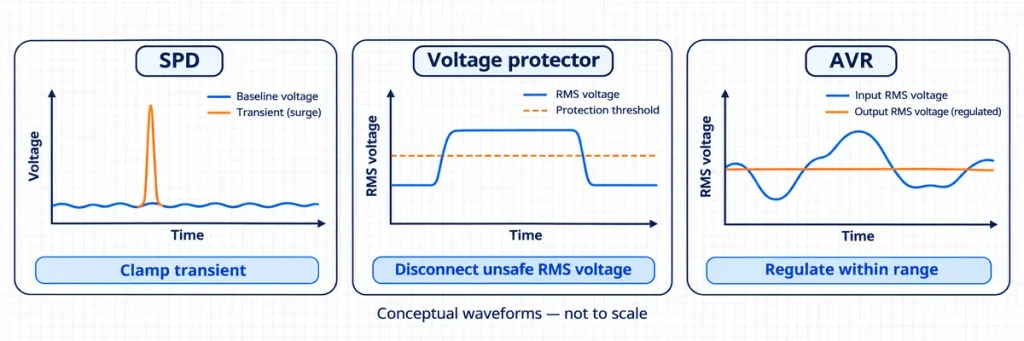
В сборках низковольтных панелей и экспортных спецификациях материалов эти три устройства часто путают, поскольку все три нечетко описываются как “защита от перенапряжений”. Тем не менее, они наблюдают разные электрические волны, действуют на разных временных масштабах и выходят из строя предсказуемым образом, когда просят выполнять работу друг друга: устойчивое перенапряжение из-за обрыва нейтрали может привести к термическому разрушению SPD, в то время как микросекундный импульс переключения может пробить изоляцию оборудования до того, как механический реле напряжения начнет открывать свои контакты.
Для полного рабочего процесса по подбору самовосстанавливающихся защитников смотрите наш руководство по защите от перенапряжения и пониженного напряжения, а для аппаратного обеспечения защиты от перенапряжений смотрите руководство по устройствам защиты от импульсных перенапряжений. Здесь мы сосредотачиваемся конкретно на сравнении защитников от перенапряжений и недовольтажа с SPD и стабилизаторами напряжения (AVR), а также на координации всех трех внутри низковольтного распределительного щита.
Импульсы перенапряжения против устойчивого дрейфа RMS напряжения
Напряженческие нарушения разделяются по продолжительности и энергии следования тока, а не только по пиковому напряжению. IEC 60364-4-44:2024 рассматривает временные перенапряжения и временные перенапряжения с частотой сети как отдельные опасности установки, требующие различных защитных реакций:
- Временные перенапряжения (микросекунды): Короткие, высоковольтные импульсы (обычно от 1,5 кВ до 6 кВ или выше в распределении зданий), вызванные косвенной молнией или индуктивным переключением. Поскольку импульс поднимается и спадает за микросекунды (моделируется с помощью 8/20 мкС тока или 1,2/50 мкС напряжения), SPD может зажать пиковое напряжение и отвлечь кратковременный импульсный ток на защитное заземление (PE) без прерывания питания.
- Устойчивые перенапряжения с частотой сети (миллисекунды до часов): Эффективные (RMS) пиковые напряжения на 50 Гц или 60 Гц, вызванные неисправностями обмоток трансформатора, отказом нагрузки или обрывом нейтрали в трехфазной четырехпроводной сети. Поскольку трансформатор питания подает непрерывный ток за пиковым напряжением, его зажатие на землю вызывает быстрое тепловое перегревание. Цепь должна быть отключена или отрегулирована.
- Устойчивые недовольтажа и провалы напряжения (секунды до часов): Падения напряжения 50/60 Гц RMS ниже безопасного рабочего диапазона оборудования. Двигатели и компрессоры потребляют больший ток по мере падения напряжения, что вызывает перегрев обмоток или остановку, если цепь не отключена или не повышена.
Почему открытая нейтраль сжигает нагрузки 230 В и SPD: упрощенный расчет
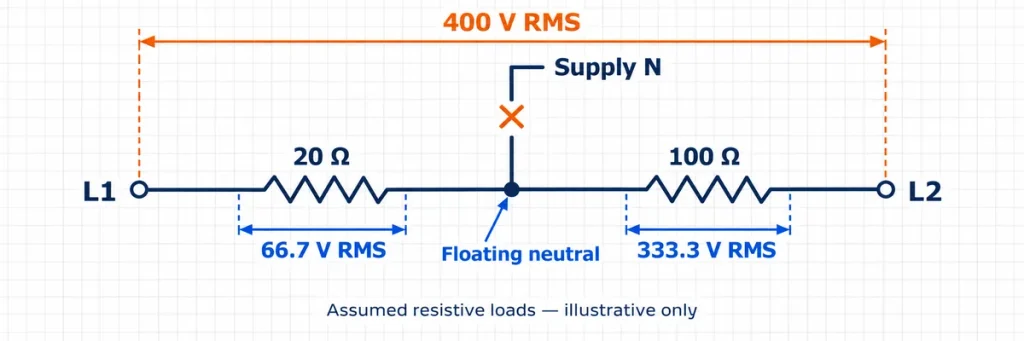
Предположим, что две однофазные резистивные нагрузки делят обрыв нейтрали на 400 В между фазами: нагрузка 20 Ом на фазе A и нагрузка 100 Ом на фазе B (120 Ом последовательно, 3,33 А).
VA = 400 В × (20 / 120) = 66,7 В | VB = 400 В × (100 / 120) = 333,3 В
Это предполагаемые резистивные значения для иллюстрации, а не данные испытаний продукта. Фаза A переходит в глубокое понижение напряжения, в то время как Фаза B получает непрерывное 333.3 В RMS перенапряжение, которое SPD не может отключить.
Сравнение бок о бок: Защита от перенапряжения/пониженного напряжения против SPD против AVR
Таблица ниже сравнивает три устройства по аналогичным инженерным и эксплуатационным параметрам для распределительных систем 230 В и 400 В AC.
| Параметр сравнения | Защита от перенапряжения и пониженного напряжения (автоматическое восстановление OVP/UVP) | Устройство защиты от перенапряжений (SPD) | Автоматический регулятор напряжения / стабилизатор (AVR) |
|---|---|---|---|
| Основное целевое нарушение | Устойчивые перенапряжения на частоте сети (50/60 Гц RMS), понижения напряжения/недостаточное напряжение и дрейф напряжения нейтрали | Импульсы переходного перенапряжения от косвенной молнии и индуктивного переключения | Хронические, непрерывные провалы напряжения в сети и умеренные подъемы напряжения |
| Масштаб времени нарушения | Десятки миллисекунд до часов (задержка подтверждения срабатывания обычно 0.1 с до нескольких секунд в зависимости от амплитуды неисправности) | Наносекунды до микросекунд (например, 1.2/50 мкс волна напряжения, 8/20 мкс или 10/350 мкс импульсы тока) | Непрерывная регулировка напряжения в реальном времени на протяжении минут, часов или дней |
| Защитный механизм | Открывает внутренние контакты реле с защелкой (или срабатывает внешний контактор) последовательно с цепью для изоляции нагрузки | Подключено параллельно; ограничивает переходное пиковое напряжение и отвлекает импульс тока перенапряжения на систему заземления PE | Подключено последовательно; понижает (уменьшает) или повышает (увеличивает) напряжение через отводы трансформатора, сервомоторы или статическую электронику |
| Прерывает ли это подачу питания на нагрузку? | Да — отключает питание во время аномалии и автоматически восстанавливает его после стабилизации сети | Нет — нагрузка продолжает работать, пока микросекундный импульс отвлекается | Нет — поддерживает непрерывный регулируемый выход, пока вход остается в пределах окна регулирования AVR |
| Защита от пониженного напряжения (понижение напряжения)? | Да — отключается, когда RMS напряжение падает ниже установленного V_мин threshold | Нет — completely inactive at normal or low supply voltages | Да — boosts low input voltage back toward nominal until input drops below its minimum cutoff |
| Sustained 330 V–400 V broken-neutral defense? | Да — disconnects the circuit within its overvoltage response window (confirm power-frequency withstand rating on the model datasheet) | Нет — sustained RMS overvoltage above U_c drives the varistor into thermal disconnection or trips its backup breaker | Limited — only if the AVR incorporates an internal high-voltage cutoff rated for 400 V line-to-line stress |
| Typical mounting & footprint | Compact 35 mm DIN-rail modular housing inside the distribution board | Compact 35 mm DIN-rail modular housing mounted near the incoming supply feed | Standalone floor, wall, or rack cabinet housing heavy transformer windings |
| Hardware cost & maintenance | Low unit cost; zero routine maintenance (digital MCU sampling + magnetic latching relay) | Low-to-moderate unit cost; requires visual status-window inspection and cartridge replacement after end-of-life | High capital cost per kVA, significant heat dissipation, and brush/servo maintenance on electro-mechanical units |
| Relevant standards context | IEC 63052:2019 (household POPs up to 63 A); market-specific self-reclosing standards (such as JB/T 12762-2015) | IEC 61643-11:2025 (and Edition 1.0, 2011) for low-voltage AC SPDs | IEC 61558 / voltage stabilizer performance standards depending on topology and market |
What Each Device Can—and Cannot—Do in a Distribution Panel
Surge Protective Device (SPD): Fast Clamping, Not RMS Disconnection
An SPD tested to IEC 61643-11 sits in a high-impedance standby state as long as the 50/60 Hz RMS supply remains below its maximum continuous operating voltage (U_c, commonly 275 V AC, 320 V AC, or 385 V AC on 230/400 V networks). When a microsecond transient exceeds the clamping threshold, internal metal-oxide varistors (MOVs) or gas discharge tubes (GDTs) switch to low impedance in nanoseconds, shunting impulse current to earth and limiting the voltage protection level (U_p) across downstream equipment.
- Why an SPD cannot replace a voltage protector: An SPD provides zero protection against undervoltage brownouts, and it is not a disconnecting switch for sustained power-frequency overvoltages. If a broken neutral holds a single-phase line at 340 V to 380 V RMS above the SPD’s
U_crating, the MOV conducts continuous power-frequency current and heats rapidly until its internal thermal disconnector opens (turning the status window red) or its upstream backup fuse/MCB trips. Selecting a higherU_chelps the SPD survive wider grid fluctuations—as explained in 275 В против 320 В против 385 В SPD: Как выбрать правильное Uc—but it still leaves the downstream load exposed to the high RMS voltage unless an overvoltage protector opens the circuit.
Automatic-Reclosing Over and Under Voltage Protector: RMS Isolation and Timed Recovery
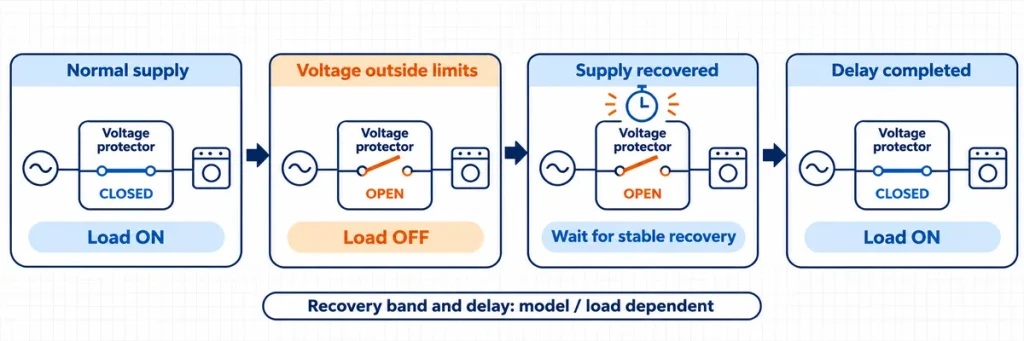
A self-resetting over and under voltage protector continuously samples the incoming 50/60 Hz RMS voltage using a microprocessor control unit (MCU). When measured voltage rises above the programmed overvoltage threshold (V_max) or falls below the undervoltage threshold (V_мин) for longer than the confirmation delay, an internal latching relay opens the circuit in series.
Unlike a manual-reset power-frequency overvoltage protective device (POP) covered by IEC 63052:2019—which is designed primarily to trip an actuator during power-frequency overvoltage in household applications—an automatic-reclosing over and under voltage protector supervises both high and low voltage thresholds and incorporates an automatic reconnection timer. Once supply voltage returns within the hysteresis recovery band and stays stable for the full countdown (allowing refrigerant pressure in HVAC and refrigeration compressors to equalize), the device automatically recloses.
- Why a voltage protector cannot replace an SPD or MCB: Because RMS digital filtering and mechanical contact separation take milliseconds to tens of milliseconds, a voltage protector cannot intercept a microsecond lightning surge. Nor does it replace a miniature circuit breaker (MCB), molded case circuit breaker (MCCB), or residual current circuit breaker (RCCB)—see our guide to MCB, MCCB, RCCB, and RCBO protection for overcurrent and earth-leakage boundaries. Finally, because it protects by disconnecting the supply, installing it on a chronically sagging feeder without voltage regulation will cause repeated shutdowns; if a unit cycles off repeatedly in service, follow the diagnostic checks in Защита от перенапряжения постоянно срабатывает: причины, настройки и решения rather than blindly widening trip thresholds.
Automatic Voltage Regulator / Stabilizer (AVR): Continuous Correction at Higher Cost
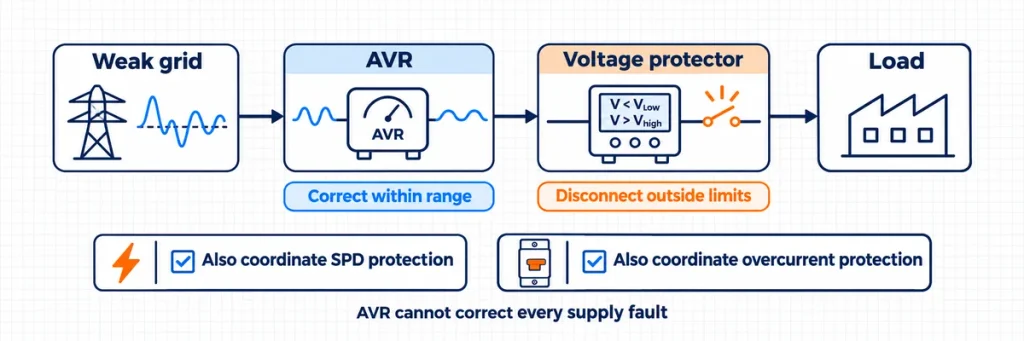
Where an over and under voltage protector asks “Is the supply safe to keep connected?”, an AVR actively adjusts its transformer ratio to boost sags or buck moderate swells (for example, lifting a chronic 185 V supply back to 220 V–230 V) so sensitive equipment keeps running without interruption.
- Why an AVR still needs upstream surge and downstream cutoff protection: AVRs require heavy magnetic cores, substantial cabinet or floor space, and a much higher per-kilowatt budget than a DIN-rail voltage protector. Furthermore, servo-driven AVRs have mechanical slewing time: if a sudden step overvoltage or broken neutral occurs, output voltage can momentarily overshoot before the servo brush travels back. Panel builders therefore commonly place an SPD upstream of an AVR and a fast DIN-rail over and under voltage protector downstream as an independent hard-cutoff fail-safe.
Panel Coordination: How to Combine MCB, SPD, and Voltage Protector on a DIN Rail
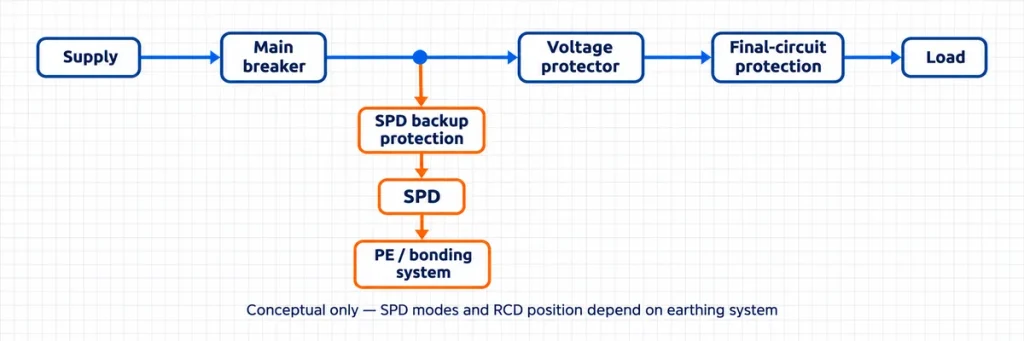
In a well-coordinated low-voltage distribution board, overcurrent breakers, transient surge arresters, and RMS voltage protectors are arranged so each device protects both the downstream load and its neighboring protective hardware.
- Stage 1 — Main incoming isolator or circuit breaker (MCB / MCCB): Provides safe manual isolation and primary overload and short-circuit breaking capacity (such as 6 kA or 10 kA). A modular voltage protector is not a short-circuit interrupting breaker and relies on coordinated upstream overcurrent protection.
- Stage 2 — Parallel SPD branch + dedicated backup protection: Tee-connected between the live conductors after the main switch/breaker and the main earthing terminal (PE), keeping total connecting lead length within 0.5 m wherever practicable. Placing the SPD connection electrically upstream of the over and under voltage protector ensures kilovolt lightning and switching transients are clamped to earth before they stress the voltage protector’s internal power supply, MCU sampling resistors, and relay contacts.
- Stage 3 — Series automatic-reclosing over and under voltage protector: Connected in series downstream of the SPD tee-off point. It continuously supervises the 50/60 Hz RMS voltage and disconnects the downstream busbar during sustained swells, brownouts, or open-neutral events.
- Stage 4 — Outgoing RCCBs / RCBOs and final branch MCBs: Feed the individual final circuits. Keeping outgoing residual-current devices downstream of both the SPD branch and the over/under voltage protector prevents surge discharge currents from causing nuisance RCD trips and shields electronic RCD sensing boards from sustained neutral-shift overvoltages. (For earthing-specific rules on SPD and RCD order in TN and TT systems, see Should an SPD Go Before or After an RCD?.)
Coordinating High-Current Feeders (>63 A) and Compressor Restart Delays
- Direct switching vs. external AC contactor control: Standard modular DIN-rail over and under voltage protectors are typically rated for direct load currents up to 40 A, 63 A, or 80 A depending on the specific model datasheet. Never route a 100 A or 250 A feeder directly through a 63 A modular protector. For high-current sub-panels or heavy three-phase motor feeders, use the voltage protector (or a phase-monitoring relay) in the control circuit to switch the coil of an appropriately rated industrial AC contactor sized using the Руководство по выбору контакторов переменного тока.
- Configuring trip windows and reconnection delays: Match the trip threshold, hysteresis recovery voltage, and reconnection countdown to the most restart-sensitive load on the branch. You can model starting voltage windows and compressor equalization delays with the Калькулятор настроек реле защиты от повышенного / пониженного напряжения.
Safety note: Work on fixed distribution panels must be performed by qualified electrical personnel. Always isolate the incoming supply, apply lockout/tagout (LOTO), verify dead-circuit conditions with a properly rated voltage tester before wiring or testing, and follow applicable national wiring regulations and the manufacturer’s installation manual.
Application Decision Matrix: Four Typical Panel Architectures
Rather than treating the three devices as mutually exclusive alternatives, panel builders and specifiers combine them according to grid stability, load sensitivity, and acceptable downtime.
| Application & Grid Profile | Recommended Protection Architecture | Engineering Rationale |
|---|---|---|
| Residential apartments & multi-unit consumer units (Generally stable supply; exposure to switching transients and occasional neutral faults) | Main MCB + Type 2 SPD + Preset Over/Under Voltage Protector (followed by outgoing RCCBs/RCBOs) | Clamps lightning and switching impulses at the panel entry and automatically isolates household appliances during utility swells or open-neutral faults without manual reset calls. |
| Commercial refrigeration, cold-chain & HVAC boards (Frequent peak-hour brownouts and post-blackout recovery surges) | Main MCB + Type 2 SPD + Adjustable Digital Over/Under Voltage Protector (set with compressor restart delay) | Prevents compressor motor stall during brownouts and enforces a mandatory stabilization countdown before re-energizing compressors after supply restoration. |
| Chronically weak rural or industrial feeders serving continuous loads (Voltage regularly sags to 175 V–195 V for hours; shutdowns disrupt operations) | Upstream SPD + AVR (Voltage Stabilizer) + Downstream Over/Under Voltage Protector | The AVR boosts chronic low voltage so operations continue without repeated cutoff trips, while the downstream OVP/UVP provides a fast hard-disconnect fail-safe if a fault exceeds the AVR’s regulation range. |
| Heavy industrial main feeders & motor panels (>63 A) (Three-phase machinery, pumps, and plant distribution) | MCCB + Type 1+2 / Type 2 SPD + Voltage Protector / Monitoring Relay Controlling an External AC Contactor | Separates high-precision RMS voltage supervision from heavy inductive load-switching duty, allowing an AC-1 or AC-3 contactor to carry and break high current reliably. |
Matching the Right JUTRION Voltage Protector Series to Your Panel Build
To support electrical distributors, panel builders, and OEM equipment manufacturers across different enclosure space, display, and parameter-control requirements, JUTRION organizes its over and under voltage protector range into three 35 mm DIN-rail series:
- JRGQ-63 Series (Digital Adjustable Dual-Display Protector): Built for commercial and industrial distribution panels where commissioning engineers need simultaneous real-time visibility of both voltage (V) and current (A), alongside field-adjustable overvoltage thresholds, undervoltage thresholds, overcurrent protection, and automatic-reclosing delay timers.
- JQGQ-63 Series (Compact Digital Adjustable Protector): Designed for high-density distribution boards and OEM control cabinets where DIN-rail width is constrained, while retaining smart digital monitoring and configurable voltage trip limits.
- JUGQ-63 Series (Standard Preset Automatic-Reclosing Protector): A cost-effective, factory-calibrated series with fixed protection thresholds for standardized residential rollouts and high-volume distributor stock where simple installation and tamper-resistant settings are prioritized.
Specification verification note: Because rated current variants, pole arrangements, exact adjustable voltage and delay ranges, maximum power-frequency withstand capabilities, and conformity certificates depend on the exact catalogue number ordered, always verify model-level parameters against the approved JUTRION datasheet before finalizing panel drawings or tender submittals.
RFQ Checklist: Information to Include When Specifying Panel Voltage Protection
When requesting a quotation, coordinated BOM review, or OEM/ODM customization from JUTRION, include these six project details so the engineering team can match the exact series and accessory ratings:
- System voltage, frequency, and earthing arrangement: Single-phase (1P+N, e.g., 230 V AC) or three-phase (3P+N, e.g., 400 V AC), 50 Hz or 60 Hz, and network earthing type (TN-S, TN-C-S, TT, or IT).
- Continuous current and switching architecture: Direct DIN-rail switching (≤63 A) or external Контактор переменного тока control for feeders above 63 A or heavy motor loads.
- Connected load characteristics: Resistive heating/lighting, single- or three-phase compressors/pumps, or switch-mode electronic power supplies.
- Display and adjustability preference: Dual V/A adjustable display (
JRGQ-63), compact digital adjustable (JQGQ-63), or factory-preset automatic-reclosing (JUGQ-63). - Coordinated panel components: Whether your bill of materials also requires matched JUTRION surge protective devices (SPDs), circuit breakers, or contactors from one supplier.
- Destination market and order scope: Applicable local standards, required conformity documentation, estimated quantity, and any private-label printing or custom preset threshold requirements.
Ready to confirm the right protection combination for your distribution board? Contact JUTRION’s engineering team with your single-line diagram or bill of materials for model matching and quotation support.
Часто задаваемые вопросы
Can an over and under voltage protector replace a surge protector (SPD)?
No. An over and under voltage protector supervises 50/60 Hz RMS voltage and takes milliseconds to open its mechanical contacts, which is far too slow to intercept a microsecond lightning or switching transient. Conversely, an SPD clamps microsecond impulses to earth but cannot disconnect a brownout or clear a sustained power-frequency overvoltage. Most distribution panels require both devices.
Should the SPD be installed before or after the over and under voltage protector?
Connect the parallel SPD branch (together with its required backup overcurrent protection) electrically upstream of the over and under voltage protector—closer to the incoming supply terminals. This clamps high-energy transient surges to earth before they pass through the voltage protector’s electronic sampling circuit and latching relay.
Why did my surge protector fail or turn red during a broken-neutral fault?
In a three-phase four-wire system, an open neutral shifts the neutral point and can expose single-phase 230 V branches to sustained power-frequency voltages reaching 330 V to 400 V RMS. When sustained RMS voltage exceeds the SPD’s maximum continuous operating voltage (U_c), its varistor conducts continuous 50/60 Hz current and overheats until its thermal disconnector opens (turning the indicator red) or its backup fuse operates. For post-event checks on the SPD itself, see диагностику и замену красного индикатора SPD.
When should I combine an AVR (voltage stabilizer) with an over and under voltage protector?
Combine them when critical equipment runs on a chronically weak or fluctuating grid where an over and under voltage protector alone would disconnect power too often. Install the AVR upstream to regulate everyday sags and swells continuously, and fit a DIN-rail over and under voltage protector downstream of the AVR as an independent hard-cutoff safeguard in case a severe supply fault exceeds the AVR’s regulation window.
Технические ссылки
- IEC 60364-4-44:2024 — Low-voltage electrical installations: Part 4-44: Protection for safety — Protection against voltage disturbances and electromagnetic disturbances.
- IEC 61643-11:2025 — Low-voltage surge protective devices: Part 11: Surge protective devices connected to AC low-voltage power systems — Requirements and test methods.
- IEC 63052:2019 — Power frequency overvoltage protection devices (POPs) for household and similar applications.
