

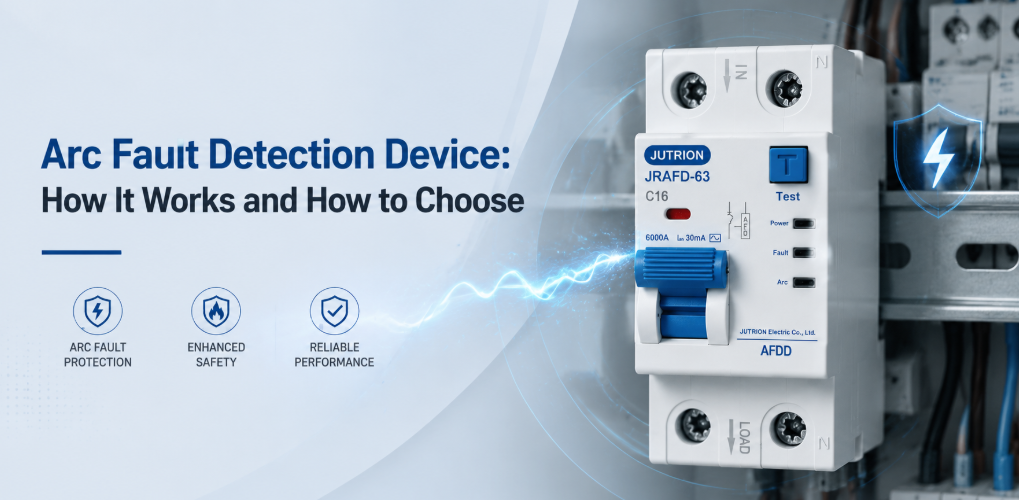
JUTRION Arc Fault Detection Device AFDD para sa proteksyon laban sa arc fault at kaligtasang elektrikal“Ang ”16 A AFDD” ay hindi kumpletong espesipikasyon. Hindi nito sinasabi sa supplier kung aling pamantayan ng produktong arc-fault ang naaangkop, kung kailangang isama ang proteksyon sa overload at residual-current, anong kapasidad ng short-circuit ang kinakailangan, paano hinahawakan ang neutral, o kung aprubado ang device para sa nilalayong distribution board. Ang mga pagkukulang na iyon ay maaaring gawing hindi tugmang bill of materials ang isang wastong konsepto ng proteksyon sa sunog.
Ang praktikal na panuntunan sa pagpili ay magsimula mula sa final circuit palabas. Unang kumpirmahin kung ang installation code ay nangangailangan o nagrerekomenda ng proteksyon laban sa arc-fault para sa circuit na iyon. Pagkatapos ay piliin ang arkitektura ng proteksyon, i-coordinate ang bawat rating na elektrikal, at itugma ang device sa distribution board. Isang arc fault detection device (AFDD) ay nagdaragdag ng proteksyon laban sa mapanganib na mga series at parallel arc; hindi nito awtomatikong pinapalitan ang isang MCB, RCD, RCBO, SPD, o wastong kasanayan sa pag-wire.
Mga Pangunahing Punto
- Natutukoy ng mga AFDD ang mapanganib na mga pattern ng series at parallel arc na maaaring hindi makagawa ng sapat na overcurrent o earth leakage upang paandarin ang isang kumbensyonal na MCB o RCD.
- Ang isang AFDD ay komplemento sa iba pang mga protective device sa halip na pinapalitan ang mga ito. Ang proteksyon sa overload, short-circuit, residual-current, at surge ay dapat pa ring ibigay kung saan kinakailangan.
- Ang mga pamantayan ng produkto at instalasyon ay sumasagot sa magkaibang mga tanong. Sinasaklaw ng IEC 62606 ang mga kinakailangan sa produktong AFDD, habang tinutukoy ng mga pambansang panuntunan sa pag-wire kung saan kinakailangan o inirerekomenda ang proteksyon.
- Ang arkitektura ng proteksyon ay nakaaapekto sa buong disenyo ng circuit. Ang Standalone AFDD, AFDD-MCB, AFDD-RCBO, at mga aprubadong modular na kombinasyon ay nagbibigay ng magkakaibang hanay ng mga function.
- Ang rated current lamang ay hindi sapat para sa pagpili. Ang boltahe, frequency, mga pole, curve, breaking capacity, uri ng RCD, busbar, mga terminal, lapad ng module, at mga kondisyon ng enclosure ay dapat ding magtugma.
- Ang wastong instalasyon at pagsubok ay mahalaga. Ang neutral routing, terminal torque, mga kondisyong thermal, mga pamamaraan ng pagsubok, at indikasyon ng sanhi ng pag-trip ay lahat nakaaapekto sa maaasahang operasyon at paghahanap ng sira.
Gamitin ang sumusunod na pitong punto upang ihambing ang mga opsyon sa AFDD para sa isang partikular na circuit at target na merkado.
| Desisyon | Tanong na sasagutin | Bakit nito binabago ang pagpili |
|---|---|---|
| Saklaw ng regulasyon | Aling bansa, edisyon ng code, occupancy, uri ng circuit, at rated current ang naaangkop? | Ang mga kinakailangan sa AFDD ay hindi pangkalahatan at maaaring magbago ayon sa pambansang pagtanggap. |
| Sistema ng produkto | Ang proyekto ba ay IEC AFDD, UK BS EN AFDD, o North American AFCI? | Ang mga pamantayan, rating, sertipikasyon, mga interface ng panel, at terminolohiya ay magkakaiba. |
| Arkitektura ng proteksyon | Ang arc detection ba ay standalone, pinagsama sa isang MCB, o pinagsama sa isang RCBO? | Tinutukoy ng pagpili kung aling mga karagdagang protective device ang mananatiling kinakailangan. |
| Mga rating na elektrikal | Anong boltahe, frequency, current, curve, uri ng residual-current, at breaking capacity ang kinakailangan? | Ang bawat halaga ay tumutugma sa ibang kondisyon ng operasyon o sira. |
| Interface ng assembly | Aling board, busbar, mga pole, kaayusan ng neutral, lapad ng module, at mga accessory ang naaangkop? | Ang mekanikal na pagkakatugma lamang ay hindi nagtatatag ng pagkakatugmang elektrikal o sertipikasyon. |
| Mga kahihinatnan sa operasyon | Ano ang mangyayari kung mag-trip ang circuit, at paano matutukoy ang sanhi? | Ang continuity, selectivity, indikasyon, at access sa maintenance ay nakaaapekto sa disenyo. |
| Suporta sa produkto | Aling mga data sheet, tagubilin, sertipiko, sample, at serbisyo sa pag-customize ang makatutulong sa proyekto? | Ginagawang mas madali ng malinaw na dokumentasyon ang paghahambing, instalasyon, pag-apruba, at paulit-ulit na pag-order. |
Nakakatulong ang order na ito sa mga mamimili na paghambingin ang mga katumbas na produkto at maiparating nang mahusay ang kanilang mga kinakailangan. Pinaghihiwalay rin nito ang mga desisyong kadalasang napagkakamalan. Halimbawa, inilalarawan ng C tripping curve ang isang overcurrent function; hindi nito inilalarawan ang arc sensitivity. Ang 30 mA marking ay naglalarawan ng residual-current protection; hindi nito pinatutunayan na may kasamang AFDD functionality ang device.
Ano ang Electrical Arc, at Bakit Ito Maaaring Magsimula ng Sunog?
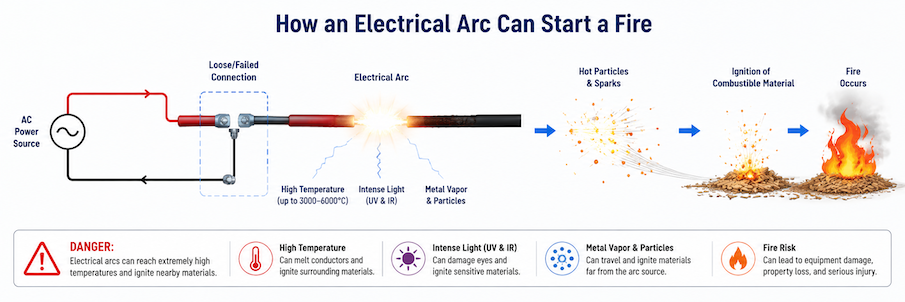
Ang electrical arc ay isang tuluy-tuloy na pagdaloy ng current sa pamamagitan ng ionized gap sa pagitan ng mga conductive point. Sa isang malusog na switch, maaaring magkaroon ng napakaikling arc kapag bumukas ang mga contact at karaniwan itong napipigil ng device. Iba ang fault arc: hindi ito sinasadya at nabubuo sa sirang insulation, putol na conductor, o mahinang koneksyon at maaaring paulit-ulit na maglabas ng matinding init sa kalapit na materyal.
Mahalaga ang AFDD dahil ang ilang mapanganib na arc ay nananatiling mas mababa sa operating threshold ng mga karaniwang protective device. Maaaring magkaroon ng series arc sa maluwag na terminal, bahagyang putol na conductor, o sirang plug contact. Nananatiling naka-series ang load sa fault, kaya ang 6 A load ay maaaring patuloy na kumukuha ng humigit-kumulang normal nitong current habang nagkakaroon ng matinding init sa napakaliit na contact area. Isang 16 A miniature circuit breaker (MCB) ay walang dahilan ng overload para mag-trip, at maaaring walang makitang imbalance ang RCD kung bumabalik ang current sa pamamagitan ng neutral.
Ang isang parallel arc ay tumatawid sa pagitan ng mga konduktor na may magkaibang potensyal. Maaari itong sumunod sa insulasyong nasira ng isang pangkabit, pagkapisa, kahalumigmigan, pagkakalantad sa ultraviolet, mga peste, o thermal aging. Maaaring limitahan at putulin ng landas ng arc ang agos, na pumipigil sa isang kumbensyonal na breaker na makakita ng matatag na metallic short circuit. Ang isang line-to-earth arc ay maaaring magpaandar ng isang RCD, ngunit ang isang line-to-neutral arc ay maaaring manatiling balanse mula sa pananaw ng RCD.
Kabilang sa mga karaniwang kondisyon ng babala ang mga maluwag na terminal ng socket, mga pudpod na kontak ng plug, mga kableng naipit sa likod ng mga kasangkapan, mga konduktor na nasira habang binabalatan, mga flexible cord na paulit-ulit na binabaluktot malapit sa isang appliance, at insulasyong nabutas ng mga turnilyo o pako. Ang ilang mga fault ay nagsisimula bilang isang high-resistance connection na umiinit at nag-o-oxidize bago lumitaw ang paulit-ulit na arcing. Ang iba naman ay nabubuo sa isang carbonized insulation path pagkatapos ng orihinal na pinsala. Ipinapaliwanag ng mga mekanismong ito kung bakit nananatiling mahalaga ang tamang torque, maingat na pagruruta ng kable, angkop na mga accessory, at pana-panahong inspeksyon kahit na naka-install ang proteksyong AFDD.
Ang normal na kagamitan ay maaari ring gumawa ng mga electrical signature na kahawig ng mga bahagi ng isang arc waveform. Ang mga switch contact, relay, dimmer, brushed motor, at switched-mode power supply ay mga pamilyar na halimbawa. Ang isang sumusunod na AFDD ay gumagamit ng ilang katangian ng signal at ang tagal ng mga ito sa halip na tumugon sa bawat spark o high-frequency disturbance. Sinusuportahan ng diskriminasyong ito ang normal na operasyon habang pinapayagan ang aparato na tumugon kapag ang isang mapanganib na pattern ay nakakatugon sa mga pamantayan ng pag-trip nito.
Patuloy na sinusuri ng AFDD ang mga katangiang elektrikal tulad ng tagal ng burst, iregularidad, mga high-frequency component, discontinuity ng agos, at pag-uugali sa paligid ng AC zero crossing. Dapat makilala ng algorithm nito ang mga mapanganib na pattern mula sa mga normal na switching arc, operasyon ng relay, dimmer, brushed motor, at electronic power supply. Kapag natugunan na ang mga tinukoy na pamantayan, inuutusan nito ang isang mekanismo ng pagbubukas na idiskonekta ang circuit.
Ang prinsipyong ito ng paggana ay humahantong sa tatlong hangganan ng pagpili:
- Ang isang AFDD ay hindi lamang isang mas sensitibong MCB. Ang magnitude ng agos at pagkilala ng arc-pattern ay magkaibang mga prinsipyo ng proteksyon.
- Ang isang AFDD ay hindi isang RCD. Ang isang earth-leakage threshold tulad ng 30 mA ay hindi naglalarawan ng pagtukoy ng arc.
- Hindi kayang tumbasan ng isang AFDD ang isang underrated na konduktor, hindi sapat na short-circuit capacity, isang maling uri ng RCD, o isang hindi magandang terminal.
Sa praktika, una kong imamapa ang mga kinakailangang function ng proteksyon sa isang matrix: overload, short circuit, residual current, arc fault, at transient overvoltage. Ang bawat kinakailangang function ay dapat italaga sa isang angkop na aparato o pinagsamang produkto. Inilalantad nito ang nawawalang proteksyon at iniiwasan ang pagbabayad nang doble para sa isang function nang hindi nauunawaan ang koordinasyon.
| Aparato/function | Pangunahing kondisyong natutukoy | Ano ang hindi nito karaniwang pinapalitan |
|---|---|---|
| MCB o fuse | Overload at short-circuit overcurrent | Residual-current o arc-pattern detection |
| RCCB/RCD | Imbalance ng residual-current | Proteksyon sa overcurrent maliban kung partikular na isinama |
| RCBO | Overcurrent kasama ang residual current | Arc detection maliban kung ang produkto ay tahasang isang AFDD-RCBO |
| AFDD | Mga tinukoy na mapanganib na arc signature | Iba pang mga function na hindi nakasaad sa sertipiko ng produkto |
| SPD | Paglilimita ng transient overvoltage | Proteksyon sa overcurrent, residual-current, o arc-fault |
Kumpirmahin Kung Saan Nalalapat ang Panuntunan Bago Pumili ng Rating
Ang pagsunod ng produkto at pagsunod sa instalasyon ay sumasagot sa magkaibang mga tanong. Sinasabi ng pamantayan ng produkto sa isang tagagawa kung paano ginagawa at sinusuri ang isang AFDD. Sinasabi ng pamantayan sa instalasyon sa isang taga-disenyo kung saan kinakailangan o inirerekomenda ang mga proteksiyong hakbang. Tinutukoy ng pambansang batas at ng awtoridad na may hurisdiksiyon kung aling edisyon ang maipapatupad.
Mga Proyekto ng IEC: Gamitin Nang Magkasama ang mga Pamantayan ng Produkto at Instalasyon
IEC 62606:2013+A1:2017+A2:2022, pinagsamang edisyon 1.2, ay nalalapat sa mga aparato sa pagtukoy at proteksiyon laban sa arc fault para sa sambahayan at katulad na mga gamit sa mga AC circuit. Kinikilala nito ang isang aparatong may paraan ng pagbubukas na ginagamit kasama ng idineklarang proteksiyon, isang produktong nagsasama ng isa pang aparatong proteksiyon, at isang hiwalay na yunit ng pagtukoy ng arc na binuo kasama ng isang idineklarang aparatong proteksiyon. Tinutukoy ng saklaw na ito ang pamilya ng produkto; hindi nito mismo pinagpapasiyahan ang bawat lokasyon kung saan dapat ilagay ang isang AFDD.
Ang konteksto ng instalasyon ay matatagpuan sa mga pamantayan tulad ng IEC 60364-4-42:2024, na tumatalakay sa proteksiyon laban sa mga thermal effect. Ang rebisyon nito noong 2024 ay muling inayos at pinalawak ang mga kinakailangan para sa mga lokasyon kung saan malala ang mga kahihinatnan ng sunog. Maaaring gamitin ng mga pambansang pamantayan batay sa IEC 60364 ang mga probisyong ito sa iba't ibang panahon o may mga pagbabago. Kaya naman, ang “bansang IEC” ay hindi sapat na pahayag ng pagsunod.
Itala ang destinasyong bansa, ang eksaktong pambansang pamantayan at edisyon, ang klasipikasyon ng occupancy, kung ang circuit ay nagsusuplay ng mga socket outlet o nakapirming kagamitan, ang rating nito, at anumang mga eksepsiyon. Kung ang produkto ay inilaan para sa ilang mga merkado, gumawa ng market matrix sa halip na isang pandaigdigang pahayag.
United Kingdom: Kontrolin ang Transisyon ng Edisyon
Dapat tukuyin ng mga espesipikasyon ng UK ang kasalukuyang posisyon ng BS 7671. Ang Tagasuri ng edisyon ng IET ay nagsasaad na ang BS 7671:2018+A4:2026 ay nailathala na at ang Amendment 3:2024 ay nananatiling balido hanggang 15 Oktubre 2026. Ang isang proyektong dinisenyo sa panahon ng transisyong ito ay dapat magsaad kung aling edisyon ang bumubuo sa kontraktwal na batayan sa halip na paghaluin ang teksto mula sa mga artikulo sa web ng A2, A3, at A4.
Huwag kopyahin ang isang listahan ng “mga mandatoryong gusali” mula sa isang blog ng installer na walang petsa. Suriin ang kasalukuyang regulasyon, mga kahulugan, saklaw ng circuit, mga eksepsiyon, at mga kinakailangan ng proyekto. Ang mga pamantayan ng kliyente, mga insurer, mga estratehiya sa sunog, o isang dokumentadong pagtatasa ng panganib ay maaari ring magbigay-katwiran sa proteksiyon na lampas sa minimum na pambansang tuntunin.
Hilagang Amerika: Tukuyin ang AFCI, Hindi ang Henerikong IEC AFDD
Sa Estados Unidos at Canada, ang karaniwang termino ay arc-fault circuit interrupter (AFCI). Tinutukoy ng UL Solutions ang UL 1699 para sa pagsusuri ng AFCI sa US at ang CSA C22.2 No. 270 para sa Canada. Kasama sa mga produkto ng Hilagang Amerika ang mga anyong circuit-breaker at receptacle na may tinukoy na mga kategorya ng aplikasyon.
Ang isang IEC 62606 DIN-rail AFDD at isang UL-listed AFCI ay hindi maaaring pagpalitin dahil lamang pareho silang tumutugon sa mga arc. Magkaiba ang boltahe, frequency, rating ng circuit, listahan ng panelboard, koneksiyon ng neutral, programa ng pagsusuri, at kodigo ng instalasyon. Para sa trabaho sa US, beripikahin din ang lokal na pinagtibay na edisyon ng NEC at mga susog. Para sa mga pamalit na breaker, ang Gabay sa pagmamarka at aplikasyon ng UL ay nagbibigay-diin sa pagkakakilanlan ng produkto, mga tagubilin, at pagkakatugma sa naaangkop na panelboard.
Piliin ang Arkitektura ng Proteksiyon Bago Ihambing ang mga Modelo ng AFDD
Pinapayagan ng IEC 62606 ang ilang mga paraan ng konstruksiyon, ngunit maaaring ilarawan ng mga katalogo ang mga ito nang magkaiba. Ang tanong sa inhinyeriya ay kung aling mga tungkulin ang nasa loob ng napiling produkto at alin ang dapat ibigay ng mga idineklarang kaugnay na aparato.
| Arkitektura | Mga tungkuling karaniwang naroroon | Konsiderasyon para sa pinakaangkop | Main verification risk |
|---|---|---|---|
| AFDD with opening means | Arc detection and circuit opening | Projects using a separately declared overcurrent or residual-current device | Assuming it has MCB or RCD protection when it does not |
| AFDD integrated with MCB | Arc, overload, and short-circuit protection | Circuits where residual-current protection is separate or not required | Omitting required RCD protection or using an unsuitable shared RCD |
| AFDD integrated with RCBO | Arc, overload, short circuit, and residual current | Individual final-circuit protection and clearer fault separation | Treating all RCBO details as standard when type, sensitivity, curve, and poles vary |
| AFD unit plus declared protective device | Depends on the approved combination | Manufacturer systems designed for field assembly | Combining visually compatible modules that were never evaluated together |
An AFDD-RCBO is often the clearest architecture for a final circuit requiring both additional residual-current protection and arc-fault mitigation. It adds arc detection to the overload, short-circuit, and residual-current functions associated with an RCBO. This arrangement limits a residual-current or arc trip to one circuit and reduces interconnections. The residual-current type must still suit the loads, the MCB curve must coordinate with fault conditions and inrush, and the device must be compatible with the board.
A shared upstream RCCB with several AFDD-MCB final circuits may reduce device cost, but one residual-current event can disconnect multiple circuits. Leakage from several electronic loads can accumulate, and diagnosis becomes less direct. The designer must consider unwanted loss of service, selectivity, permissible earth leakage, and any rule requiring individual protection.
Separate modules provide flexibility when the manufacturer declares the combination. Similar width, matching color, or a common DIN rail does not by itself confirm short-circuit coordination, trip coupling, or terminal temperature performance. Sharing the existing board and protection details with the manufacturer makes it easier to identify a suitable combination.
Where AFDD Protection Provides the Most Value
AFDDs are primarily used on final circuits where damaged cables or loose electrical connections may generate dangerous arc faults that conventional overcurrent or residual-current protection cannot detect. The need for AFDD protection depends on both the likelihood of cable damage and the potential consequences of a fire.
Bedrooms and Buildings with Sleeping Accommodation
- Bedrooms, hotels, care homes, student residences, hostels, and similar sleeping environments are among the most common applications for AFDDs. Because occupants may not notice the smell, sound, or early signs of an electrical fault while asleep, AFDDs provide an additional layer of protection by detecting arc faults caused by loose connections, damaged wiring, or deteriorated appliance cords.
The exact circuits requiring AFDD protection depend on local electrical regulations and installation standards. Designers should also consider power continuity for emergency systems, alarms, and other safety-related equipment.
Timber Buildings and Combustible Environments
- Timber-frame buildings, woodworking workshops, barns, storage facilities, and other locations containing combustible materials present a higher fire risk if an electrical arc occurs. AFDDs can help reduce this risk by interrupting developing arc faults before they become an ignition source.
AFDD protection should always complement—not replace—proper cable installation, overcurrent protection, enclosure design, routine inspection, and good housekeeping practices.
Museums, Archives, and Historic Buildings
- Museums, libraries, galleries, archives, and historic buildings often contain irreplaceable cultural or historical assets. Because electrical wiring may be concealed behind walls or difficult to inspect, AFDDs can support the overall fire-protection strategy by reducing the likelihood of arc-fault ignition.
Renovations and Aging Electrical Installations
- Renovation projects and older electrical installations may contain aging insulation, inaccessible junction boxes, damaged cables, or wiring that has been modified multiple times over its service life. Cable damage caused by drilling, crushing, vibration, or repeated movement can also increase the probability of arc faults.
Where inspection identifies elevated fire risk, AFDD protection may be considered for the affected final circuits in accordance with local installation requirements.
Outdoor and Frequently Damaged Circuits
- Outdoor wiring, movable equipment, extension leads, socket circuits in frequently reconfigured spaces, and installations exposed to vibration, moisture, rodents, or mechanical damage may experience a higher probability of cable deterioration. When appropriate, AFDDs can provide additional protection for these final circuits, provided the selected device matches the circuit voltage, current, load characteristics, and environmental conditions.
Example Application
- A student residence installs AFDD-RCBOs on bedroom socket circuits supplying chargers, computers, portable heaters, and other everyday appliances. By providing arc-fault, overload, short-circuit, and residual-current protection for each individual final circuit, faults can be isolated quickly without disconnecting unrelated areas of the building.
Applications That Require Other Arc-Fault Solutions
AFDDs designed for household and similar AC installations should not be automatically applied to three-phase industrial feeders, variable-speed drive outputs, photovoltaic (PV) string circuits, battery energy storage systems, or other DC networks. These applications have different electrical characteristics, arc behavior, and product standards, and therefore require dedicated protection devices specifically designed for those systems.
It is also important to distinguish AFDDs from arc-flash protection. AFDDs are intended to detect and interrupt dangerous electrical arc faults in final circuits to reduce fire risk, whereas arc-flash protection focuses on protecting personnel from high-energy arc-flash events in industrial switchgear through equipment design, energy-reduction methods, safe working procedures, and appropriate personal protective equipment (PPE). These two technologies address different hazards and should not be considered interchangeable.
Freeze the Electrical and Assembly Parameters
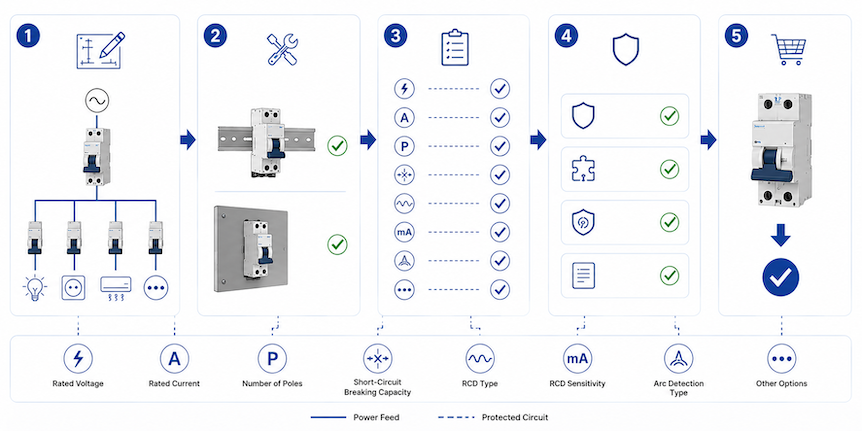
Once the architecture is decided, the AFDD schedule should be completed like any other engineered protective-device schedule. Each parameter represents a condition that the device must carry, detect, or interrupt.
Circuit Ratings: Voltage, Frequency, Current, and Poles
Confirm the nominal voltage, permitted voltage range, and supply frequency. The electronic detection circuit needs a valid supply; a 230 V, 50 Hz marking cannot be assumed suitable for 120 V, 60 Hz. If the product is marked for a range, confirm that all integrated protective functions operate throughout that range.
Identify single-phase, line-to-neutral, line-to-line, or other circuit arrangements. Check whether the device is 1P+N, two-pole, or another configuration, and which poles are protected and switched. Some products require designated line and neutral terminals or a specific supply/load orientation.
Rated current and conductor protection. The rated current is the continuous current the protective device can carry under defined conditions. It must satisfy the familiar coordination relationship between design current, protective-device rating, and conductor current-carrying capacity, with correction factors applied for ambient temperature, grouping, installation method, and thermal insulation.
Suppose a final circuit has a 13 A design current and its corrected conductor capacity is 18 A. A 16 A integrated AFDD-RCBO may be a candidate because the design current does not exceed the device rating and the device rating does not exceed the corrected conductor capacity. That simple check does not finish the design: voltage drop, disconnection time, inrush, terminal capacity, and board derating still matter.
Do not increase an AFDD from 16 A to 25 A merely to stop trips. If the trip indication shows overload, the load or circuit needs correction. If it shows an arc event, the higher current marking will not solve the arc signature and may leave the conductor underprotected.
Overcurrent Curve and Short-Circuit Capacity
For an integrated MCB or RCBO, the B, C, or other curve defines the instantaneous overcurrent operating range. C curve can tolerate more inrush than B curve, but it also needs higher fault current for instantaneous operation. The designer must verify the required automatic disconnection time using the applicable fault-loop or short-circuit calculation.
The curve does not adjust AFDD sensitivity. Changing curve to address an arc trip is a category error. Use trip indication and circuit testing to determine which function operated.
Breaking capacity and backup protection. The device’s rated short-circuit capacity must be adequate for the prospective short-circuit current at its installation point. A 6 kA device should not be selected for a calculated 8 kA location unless a manufacturer-documented backup arrangement increases the conditional capability under the exact conditions.
Where backup protection is used, record the upstream fuse or breaker model, rating, maximum prospective current, and applicable coordination table. A generic statement such as “protected by upstream MCCB” is not enough. The AFDD electronics do not compensate for contacts or terminals exposed beyond their short-circuit rating.
Residual-Current Sensitivity and Type
For an AFDD-RCBO, specify both rated residual operating current and RCD type. A 30 mA value is commonly associated with additional protection, but the applicable rule and circuit must be checked. It is a sensitivity value, not a universal fire-protection setting.
RCD type defines the residual-current waveforms the device can detect correctly. Type A is widely used where equipment can produce pulsating DC residual current. Loads involving frequency control, smooth DC components, or specialized power electronics may require another type according to the equipment instructions and national rules. Never assume that arc detection makes the residual-current type irrelevant.
Board, Busbar, Terminal, and Thermal Compatibility
Distribution-board compatibility deserves more than a photograph. Share the board series, rail, busbar geometry, phase position, terminal form, enclosure depth, module width, accessories, and maximum assembly current. A supplier can then recommend a suitable format and explain whether a new busbar, enclosure, or wiring arrangement is needed.
Check conductor material, cross-sectional range, stripping length, tightening torque, number of conductors allowed per terminal, and ferrule requirements. Confirm ambient-temperature and grouping derating. A row of heavily loaded electronic protective devices can run warmer than an isolated catalogue test condition.
For retrofit work, space must include conductor bending and safe access to test buttons and indicators. Replacing a one-module RCBO with a wider AFDD-RCBO can require a new enclosure. Moving circuits to make space can alter phase balance, RCD grouping, neutral routing, and schedules; it is not only a mechanical exercise.
Application Example: Choosing an AFDD for a Hotel Guest Room Circuit
The following hypothetical example shows how the decisions connect. It is not a universal design or a substitute for project calculations. Assume a 230 V, 50 Hz single-phase hotel-room socket circuit. The circuit supplies a maximum assessed load of 3.0 kW, uses copper conductors, requires 30 mA additional residual-current protection under the project rules, and originates in a compatible distribution board. The calculated prospective short-circuit current at the board is 3.4 kA. The applicable project risk assessment requires arc-fault protection because occupants sleep in the premises.
Step 1: Calculate the design current.
For this simplified single-phase resistive-equivalent assessment:
Ib = P / (V × PF)
where Ib is design current in amperes, P is active power in watts, V is circuit voltage in volts, and PF is power factor. Using 3,000 W, 230 V, and an assumed aggregate power factor of 0.95:
Ib = 3,000 / (230 × 0.95) = 13.7 A
A 16 A overcurrent function is a plausible starting point because its rated current exceeds the calculated 13.7 A design current. The result does not independently prove that 16 A is correct. The designer still needs the actual load profile, diversity rules, socket-circuit requirements, inrush behavior, and conductor calculation.
Step 2: Check the conductor relationship.
Assume the selected cable has a tabulated current-carrying capacity of 24 A under its reference installation method. The combined correction factor for ambient temperature, grouping, and thermal conditions is assumed to be 0.78. The corrected conductor capacity is:
Iz = It × C = 24 × 0.78 = 18.72 A
where Iz is corrected current-carrying capacity, It is tabulated capacity, and C is the combined correction factor. The basic relationship is then:
Ib ≤ In ≤ Iz
In this example, 13.7 A ≤ 16 A ≤ 18.72 A. That relationship supports a 16 A integrated overcurrent function under the stated assumptions. The engineer must still verify overload conventions under the applicable standard, voltage drop, conductor terminals, and required disconnection time. If later grouping reduces the correction factor, the same device and cable may no longer coordinate.
Step 3: Select the function combination.
The circuit needs arc-fault, residual-current, overload, and short-circuit protection. An AFDD integrated with an RCBO can provide those four functions at the circuit origin and avoid placing multiple room circuits behind one shared RCCB. A possible schedule entry begins with “AFDD-RCBO, 1P+N, 230 V AC, 50 Hz, 16 A, 30 mA.” It remains incomplete until curve, RCD type, short-circuit capacity, neutral switching, and board system are stated.
Assume the connected equipment includes laptop chargers, television power supplies, and other Class I and Class II electronic loads. The designer selects the RCD type from the expected residual-current waveforms and equipment instructions; Type A may be appropriate for common pulsating-DC-producing loads, but that choice must be confirmed rather than copied from this example. The overcurrent curve is selected from the inrush profile and fault-loop calculation, not from AFDD behavior.
Step 4: Check short-circuit and assembly conditions.
The measured or calculated prospective short-circuit current is 3.4 kA. A device with 6 kA rated short-circuit capacity could exceed that value, subject to the relevant product rating, test conditions, and board design. A 3 kA device would not be acceptable at this point. If an upstream protective device is used to achieve a higher conditional rating, the exact pair must appear in the manufacturer’s coordination data.
The proposed AFDD-RCBO must then be checked against the hotel distribution-board series. The review covers busbar part number and geometry, supply side, neutral connection, module width, enclosure depth, row current, adjacent-device derating, terminal size, and permitted accessories. If the device is two modules wide and the board schedule has only one spare way, selecting a compact unverified substitute is not an engineering solution. The board layout or approved product system must change.
Step 5: Confirm the complete product configuration.
The result is a 16 A AFDD-RCBO candidate for a 230 V, 50 Hz, 1P+N final circuit, with 30 mA residual-current protection and at least 6 kA short-circuit capacity under the example conditions. The remaining choices are the overcurrent curve, RCD type, neutral switching, module width, busbar connection, and trip-indication format.
This final check shows why no single calculation selects the whole product. The current calculation supports the 16 A rating but does not determine RCD type. The 6 kA value addresses prospective short-circuit current but does not confirm board compatibility. Each parameter answers a different technical question.
Review the Installation as a System, Not a Row of Devices
AFDD installation quality directly affects the hazard being controlled. Loose terminals, nicked conductors, mixed neutrals, and overheated enclosures can create faults or unwanted trips. Work should be performed by a qualified person using safe isolation, verification of absence of voltage, local wiring rules, and the manufacturer’s instructions.
Place protection at the final-circuit origin.
AFDDs are generally applied at the origin of the final circuit they protect. A downstream device leaves upstream cable outside its arc-fault coverage unless another approved measure protects that section. Do not assume that one AFDD at a distribution-board incomer provides equivalent protection for every final circuit.
Individual circuit protection also improves fault location and continuity. If one upstream device monitors many nonlinear loads, the combined signatures become more complex and a trip removes a wider area. Use only topologies permitted by the product instructions and installation standard.
Keep every line and neutral in the correct circuit.
Shared or crossed neutrals are a frequent cause of residual-current trips in boards with RCBO functions. They can also defeat isolation expectations. Trace the circuit before conversion, keep line and neutral associated, and follow the designated supply and load terminals.
Multiwire or shared-neutral arrangements require products and connection methods specifically accepted for that system. Do not split related conductors across independent single-pole devices without the required common operation and manufacturer approval.
Control termination and heat.
Prepare conductors without cutting strands, trapping insulation, or exposing excess copper. Use a calibrated torque tool at the value stated by the manufacturer. Do not put two conductors in a terminal unless it is designed and documented for that use. Recheck any connection disturbed during busbar installation.
Apply enclosure and device derating rules, especially in full boards, high ambient temperatures, or installations with sustained loads. If the manufacturer specifies spacing or maximum adjacent loading, include it in the layout review. A correct front-label rating can still be misapplied under a different thermal condition.
Protect continuity-critical loads deliberately.
Fire protection and continuity are both safety considerations. A trip on life-support equipment, safety services, refrigeration for medicines, alarms, or process controls can create another hazard. The answer is not to omit required protection casually. Use the local rules and a documented risk assessment to determine circuit separation, alarming, alternative supplies, redundancy, or another accepted protective measure.
Trip indication is especially valuable where restoration time matters. Specify whether the product distinguishes arc, residual-current, overcurrent, overtemperature, internal fault, and manual opening. Indicator behavior is manufacturer-specific; include its operating table in the handover documents.
How to Test an AFDD After Installation
Commissioning has two layers. Standard installation tests verify the wiring and conventional protective functions. The manufacturer’s functional procedure verifies designated AFDD electronics and opening behavior. Neither layer replaces the other.
- Inspect: Check model, ratings, certification markings, poles, line/load orientation, neutral, busbar engagement, conductor preparation, torque, labels, and enclosure compatibility.
- Verify the circuit: Complete continuity, insulation resistance, polarity, prospective fault-current or loop tests, and other tests required by the local installation standard.
- Test integrated protection: Where an RCD function is present, perform the specified RCD tests with suitable instruments and methods.
- Operate the AFDD test function: Follow the product instructions under the stated supply and handle conditions. Confirm opening, indication, and reset.
- Apply representative load: Check normal operation and record any unusual equipment restrictions stated by the manufacturer.
- Document: Record the exact part number, serial or batch where required, test results, trip-code guide, and replacement constraints.
Do not create a field arc by loosening a terminal, cutting insulation, or striking conductors. Such a test is unsafe and does not reproduce the standardized product test. Use only approved test equipment and procedures.
The test button is also easy to overstate. It checks functions defined by that product; it does not prove the condition of every downstream joint, confirm cable insulation, or demonstrate operation for every imaginable arc. Periodic inspection and testing remain necessary.
Use the Trip Cause Before Resetting
When an integrated AFDD trips, identify which function operated before resetting it. Some devices retain a mechanical indication; others show an LED sequence only during a defined reset or power-up procedure. Repeated switching can erase useful evidence.
| Observed condition | Likely investigation path | Unsafe shortcut to avoid |
|---|---|---|
| Arc indication after a particular load operates | Inspect its cord, plug, switch, internal connections, socket, and compatibility guidance | Replacing the AFDD with an MCB without testing the load |
| Residual-current indication | Check insulation, connected equipment, accumulated leakage, and crossed neutrals | Increasing RCD sensitivity value without design review |
| Overcurrent indication | Measure load, check inrush, short circuits, conductor protection, and selected curve | Installing a higher current rating to stop trips |
| Immediate trip after board modification | Verify line/load orientation, neutral association, busbar position, and wiring damage | Assuming a new device is defective before checking installation |
| Internal-fault or failed self-test indication | Follow manufacturer replacement and warranty instructions | Bypassing the electronic function permanently |
If no visible defect is found, disconnect portable loads and inspect accessible accessories under safe isolation. Reconnect equipment systematically only after required tests. For unusual electronic loads, provide the manufacturer with the AFDD model, production code, circuit data, load model, trip indication, and timing. “Nuisance trip” is a symptom description, not a diagnosis.
Frequently Asked AFDD Selection Questions
Pinapalitan ba ng isang AFDD ang isang RCBO?
Only a product explicitly certified as an AFDD integrated with an RCBO provides arc, overload, short-circuit, and residual-current functions in one unit. A standalone AFDD does not automatically provide those functions. Read the markings, certificate scope, and data sheet.
How do I choose the AFDD current rating?
Coordinate the rating with design current, corrected conductor capacity, installation method, ambient temperature, grouping, and integrated overcurrent characteristics. Do not select it from the connected appliance rating alone or increase it to mask unexplained trips.
Is an AFDD mandatory on every final circuit?
No universal rule applies worldwide. The answer depends on the adopted installation standard, edition, building use, circuit purpose and rating, national amendments, and project requirements. Confirm the exact jurisdiction before producing the bill of materials.
What is the difference between AFDD and AFCI?
AFDD is normally associated with IEC 62606 and IEC-style installations. AFCI is the North American term associated with standards such as UL 1699 and local NEC requirements. They mitigate similar arc hazards but are not automatically interchangeable products.
Can one AFDD protect several final circuits?
Do not assume so. AFDDs are generally applied at the origin of the final circuit, and individual devices improve fault location and continuity. Any shared arrangement must be permitted by the applicable standard and the manufacturer’s instructions.
Why can an AFDD trip when an MCB and RCD would not?
The AFDD analyzes arc signatures rather than relying only on excessive current or earth-leakage imbalance. A series arc may remain at normal load current, while a line-to-neutral parallel arc may create no residual imbalance. The trip indication should still be checked because an integrated product may have operated for another function.
The Final AFDD Selection Rule
An AFDD choice is ready for quotation when four things are clear: the circuit application, the applicable market requirement, the protection functions and ratings, and the distribution-board interface. If the inquiry can state only “AFDD, 16 A,” the manufacturer will need more information before recommending the right model.
For B2B buyers, the easiest next step is to send the destination country, voltage and frequency, rated current, required protection combination, pole arrangement, short-circuit level, residual-current requirement, board details, quantity, and certification needs. You can contact JUTRION with these details to discuss suitable AFDD options, product documents, samples, and OEM/ODM requirements.
Mga Teknikal na Sanggunian
- IEC 62606 consolidated edition 1.2 — General requirements for arc fault detection and protection devices
- IEC 60364-4-42:2024 — Protection against thermal effects
- IET — BS 7671 current edition and transition checker
- IET — BS 7671:2018+A4:2026 publications
- UL Solutions — AFCI device testing and certification
- BEAMA — Guide to arc fault detection devices
