

低圧配電網では、分岐回路に設置される配線用遮断器(MCCB)が各回路の過負荷および短絡保護を担います。一方、主配電盤(MDB)の受電側に設置される気中遮断器(ACB)は、業界では一般に万能遮断器とも呼ばれ、主受電制御、系統保護協調、大電流主配電管理において中核的な役割を果たします。.
電気のバックグラウンドを持たない多くの若手エンジニアや購買担当者は、ACBを単に「定格電流が大きいMCCB」と理解しがちです。しかし、実際の産業現場や大規模商業ビルにおいて、主受電遮断器の価値は決して定格電流の大きさだけにとどまりません。その真の重要性は、より強い短時間耐量、より完全な保護設定ロジック、そして故障発生時の系統選択性と電力供給継続性を確実に支えられるかどうかにあります。.
ACBが主受電回路や大電流主配電回路で長年使用されてきた理由は、単にサイズが大きいからではありません。より重要なのは、ACBが構造上の保守性、短時間耐電流(Icw)、付属品の拡張性、インテリジェント保護機能の面で、通常の低圧遮断器とは明確に異なるシステムレベルの利点を提供することです。.
気中遮断器(ACB)とは?
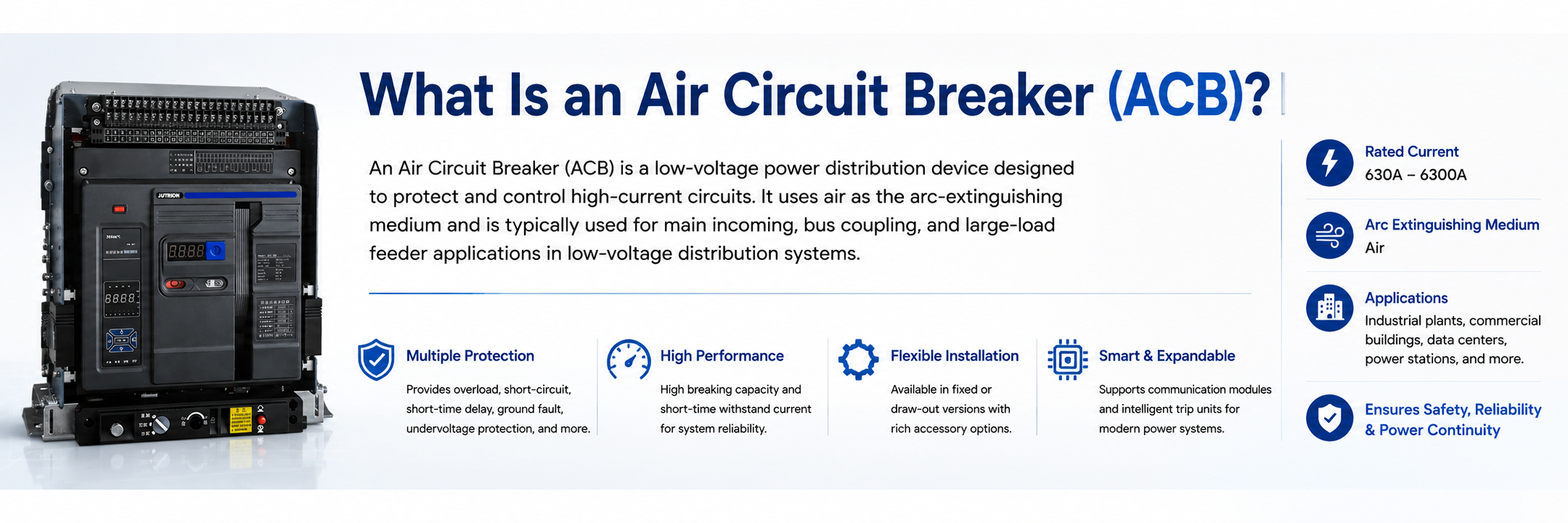
現代の気中遮断器(ACB)の主要な特長。その高い遮断容量と柔軟な引出し設計により、主配電盤(MDB)のまさに心臓部となっています。.
ACB(気中遮断器)は、低圧配電システムで使用される重要な保護・制御機器です。特に主受電フィーダ、母線連絡、大電流主配電回路に適しています。空気を消弧媒体として使用し、一般的に定格電流範囲は630Aから6300Aです。通常の分岐遮断器とは異なり、ACBは系統レベルの保護協調、短時間耐量、電力供給継続性により重点を置いて設計されています。.
低圧遮断器については、, IEC 60947-2 遮断容量、短時間耐量、保護協調などの性能要件を定義するために使用される主要な国際基準の1つです。.
ACBの主な特長と一般的なパラメータ
- ACBは広い定格電流範囲を持ち、一般的に 630Aから6300A, をカバーし、大規模な主配電回路の負荷要件を満たします。.
- 強力な短絡遮断容量を持ち、限界短絡遮断容量は 50~150kA, に達し、短絡故障電流を迅速に遮断できます。.
- 長時間過負荷保護、短時間遅延短絡保護、瞬時短絡保護、不足電圧保護など、複数の調整可能な保護機能を提供します。保護パラメータは現場で調整できます。.
- 手動開閉、電動ばね充電操作、PLC接続による遠隔自動制御など、複数の操作モードをサポートします。.
- 引出し構造により、接続位置、試験位置、断路位置を提供し、配電盤を取り外すことなく点検や交換が容易になります。.
- 一般的に 400Vおよび690V の低圧交流配電システムに適しています。.
気中遮断器(ACB)の主要構成部品
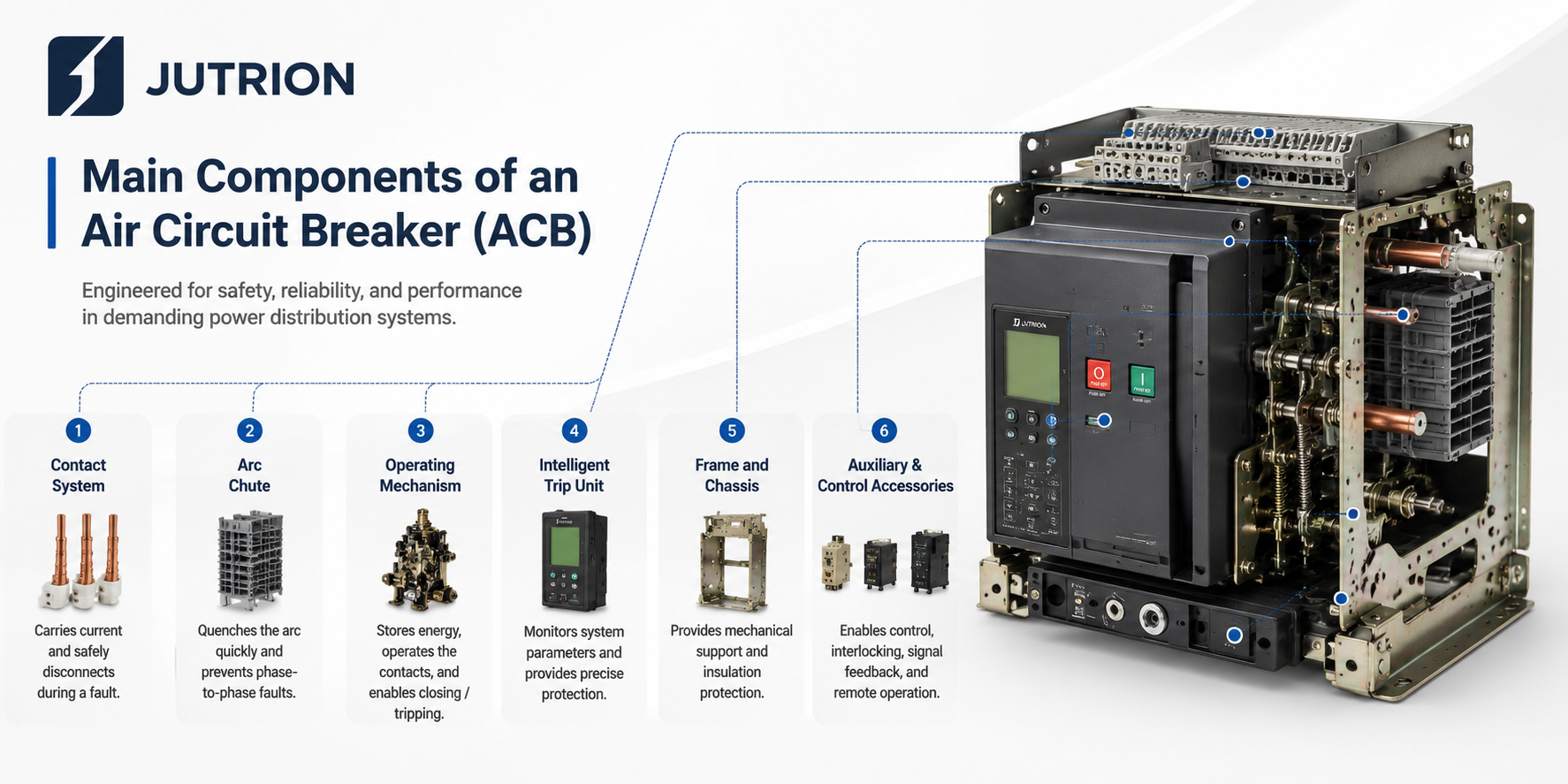
現代のACBのモジュール構造。密閉型MCCBとは異なり、開放フレームシャーシにより、エンジニアはアークシュートや操作機構などの中核部品を個別に点検、保守、交換できるため、重要施設での保守停止時間を大幅に短縮できます。.
ACBの構造は、次の3つの中核目的を中心に設計されています。 信頼性の高い通電、高速な故障遮断、安定した保護制御. 。通常、以下の主要部品で構成されます。
接点システム
- これには 主接点 と アーク接点, が含まれ、電流の通電と遮断を担う中核部品です。.
- The 主接点 は長期運転中に定格電流を流し、 アーク接点 は最初にアーク侵食に耐え、主接点を保護するように設計されています。.
- 多段接点構造は高速ばね機構と組み合わせて使用されることが多く、アークのない主接点分離と長い電気的寿命を実現します。.
アークシュート
- アークシュートは 空気を消弧媒体として使用, し、その内部構造には通常、金属分割板またはラビリンス型アーク室が含まれています。.
- アークはアークシュートに入った後、分割、冷却、延伸され、急速に消滅し、相間短絡の防止に役立ちます。.
- これはACBの 限界遮断容量 を決定する重要な部品です。.
操作機構
- これには 蓄勢機構、伝動機構、引き外し機構.
- これは 手動操作、電動ばね充電/投入, をサポートし、現場および遠隔制御の両方を実現できます。.
- 4節または5節リンク機構が一般的に使用され、高速で安定した滑らかな開閉動作を保証します。.
インテリジェントトリップユニット / 保護ユニット
- これはACBの「頭脳」であり、長時間過負荷保護、短時間遅延短絡保護、瞬時短絡保護、不足電圧 / 停電保護など、複数の保護機能を統合しています。.
- 電流、電圧、温度などの複数のパラメータの収集をサポートしています。保護曲線はローカルまたはリモートで調整できます。.
- 一部のモデルには通信インターフェースが装備されており、PLCや電力監視システムに接続して、遠隔通信、遠隔計測、遠隔制御を実現できます。.
フレームとシャーシ
- 機械的支持と絶縁保護を提供します。引出し構造は主流のACB設計で広く採用されています。.
- 接続位置、試験位置、断路位置の3つのポジションがあり、オンライン点検、保守、遮断器交換がより便利になります。.
- 内部短絡を防止するために、内部絶縁バリアと相間絶縁部品が組み込まれています。.
補助および制御アクセサリ
- 一般的なアクセサリには、補助接点、引き外しコイル、不足電圧引き外し装置、電動操作機構、蓄勢モータ、その他の制御部品が含まれます。.
- これらのアクセサリにより、信号フィードバック、インターロック制御、自動開閉、配電自動化システムとの互換性が可能になります。.
気中遮断器はどのように動作するのか?
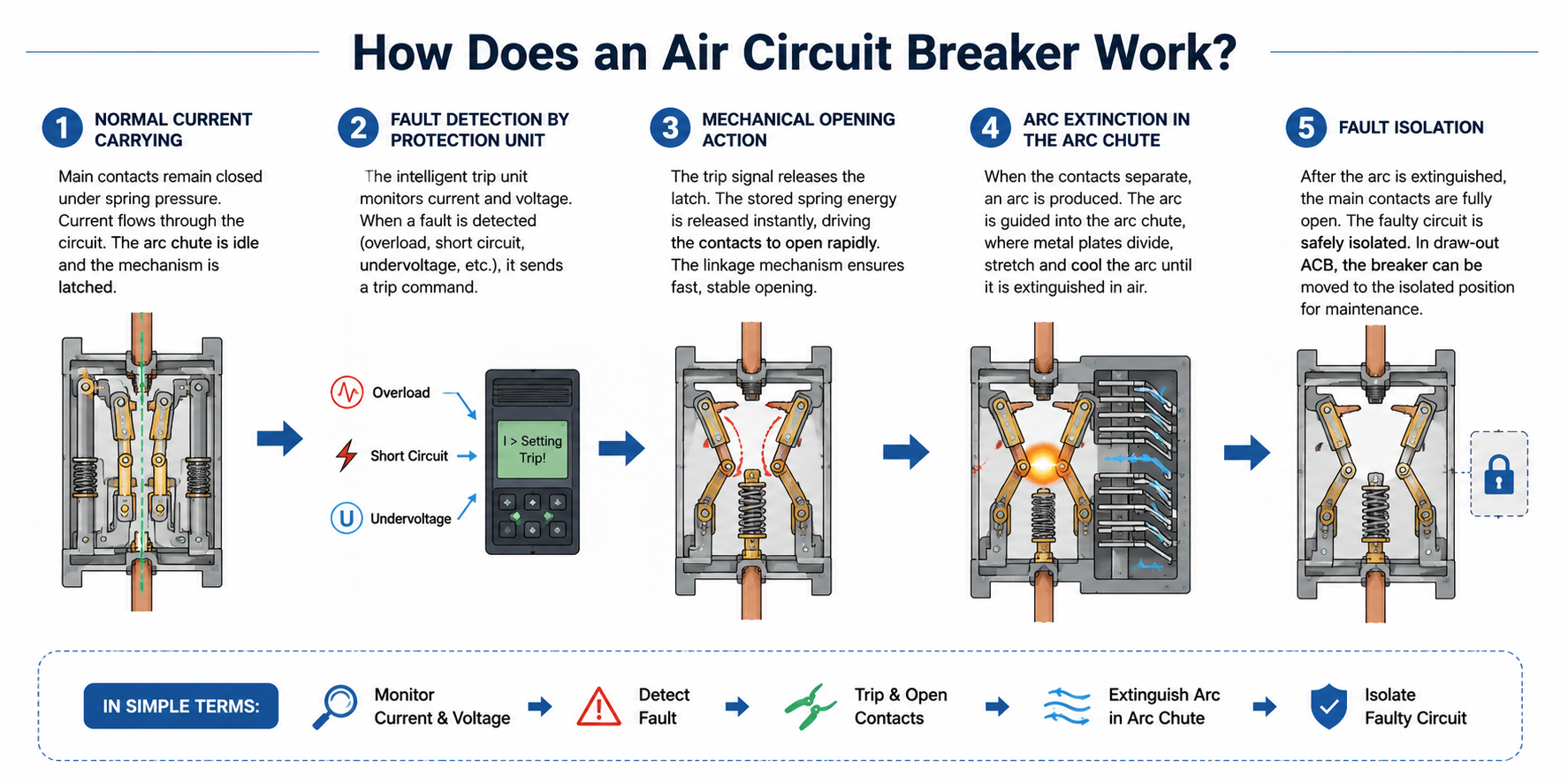
故障遮断時に気中遮断器(ACB)がどのように動作するか
簡単に言えば、ACBは低圧主配電システムにおける「インテリジェントな主安全スイッチ」のように機能します。通常動作時は高電流を継続的に流します。過負荷、短絡、不足電圧、停電などの故障が発生すると、回路を迅速かつ確実に遮断し、故障の拡大を防ぎます。.
通常の通電
通常動作時、主接点はばね圧力によってしっかりと閉じた状態を保ち、電流が接点システムと導体経路を通って流れます。この段階では、アークシュートは動作しません。操作機構は充電されラッチされた位置に保持され、遮断器を閉状態に保ちます。.
保護ユニットによる故障検出
インテリジェントトリップユニットは電流と電圧の信号を継続的に監視します。異常状態が検出されると、事前に設定された保護設定に従って遮断器をトリップさせるかどうかを判断します。.
過負荷故障の場合、電流が設定値を超え、トリップユニットは長時間遅延保護曲線に従ってトリップ指令を送信します。.
短絡故障の場合、電流が急激に上昇し、トリップユニットは短時間遅延または瞬時保護によって応答します。.
不足電圧または停電状態の場合、不足電圧引き外し装置が遮断器を開放させることができます。.
機械的開放動作
トリップ信号が発せられた後、操作機構内のラッチが解放されます。蓄えられたばねエネルギーが瞬時に放出され、接点システムを急速に開放させます。4節または5節リンク機構が、高速で安定したスムーズな開放動作を確保します。.
アークシュートでの消弧
負荷または故障電流の下で接点が分離すると、接点間に高温のアークが発生します。このアークはアークシュートに導かれ、金属製の分割板がアークを分割、伸長、冷却します。その後、アークは空気中で消滅し、相間故障や機器の損傷を防ぎます。.
故障隔離
開路動作が完了すると、主接点は完全に開離し、アークは消弧されます。故障回路は安全に絶縁されます。一部の引出形ACB設計では、遮断器を断路位置に移動させることもでき、点検・保守のために物理的な隔離を提供します。.
一文まとめ:
ACBは、次の完全なプロセスを通じて故障回路を安全に遮断します。 保護ユニットの故障検出 → 操作機構による急速開放 → アークシュートでの消弧, 。これにより、配電システムと電気機器の保護に役立ちます。.
ACB保護機能:LSIおよびLSIG保護の理解
ACBの保護機能は、低圧主配電システムにおける「インテリジェントな安全ファイアウォール」のようなものです。電流と電圧の状態を継続的に監視し、過負荷、短絡、不足電圧などの異常状態が発生すると、事前に設定された保護ロジックに従って自動的に電源を遮断し、機器の損傷や故障の拡大を防ぎます。.
長時間過負荷保護(L保護)
- 機能: 長時間の過負荷によるケーブルの過熱、機器の過熱、絶縁劣化を防ぎます。.
- 原理: 電流が設定値を超えると、トリップユニットは反限時特性に従ってトリップします。電流が大きいほど、遅延時間は短くなります。.
短時間短絡保護(S保護)
- 機能: 上流と下流の遮断器間の選択的協調を実現し、故障時の大規模停電を回避します。.
- 原理: 短絡電流が設定値に達すると、ACBは短時間トリップを遅延させ、下流の遮断器が先に故障を除去できるようにします。故障が除去されない場合、ACBはその後トリップします。.
瞬時短絡保護(I保護)
- 機能: 重大な短絡故障に対応し、高い故障電流を迅速に遮断して機器と母線を保護します。.
- 原理: 電流が瞬時設定値を超えると、遮断器は意図的な遅延なしに、または極めて短い遅延で即座にトリップします。.
不足電圧/電圧喪失保護(U保護)
- 機能: 電圧が低すぎる場合や停電後の復電時に、電動機の自動再始動による機器の損傷や電力系統への影響を防ぎます。.
- 原理: 系統電圧が設定しきい値(例:70% Ue)を下回ると、不足電圧引き外し装置が動作し、遮断器を強制的に開放します。.
地絡/漏電保護(G保護、オプション)
- 機能: 地絡や漏電電流を検出し、感電や機器損傷のリスクを低減します。.
- 原理: 零相変流器を通じて三相不平衡電流を監視します。地絡電流が設定値を超えると、保護機能が作動します。.
補足説明: ACBの保護パラメータ(電流、時限、保護曲線など)は、通常、現地または遠隔で調整できます。複数の保護組み合わせにより、ACBは低圧主配電システムにおいて選択保護を実現するための重要な機器となります。.
ACBの代表的な用途
実際のプロジェクトでは、ACBは通常、低圧配電盤または主配電盤の内部に設置されます。正しい遮断器定格を選定することに加え、配電盤全体の設計では以下の要件も考慮する必要があります。 IEC 61439 低圧配電盤アセンブリ, (絶縁協調、温度上昇、短絡耐量、内部配置の安全性を含む).
- 低圧主幹・分岐回路(LVMDP)
変圧器の低圧側または主配電盤の主開閉器として使用されます。以下から高電流を供給します。 630Aから6300A また、短時間耐量と選択保護に関するIEC要件を満たします。. - 母線連絡回路
二重電源システムの2つの母線セクション間に設置され、区分運転または並列運転を実現し、故障拡大を防止しながら電力供給の継続性を確保します。. - 発電機・非常用電源送出回路
低圧発電機やUPSシステムなどのバックアップ電源を保護するために使用され、系統連系・単独運転制御を可能にし、電源側保護の協調要件を満たします。. - 大容量産業負荷回路
モーターコントロールセンター(MCC)やパワーコントロールセンター(PCC)の主保護装置として使用され、高出力モーター、ポンプ群、その他の重負荷用途に適しています。. - 重要配電ゾーンフィーダ
商業ビル、データセンター、その他の大規模施設の主フィーダに使用され、信頼性の高い保護と容易な保守を提供します。.
引出形ACBと固定形ACB:主な違いは何ですか?
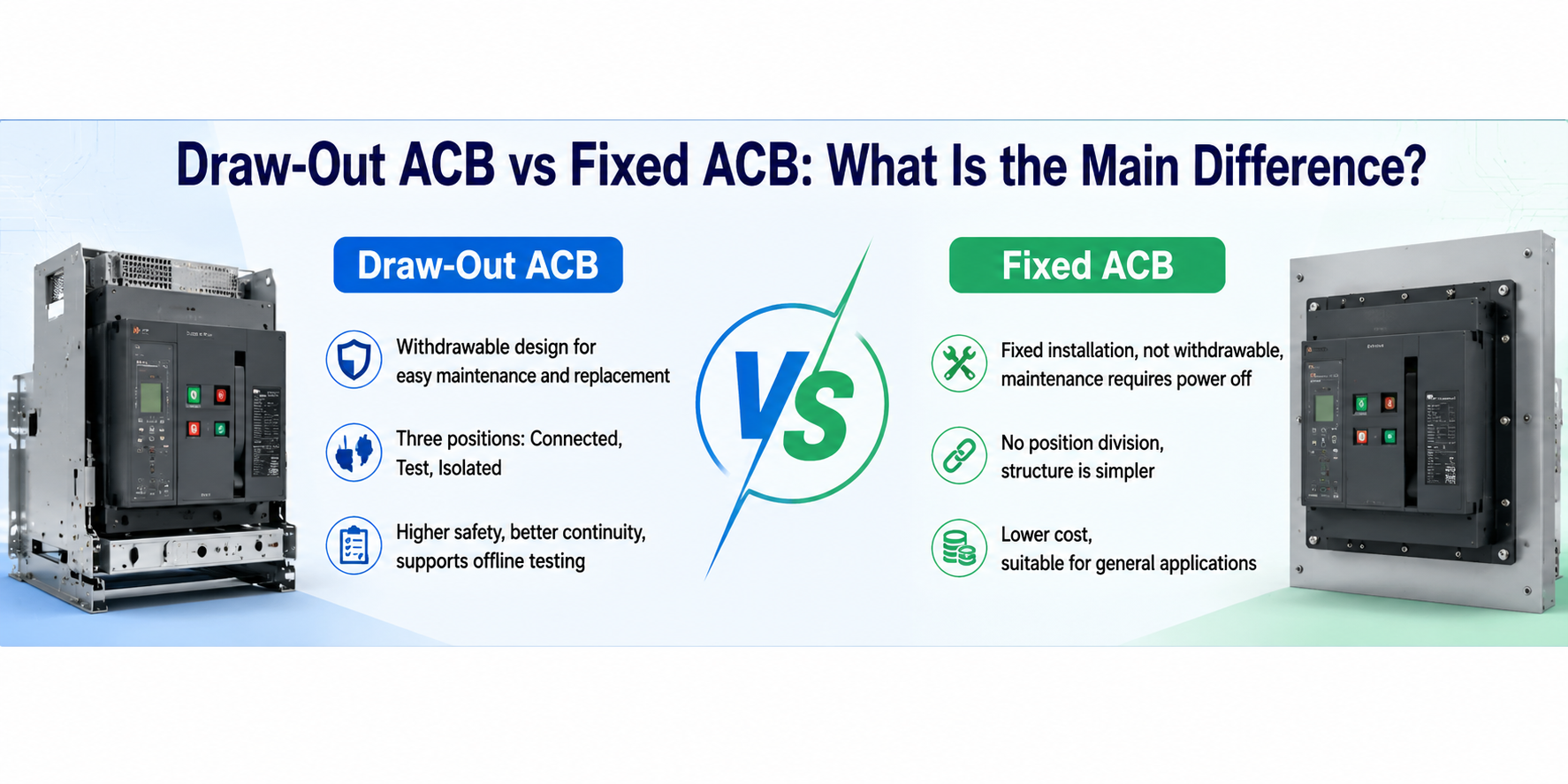
引出形と固定形ACB。引出形モデルは3ポジションクレードルを備え、安全な無通電保守が可能です。一方、固定形モデルはコスト効率の高い代替案を提供します。.
クイック比較表
| 比較項目 | 引出形ACB | 固定形ACB |
| 設置構造 | 取り外し可能な引出しシャーシ、遮断器本体とベース構造が分離 | ボルト固定設置、遮断器本体一体構造 |
| 標準ポジション | 接続、試験、断路の3ポジション | ポジション区分なし |
| 保守中の母線状態 | 母線は通電状態を維持可能。遮断器本体のみ切り離し | 保守前に母線を停電させる必要あり |
| 試験方法 | 主回路を通電せずにオフライン試験が可能で、より安全で信頼性が高い | 通電状態でのオンライン試験のみ可能で、リスクが高い |
| 保守難易度 | 保守が容易で、予備の遮断器本体を迅速に交換可能 | 分解がより複雑で、ケーブル接続の取り外しと再締結が必要 |
| 電力供給の継続性 | 高い。停電が許容されない用途に適する | 低い。保守には通常、電源停止が必要 |
引出形ACBとは何ですか?
引出形ACBは、専用の引出しシャーシ内に設置された気中遮断器です。主盤構造を完全に分解することなく、遮断器を配電盤から引き出したり挿入したりできます。.
主回路と二次制御回路の両方に分離可能なプラグイン接続を採用しており、遮断器本体を母線や制御配線に素早く接続・切り離しできます。保守時には、配電盤の母線を通電したまま、遮断器を安全な隔離位置へ移動して点検、試運転、保守、交換を行うことができます。.
引出形ACBはオフラインテストにも対応しているため、技術者は主回路で負荷試験を行う必要がありません。これにより、短絡、感電、誤操作のリスクが大幅に低減されます。.
利点: 安全性が高い、保守が容易、迅速な交換、電源供給の継続性が高い。.
欠点: 構造がより複雑、コストが高い、全体サイズが大きい。.
固定形ACBとは何ですか?
A fixed ACB is an air circuit breaker that is directly installed and bolted inside the switchboard. Unlike a draw-out ACB, the breaker body cannot be racked in or racked out from a dedicated chassis.
The main circuit and secondary control circuit are usually connected by fixed terminals, busbars, or control wiring. During inspection, maintenance, or replacement, the main power supply usually needs to be shut down, and some wiring or busbar connections may need to be removed.
A fixed ACB has a simpler structure and lower cost, making it suitable for general low-voltage distribution systems where frequent maintenance, quick replacement, or high power continuity is not the main requirement.
利点: simpler structure, lower cost, smaller installation space, and easier cabinet design.
欠点: less convenient maintenance, slower replacement, usually requires power shutdown, and lower flexibility compared with a draw-out ACB.
If you are still unsure about the difference between fixed and draw-out ACBs, you can visit our [ACB product page] to learn more about their installation structures, maintenance requirements, and suitable application scenarios.
Common Mistakes When Selecting an ACB
Many people select an ACB only based on rated current, while ignoring key factors such as breaking capacity, short-time withstand current, and protection coordination. As a result, the breaker may either fail to withstand real operating conditions or be unable to achieve selective protection, leaving potential safety risks in the power distribution system.
1. Only Checking Rated Current and Ignoring Breaking Capacity (Icu / Ics)
- Wrong practice: Believing that as long as the rated current is sufficient, the ACB can be used in all applications.
- Consequence: When the short-circuit current exceeds the ultimate breaking capacity of the ACB, the breaker may fail to extinguish the arc, which can burn the equipment or even cause an explosion.
- Correct practice: Select an ACB according to the prospective short-circuit current at the switchboard busbar, and choose an ACB with Icu ≥ prospective short-circuit current.For critical main distribution circuits, models with Ics close to or equal to Icu are generally preferred.
2. Ignoring Short-Time Withstand Current (Icw) and Only Checking Breaking Capacity
- Wrong practice: Only focusing on how much current the ACB can interrupt, without considering how long the breaker can withstand fault current.
- Consequence: Upstream and downstream breakers cannot achieve selective protection. Before the downstream breaker operates, the upstream ACB trips first, causing a large-area power outage.
- Correct practice: According to the protection delay requirements, select an ACB with Icw ≥ prospective short-circuit current, and make sure the withstand duration meets the system selectivity requirement, such as 1s / 3s.
3. Confusing the Application Scenarios of ACBs and MCCBs
- Wrong practice: Using a large-frame MCCB to replace an ACB, assuming that a high current rating is enough for a main incoming circuit.
- Consequence: The short-time withstand capability, selectivity, and maintainability of an MCCB may not meet the requirements of a main distribution system. During a fault, this can easily lead to protection miscoordination or failure to isolate the fault properly.
- Correct practice: For main incoming feeders, bus couplers, generator outgoing circuits, and other critical circuits, an ACB that complies with IEC 60947-2 should be used.
4. Protection Functions Do Not Match the Actual Requirements
- Wrong practice: Blindly choosing a fully functional trip unit, or selecting a basic model with insufficient functions.
- Consequence: Either the cost is wasted, or key protection functions, such as ground fault protection, are missing, causing the system to fail to meet safety requirements.
- Correct practice: According to the circuit type, such as incoming feeder / bus coupler / feeder, and the load characteristics, select the required protection stages L / S / I / G as needed, and make sure the parameters can be adjusted.
5. Ignoring the Installation Method and Maintenance Convenience
- Wrong practice: Choosing a fixed ACB for critical circuits just to save cost, or blindly selecting a draw-out ACB for ordinary non-critical circuits.
- Consequence: Critical circuits may require power shutdown during maintenance, affecting power supply continuity; for non-critical circuits, unnecessary cost may be added.
- Correct practice: Use draw-out ACBs for important circuits such as main incoming feeders, bus couplers, and generator circuits. Fixed ACBs can be used for ordinary feeder circuits to balance safety and cost.
6. Not Verifying Protection Coordination with Downstream Devices
- Wrong practice: Setting the protection parameters of upstream and downstream circuit breakers independently, without checking selectivity coordination.
- Consequence: During a fault, protection may trip at the wrong level, expanding the power outage range and affecting power supply reliability.
- Correct practice: match the upstream and downstream protection curves to ensure that the downstream breaker operates first while the upstream breaker remains closed.
FAQ Section
Q1: What is the main difference between an ACB (Air Circuit Breaker) and a VCB (Vacuum Circuit Breaker)?
A: The primary difference lies in the voltage application and the arc-extinguishing medium. ACBs are designed for low-voltage networks (typically under 1000V AC) and use ambient air and arc chutes to quench the arc. VCBs are used in medium-voltage networks (e.g., 11kV, 33kV) and extinguish the arc inside a highly sealed vacuum interrupter chamber. They serve entirely different sections of the power grid.
Q2: How often should an Air Circuit Breaker (ACB) be maintained?
A: In critical facilities like data centers or heavy manufacturing plants, a visual and mechanical inspection should be conducted annually. A comprehensive maintenance routine—including lubricating the draw-out cradle mechanism, cleaning the arc chutes, and performing secondary injection testing on the intelligent trip unit—should be executed every 3 to 5 years, depending on the operating environment (dust, humidity) and switching frequency.
Q3: Can two ACBs be used to build an Automatic Transfer Switch (ATS)?
A: Yes, absolutely. For extremely high-current applications (typically over 1600A) where standard ATS units reach their limits, two motorized ACBs are commonly used. By equipping them with motorized charging mechanisms, closing coils, and strict mechanical and electrical interlocks, they form a highly robust, heavy-duty transfer system perfectly suited for main generator synchronization.
Q4: Is the extra cost of a draw-out ACB really worth it over a fixed ACB?
A: If system downtime costs your facility money, the answer is a definitive yes. Replacing a damaged fixed ACB requires completely de-energizing the main busbar and spending hours unbolting heavy copper connections. A draw-out ACB can be cranked out to the “isolated” position and safely swapped with a spare unit in minutes, making the initial higher capital cost negligible compared to the savings in maintenance downtime.
Conclusion
Choosing the right ACB is not only about selecting a high current rating. A reliable ACB must match the actual short-circuit level, protection coordination requirements, installation method, and maintenance needs of the power distribution system.
For critical main distribution circuits, draw-out ACBs usually offer better safety and service continuity, while fixed ACBs are more suitable for general applications where cost and space are more important. In any project, correct selection and proper protection settings are essential to ensure safe, stable, and long-term operation of the low-voltage distribution system.
