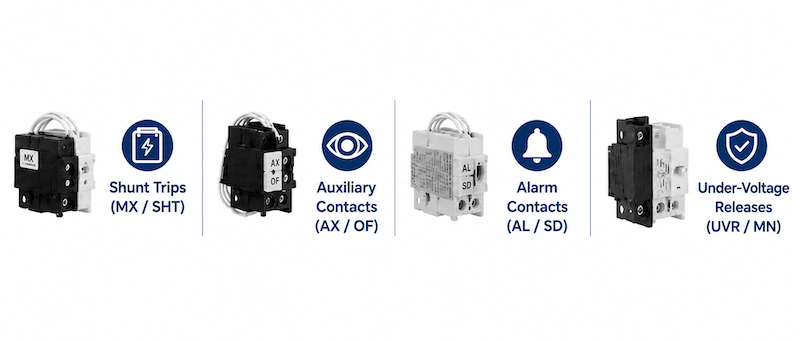
The selected accessory must match both the voltage level and the power supply type.For example, a 220V AC shunt trip should not be connected to a 220V DC control circuit,Although the voltage value is the same, the coil structure and electrical characteristics are different,An incorrect power supply may cause failure to operate, excessive heating, coil damage, or unreliable tripping.
Before confirming the accessory, check the following:
Whether the control supply is AC or DC
The nominal control voltage
The permissible operating voltage range
Whether the signal is continuous or momentary
Whether the accessory remains energized during normal operation
Important: Undervoltage releases are usually continuously energized while the circuit breaker is operating. Therefore, the control circuit must provide a stable power supply and sufficient coil capacity.
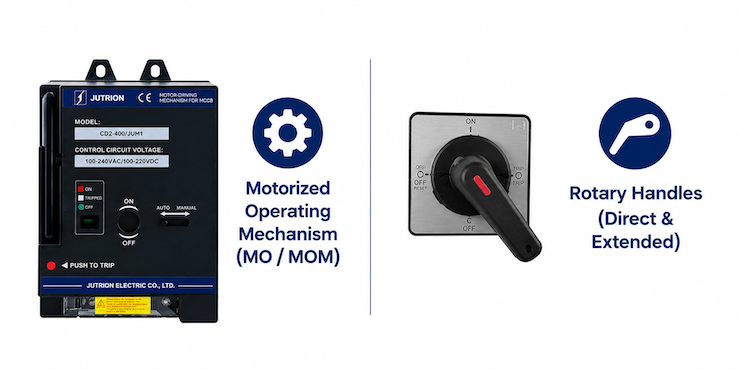
Motor Operator Power Supply: The motor operator should normally be powered from the line side of the circuit breaker or from an independent control power supply. If it is powered from the load side, it may lose power after the breaker opens or trips, preventing subsequent remote closing or reset operation.
Customization: The control voltage of the motor operator can be customized according to the customer’s power supply and project requirements.
Step 4: Check the Accessory Installation Position and Compatibility
Many MCBs and MCCBs have designated installation positions or slots for internal accessories. The number, position, and compatible accessory combinations may vary depending on the product series, frame size, and pole configuration.
Before ordering, confirm the following:
Whether the accessory is installed internally or externally
Whether it is mounted on the left side or right side
Whether one slot can accept more than one contact module
Whether the selected accessories can be installed together
Whether additional terminal blocks or wiring leads are required
Some MCCBs, especially residual current MCCBs, have limited internal space for accessories. In certain models, only one internal accessory position is available, so a standard shunt trip and a separate auxiliary contact cannot be installed independently at the same time.In this situation, an integrated shunt trip and auxiliary contact module may be selected when both remote tripping and breaker position feedback are required.The accessory mounting arrangement may also vary between different MCCB series. For example, the shunt trip may be installed on the left side in one model but on the right side in another, while the auxiliary contact or alarm contact may occupy a different designated position.
Therefore, accessory compatibility cannot be determined only by the accessory name or breaker rated current. The exact MCCB series, frame size, residual current protection function, pole configuration, and internal accessory layout must be confirmed before ordering.
គន្លឹះជាក់ស្តែង៖ If the MCCB has only one available accessory slot, confirm whether an integrated accessory module, such as a shunt trip with an auxiliary contact, is available for that breaker series.
Selecting the correct circuit breaker accessories requires more than identifying the accessory name. The breaker model, frame size, required function, control voltage, installation position, and accessory compatibility must all be confirmed together. A correct configuration should meet both the electrical control requirements and the actual cabinet installation conditions.
Step 5: Plug-In Circuit Breaker Installation and Connection Options
In addition to electrical functions, the installation and connection method of the circuit breaker can also affect accessory selection. Different plug-in configurations may require different bases, terminals, mounting arrangements, and cabinet structures.
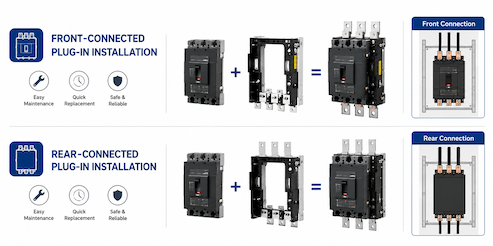
ការដំឡើងដោតចូលភ្ជាប់ខាងមុខ:
A front-connected plug-in circuit breaker is mounted on a dedicated plug-in base, with the main circuit cables or busbars connected from the front. The breaker can be removed and replaced without disconnecting the main circuit conductors from the base, helping reduce maintenance time.
ការដំឡើងដោតចូលភ្ជាប់ខាងក្រោយ:
A rear-connected plug-in circuit breaker is also mounted on a dedicated plug-in base, but the main circuit is connected from behind the mounting plate through rear terminals or connecting bars. It provides the same convenient replacement function while supporting a cleaner front cabinet layout.
Both configurations support faster breaker replacement. The main difference is the direction of the main circuit connection and the corresponding cabinet layout requirements.
Circuit Breaker Accessory Selection Checklist
Selection Item
What to Confirm
Circuit breaker type
MCB, MCCB, residual current MCCB, or ACB
Manufacturer and series
Complete product series
Complete model
Full circuit breaker model number
Frame size
100AF, 250AF, 400AF, etc.
Number of poles
1P, 2P, 3P, or 4P
Required function
Remote trip, undervoltage protection, status feedback, fault alarm, remote operation, or interlocking
Control voltage
Rated voltage and AC/DC supply type
Operating signal
Continuous or momentary
Accessory position
Internal, external, left side, or right side
Accessory combination
Separate accessory or integrated module
Connection method
Front connection or rear connection
Installation method
Fixed-mounted or plug-in
Cabinet conditions
Depth, wiring space, shaft length, and maintenance clearance
Project documents
Nameplate photo, control schematic, cabinet drawing, and technical requirements
If any of the above information is uncertain, provide the complete breaker model, nameplate photo, and project drawings to the supplier before placing the order.
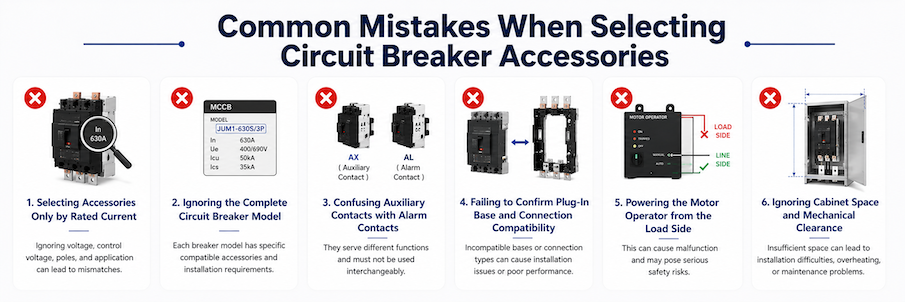
Common Mistakes When Selecting Circuit Breaker Accessories
Even experienced panel builders and project engineers can make accessory selection mistakes when the breaker model, control voltage, installation structure, or signal requirements are not fully confirmed. The following are some of the most common problems found in circuit breaker accessory selection.
1.Selecting Accessories Only by Rated Current
Circuit breaker accessories should not be selected only according to the rated current of the breaker. Two breakers with the same rated current may belong to different product series or frame sizes, and their internal structures, mounting dimensions, and accessory positions may be completely different.
How to avoid it: Always confirm the complete breaker model, product series, frame size, and number of poles.
2. Ignoring the Complete Circuit Breaker Model
Providing only information such as “250A MCCB” is usually not enough to identify the correct accessory. The complete model number may include important information about the breaker series, frame size, breaking capacity, pole configuration, and protection type.
This is especially important for residual current MCCBs, electronic MCCBs, and breakers with special internal structures.
How to avoid it: Provide the complete model number or a clear photo of the breaker nameplate.
3. Confusing Auxiliary Contacts with Alarm Contacts
Auxiliary contacts and alarm contacts both provide electrical feedback signals, but they indicate different conditions.An auxiliary contact normally indicates whether the circuit breaker is ON or OFF. An alarm contact indicates whether the breaker has tripped because of overload, short circuit, or another protection event.If the wrong contact is selected, the PLC or monitoring system may receive incorrect status information.
How to avoid it: Confirm whether the system requires position feedback or fault-trip feedback.
4.Failing to Confirm Plug-In Base and Connection Compatibility
A plug-in base must match the exact breaker series, frame size, number of poles, and connection method.Front-connected and rear-connected plug-in configurations may use different bases, terminals, connecting bars, and cabinet structures.A base selected only by rated current may not fit the breaker correctly.
How to avoid it: Confirm whether the system requires a front-connected or rear-connected plug-in configuration before ordering.
5.Powering the Motor Operator from the Load Side
If the motor operator is powered from the load side of the circuit breaker, it may lose power after the breaker opens or trips.This may prevent the breaker from being remotely closed or reset.
How to avoid it: The motor operator should normally be powered from the line side of the breaker or from an independent control power source, according to the system design.
6.Ignoring Cabinet Space and Mechanical Clearance
Even if the accessory is electrically compatible, it may still be impossible to install if the cabinet space is insufficient.Motor operators, rotary handles, plug-in bases, rear terminals, terminal covers, and cable lugs all require additional installation space.Insufficient clearance may affect wiring, cabinet door closing, operation, and future maintenance.
How to avoid it: Check the cabinet drawing, breaker dimensions, accessory dimensions, cable routing, and maintenance space before confirming the order.
Most circuit breaker accessory selection errors can be avoided by confirming the complete breaker model, control voltage, required function, internal accessory layout, installation method, and cabinet conditions before ordering.
When the accessory configuration is uncertain, provide the supplier with the breaker nameplate photo, control schematic, and cabinet drawing for compatibility verification.
Frequently Asked Questions About Circuit Breaker Accessories
Can I use JUTRION accessories as high-quality replacements or upgrades for major breaker brands?
Absolutely. At JUTRION, our complete range of internal and external accessories is custom-engineered and precision-molded to strictly match the mechanical linkage profiles and electrical specifications of standard low-voltage circuit breakers in the global market. As long as you select the verified cross-reference model from our catalog, our components deliver identical mechanical endurance and seamless integration, offering engineering teams a highly cost-effective alternative with significantly faster production lead times.
Are Circuit Breaker Accessories Universal?
No. Circuit breaker accessories are generally designed for specific product series, frame sizes, pole configurations, and internal mechanisms. Even if two circuit breakers have the same rated current, their accessories may not be interchangeable. Always confirm the complete breaker model and accessory compatibility before ordering.
What Is the Difference Between an Auxiliary Contact and an Alarm Contact?
An auxiliary contact indicates the operating position of the circuit breaker, such as ON or OFF. An alarm contact indicates that the breaker has tripped because of an overload, short circuit, earth fault, or another protection event. An auxiliary contact is used for position feedback, while an alarm contact is used for fault-trip indication.
Can I install a Shunt Trip and an Under-Voltage Release into the same breaker simultaneously?
This strictly depends on the breaker’s frame size and its internal cavity layout. In compact, lower-current devices (such as 125A frames), there is often only one physical internal slot designated for voltage-tripping coils, meaning you must choose between a shunt trip or a UVR. However, in larger frame sizes (such as 400A or 800A), multiple independent slots are typically engineered, allowing you to combine both internal accessories flawlessly. When configuring your project, our JUTRION engineering team can provide you with a precise combination layout based on your housing limits.
What is the main operational difference between a Shunt Trip and an Under-Voltage Release (UVR)?
The core difference lies in their activation logic. A Shunt Trip requires an active electrical pulse (applying voltage to the coil) to mechanically trip the breaker remotely, making it perfect for fire alarm linkages. Conversely, an Under-Voltage Release (UVR) keeps the breaker closed as long as standard grid voltage is present; it trips the breaker automatically when the control voltage drops below a safe threshold (typically between 35 percent and 70 percent of rated voltage) or completely fails. This makes the UVR ideal for protecting downstream motors from sudden grid brownouts.
How does JUTRION ensure the long-term reliability and mechanical endurance of its internal accessories over thousands of operating cycles?
Field failure is not an option when safety is on the line. At JUTRION, we treat our accessories not just as molded plastic and copper, but as the precision neural network of your power distribution system. Every batch of our shunt trips, auxiliary contacts, and motor operators undergoes rigorous, automated fatigue and dielectric testing in our compliance labs. We simulate harsh industrial environments, ensuring our micro-switches and heavy-duty coils sustain mechanical and electrical endurance ratings that fully comply with IEC standards. By engineering our components with high-grade, heat-resistant polymers and premium silver-alloy contacts, JUTRION guarantees stable signal feedback and instant remote actuation even after years of demanding operational cycles.
Circuit breaker designs vary significantly across global brands. Can JUTRION truly guarantee physical compatibility across different manufacturers?
Yes, we can. This universal adaptation capability is exactly why international clients partner with us. Over the years, JUTRION has built and continuously updated an extensive engineering database and precision matrix mold library. Today, our highly versatile internal and external accessories can seamlessly adapt to over 99 percent of low-voltage molded case circuit breakers (MCCBs) and miniature circuit breakers (MCBs) available on the global market. Whether your switchboard relies on standard European designs, traditional Asian form factors, or major mainstream multi-national brands, our engineering team can instantly match you with the precise JUTRION accessory variant designed to fit that exact internal housing and mechanical linkage profile.
Need Help Selecting Compatible Circuit Breaker Accessories?
Choosing the correct circuit breaker accessory requires more than matching the accessory name. The breaker model, frame size, control voltage, installation position, connection method, and project requirements must all be verified together.
Provide JUTRION with the following information: Complete circuit breaker model or nameplate photo Required accessory function Control voltage and AC/DC power supply type Installation method and project quantity
Our engineering team will verify accessory compatibility and recommend a suitable configuration for your electrical project.
Electrical Engineer | Low-Voltage Power Distribution
Hello, I’m Evan.
I am an electrical engineer with 10 years of experience in low-voltage electrical equipment, circuit protection, and power distribution systems. I specialize in product selection, application engineering, and technical support for industrial, commercial, and renewable-energy projects.
For technical inquiries, please contact me at evan@jutrion.com.