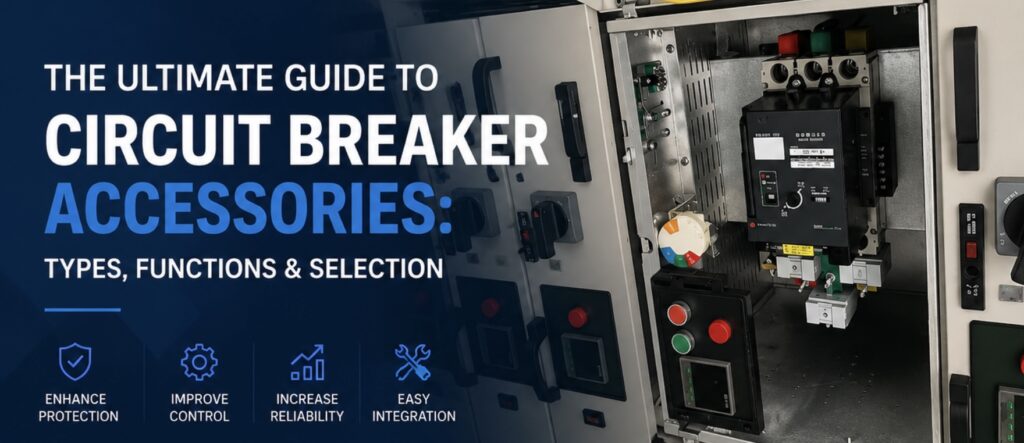
Mabilis na Sagot: Ano ang Mga Aksesorya ng Circuit Breaker?
Ayon sa IEC 60947-2 (ang pandaigdigang pamantayan na namamahala sa low-voltage switchgear at controlgear), ang pangunahing tungkulin ng isang circuit breaker ay ligtas na gumawa, magdala, at pumutol ng mga kuryente sa ilalim ng normal at tinukoy na abnormal na mga kondisyon. Gayunpaman, ang isang bare breaker ay gumagana bilang isang nakahiwalay na mekanikal na switch. Ang mga aksesorya ng circuit breaker ay ang mga standardized, modular na auxiliary na bahagi na idinisenyo upang umakma sa mga MCCB, MCB, at ACB. Bagama't hindi nila pinipigilan ang mga pangunahing fault nang mag-isa, ang mga ito ay inilalagay sa loob (tulad ng mga auxiliary switch at trip unit) o sa labas (tulad ng mga motor mechanism at rotary handle) upang palawakin ang mga kakayahan ng breaker sa apat na kritikal na dimensyon: advanced na proteksyon, remote control, status signaling, at mekanikal na pag-optimize.
Ang Estratehikong Halaga: Sa madaling salita, ang circuit breaker ay nananatiling pangunahing mekanikal na kalamnan, ngunit ang mga aksesorya ay nagsisilbing matalinong nervous system. Ngayon, sa sandaling magkaroon ng fault, agad na nagpapadala ang alarm switch ng telemetry packet sa control room, habang pinapayagan ng motor mechanism ang mga inhinyero na ligtas na ihiwalay o i-reset ang linya nang malayuan. Ang integrasyong ito ay nagbawas ng kanilang Mean Time to Repair (MTTR) ng 85% at dinala ang pasilidad sa ganap na pagsunod sa mga modernong pamantayan ng automated grid infrastructure.
Mga Karaniwang Aksesorya ng Circuit Breaker
Pangalan ng Aksesorya
Daglat
Function
Shunt Trip
MX
Nagbibigay-daan sa remote tripping sa pamamagitan ng electrical signal.
Auxiliary Contact
AX / OF
Nagpapahiwatig ng ON / OFF na status ng breaker.
Alarm Contact
AL / SD
Nagpapahiwatig kung ang breaker ay nag-trip dahil sa isang fault.
Under-Voltage Trip
MN / UVT
Awtomatikong iti-trip ang breaker sa panahon ng pagbaba ng boltahe.
Motorized Operating Mechanism
MOM / MO
Nagbibigay-daan sa remote motorized na pagsasara at pagbubukas.
Front Connection
FC
Karaniwang wiring mula sa mga front terminal.
Rear Connection
RC
Wiring mula sa likod upang makatipid ng espasyo sa loob ng panel.
Rotary Handle
–
Nagbibigay-daan sa mas ligtas na manual na pag-switch sa labas ng pinto ng cabinet.
Bakit Mahalaga ang Mga Aksesorya ng Circuit Breaker?
Sa modernong pang-industriya at komersyal na imprastraktura, ang isang karaniwang circuit breaker ay nagbibigay ng pundasyong “kalamnan”—ang hilaw na mekanikal na kapasidad upang maputol ang isang electrical current sa panahon ng isang malaking fault. Gayunpaman, ang isang bare breaker ay gumagana bilang isang nakahiwalay na bahagi. Ang mga aksesorya ang nagbibigay ng “utak” at “nervous system” sa buong electrical installation.
Ang paglalagay sa iyong mga circuit breaker ng tamang mga aksesorya ay isang kritikal na pangangailangang pang-operasyon para sa ilang mapagpasyang dahilan:
Pagpapahusay sa Kaligtasan ng mga Tauhan sa Field: Ang mga high-power na kapaligiran ay likas na may mga panganib ng arc flash. Ang mga aksesorya tulad ng mga motor mechanism at extended rotary handle ay ganap na binabago ang iyong mga on-site na safety protocol sa pamamagitan ng pagpapahintulot sa mga operator na mag-switch, mag-reset, o mag-rack out ng mga breaker mula sa ligtas na distansya—sa labas man ng naka-lock na pinto ng enclosure o malayuan mula sa isang sentralisadong control room.
Pagbabawas ng Magastos na Paghinto ng Produksyon: Kapag ang isang kritikal na linya ng produksyon ay biglang huminto, bawat segundo ay nauuwi sa nawalang kita. Kung walang mga aksesorya, ang mga maintenance team ay kailangang manu-manong subukan ang mga linya upang malaman kung bakit bumukas ang isang breaker. Sa pamamagitan ng paggamit ng Auxiliary at Alarm Contacts, agad na nagpapadala ang breaker ng tumpak na telemetry sa iyong PLC o SCADA system, na pinag-iiba ang isang karaniwang manual na pagpatay mula sa isang malubhang short-circuit trip sa loob ng mga millisecond.
Proactive Asset Protection laban sa Power Quality Issues: Habang ang mga standard breaker ay tumutugon sa mga overload, ang modernong makinarya (tulad ng mga CNC center, data server, at heavy-duty na motor) ay lubhang mahina sa mas banayad na pagbabago-bago ng kuryente. Ang mga under-voltage release (UVR) ay kumikilos bilang mga proactive na tagapagbantay, na pinapatid ang breaker sa panahon ng matinding pagbaba ng boltahe (voltage sags) bago pa masunog ng mababang boltahe ang mamahaling motor windings.
Pagtitiyak ng International Compliance at Space Optimization: Ang mga international standard tulad ng IEC 61439 ay nagtatakda ng mahigpit na mga mandato sa electrical clearances, segregation, at ingress protection (IP ratings). Ang mga structural accessory, tulad ng rear connection kits at terminal shields, ay nagbibigay-daan sa mga panel builder na maayos na iruta ang malalaking cable, na tinitiyak ang ganap na pagsunod habang binabawasan ang pisikal na footprint ng switchboard nang hanggang 35%.
Ang Bottom Line: Ang pamumuhunan sa mga premium circuit breaker ngunit pagtitipid sa mga accessory ay parang pagbili ng high-performance na sasakyan na walang dashboard o salamin. Mahalaga ang mga circuit breaker accessory dahil ginagawa nilang operational continuity, predictable maintenance, at ganap na peace of mind on-site ang raw electrical protection.
Mga Pangunahing Uri ng Circuit Breaker Accessories
Upang makabuo ng highly automated at compliant na low-voltage distribution network, inuuri ng mga industry standard ang mga circuit breaker accessory sa tatlong pangunahing functional category batay sa kanilang pisikal na pagkakalagay at operational role sa loob ng system:
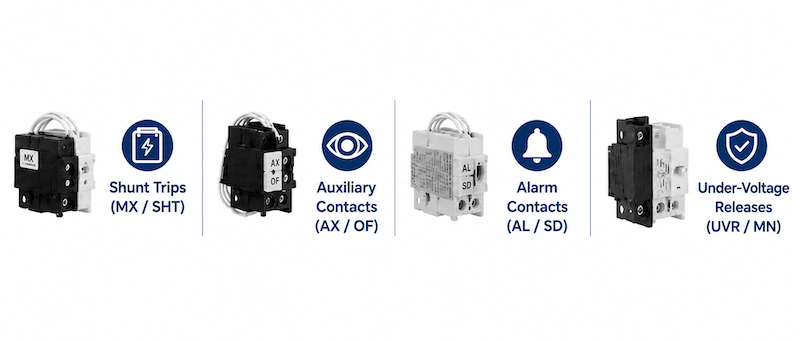
Ang mga component na ito ay inilalagay sa loob ng mga dedicated internal slot sa loob ng circuit breaker housing. Direkta silang nakikipag-ugnayan sa internal mechanism ng breaker upang magbigay ng telemetry data o magsagawa ng mga automated safety trip.
Shunt Trips (MX / SHT):
Mga tagapagpagana ng remote emergency isolation. Kapag pinasigla ng external voltage source (tulad ng fire alarm signal o emergency stop button), agad na pinipilit ng shunt trip na bumukas ang mechanical latch ng breaker.
Auxiliary Contacts (AX / OF):
Gumaganap bilang “mga mata” ng iyong automation system. Sinasalamin ng mga ito ang pisikal na estado ng mga pangunahing breaker contact, na nagpapadala ng real-time na “Open” o “Closed” na signal sa mga PLC, SCADA system, o mga indicator light sa panel door.
Mga Contact ng Alarm (AL / SD):
Ito ay mga espesyalisadong switch na lamang umaandar kapag nag-trip ang breaker dahil sa isang electrical fault (overload, short circuit, o earth fault). Pinapahintulutan nito ang mga maintenance team na agad na matukoy ang isang mapanganib na trip mula sa isang regular na manwal na pagsasara.
Mga Under-Voltage Release (UVR / MN):
Under-Voltage Releases (UVR / MN): Mga maagap na tagapangalaga ng kalidad ng boltahe. Awtomatikong itinitrip ng mga ito ang breaker kung ang papasok na line voltage ay bumaba sa ibaba ng isang kritikal na threshold (karaniwang 35% – 70% ng rated voltage), na pinoprotektahan ang mga downstream motor mula sa pagkasunog sa panahon ng matinding pagbaba ng boltahe.
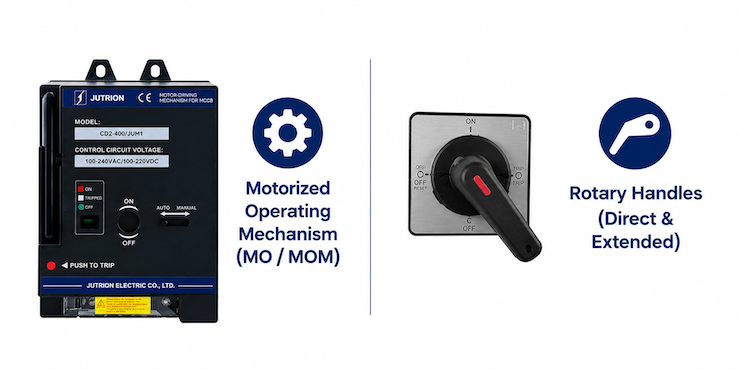
Sa paglipat mula sa mga panloob na bahagi, ang ilang mahahalagang accessory ay ikinakabit sa labas sa harap o gilid ng breaker. Pangunahing binabago ng mga modyul na ito kung paano pinapatakbo ang aparato, na inililipat ang iyong sistema mula sa simpleng manwal na pag-toggle patungo sa advanced na PLC automation o mga high-safety, through-the-door na manwal na configuration.
Motorized Operating Mechanism(MO / MOM):
Ang mga espesyalisadong motorized unit na ito ay direktang ikinakabit sa harap ng Molded Case Circuit Breakers (MCCBs) upang awtomatikong paandarin ang internal toggle system. Sa pamamagitan ng pag-convert ng mga remote electrical command sa maaasahang mekanikal na puwersa, walang putol na nagsasama ang mga ito sa Programmable Logic Controllers (PLCs) sa pamamagitan ng RS485 communication protocols (tulad ng Modbus RTU). Ito ang tiyak na teknolohiya na nagbubukas ng automated circuit isolation, remote resetting, at ganap na sentralisadong pamamahala ng grid nang direkta mula sa control room.
Rotary Handles (Direct at Extended):
Ang mga karaniwang breaker toggle ay maaaring matigas at mapanganib na direktang patakbuhin sa ilalim ng load. Ang mga direct rotary handle ay nagbibigay ng mekanikal na bentahe para sa mas madaling pag-flip, habang ang mga extended rotary handle ay gumagamit ng shaft upang payagan ang mga operator na ligtas na i-switch ang breaker mula sa labas ng isang saradong enclosure door, na pinapanatili ang IP40/IP54 ingress protection.
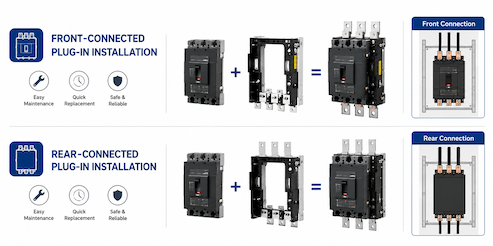
Para sa pisikal na pag-install, dapat mo ring isaalang-alang kung paano kumokonekta ang circuit breaker sa istraktura ng switchboard. Ang mga plug-in circuit breaker ay maaaring i-configure na may front-connected o rear-connected bases ayon sa layout ng cabinet, direksyon ng wiring, at mga kinakailangan sa maintenance. Ang parehong configuration ay nagpapahintulot sa breaker na alisin at palitan nang hindi dinidiskonekta ang mga pangunahing circuit conductor mula sa base.
Pag-install ng Plug-In na Nakakonekta sa Harap
Ang isang front-connected plug-in circuit breaker ay ikinakabit sa isang dedikadong plug-in base, na ang mga pangunahing circuit cable o busbar ay konektado sa mga front terminal ng base. Maaaring alisin at palitan ang breaker nang hindi dinidiskonekta ang mga pangunahing conductor, na tumutulong na pasimplehin ang maintenance at bawasan ang oras ng pagpapalit.
Pag-install ng Plug-In na Nakakonekta sa Likod
Ang isang rear-connected plug-in circuit breaker ay ikinakabit din sa isang dedikadong plug-in base, ngunit ang pangunahing circuit ay konektado mula sa likod ng mounting plate sa pamamagitan ng mga rear terminal o connecting bar. Ang kaayusang ito ay nagbibigay ng parehong maginhawang function ng pagpapalit habang pinananatiling mas malinis ang layout ng front cabinet at binabawasan ang interference sa front-side wiring.
Ang parehong configuration ay sumusuporta sa mas mabilis na pagpapalit ng breaker. Ang pangunahing pagkakaiba ay nakasalalay sa kung ang pangunahing circuit ay konektado sa front o rear terminals ng plug-in base.
Paano Pumili ng Tamang Circuit Breaker Accessories
Sa mga tunay na proyektong low-voltage na elektrikal, madalas naming nakikita ang parehong hamon sa mga panel builder, system integrator, at project engineer. Alam nila na ang mga MCCB, MCB, o ACB ay maaaring mangailangan ng mga accessory upang suportahan ang remote control, status indication, fault alarm, o door-mounted operation, ngunit madalas silang hindi sigurado kung paano pipiliin ang tamang configuration ng accessory.
Ang pag-asa lamang sa mga kumplikadong manwal ng produkto nang hindi kinukumpirma ang aktwal na istruktura ng cabinet at mga kinakailangan sa kontrol ay maaaring humantong sa magastos na mga problema sa pag-install. Halimbawa, ang pagpili ng maling control voltage para sa isang shunt trip ay maaaring makasira sa coil, ang pagkalito sa isang auxiliary contact at isang alarm contact ay maaaring magdulot ng maling status feedback, at ang pagbabalewala sa terminal layout o espasyo sa pag-install ay maaaring makaapekto sa wiring, electrical clearance, at pagpapanatili sa hinaharap.
Iyan ang dahilan kung bakit hindi dapat piliin ang mga circuit breaker accessory sa pangalan lamang. Dapat isaalang-alang ng tamang pagpili ang modelo ng breaker, laki ng frame, control voltage, paraan ng pag-install, kinakailangan sa signal, at aktwal na kapaligiran ng aplikasyon.
Upang mapadali ang kumplikadong prosesong ito at mapangalagaan ang iyong pamumuhunan sa engineering, inilatag ko ang mga pangunahing pamantayan sa pagpili sa mga praktikal at tiyak na hakbang. Tingnan natin kung paano mo tumpak na mako-configure ang ideal na layout ng accessory para sa iyong susunod na deployment.
Hakbang 1: Kumpirmahin ang Uri ng Circuit Breaker, Modelo, at Laki ng Frame
Ang unang hakbang ay tukuyin ang eksaktong platform ng circuit breaker kung saan ilalagay ang accessory. Ang mga circuit breaker accessory ay karaniwang hindi unibersal. Kahit na ang dalawang circuit breaker ay may parehong rated current, ang mga pagkakaiba sa serye ng produkto, laki ng frame, configuration ng pole, panloob na mekanismo ng pagpapatakbo, at mga sukat ng pagkakabit ay maaaring maging dahilan upang hindi magkatugma ang kanilang mga accessory. Bago pumili ng anumang accessory, kumpirmahin ang sumusunod na impormasyon:
Uri ng circuit breaker: MCB, MCCB, o ACB
Manufacturer at serye ng produkto
Kumpletong modelo ng circuit breaker
Bilang ng mga pole: 1P, 2P, 3P, o 4P
Laki ng frame, tulad ng 100A, 250A, o 400A Halimbawa, ang isang shunt trip na idinisenyo para sa isang 100AF MCCB ay maaaring hindi magkasya sa isang 250AF breaker, kahit na ang parehong circuit breaker ay gumagana sa parehong rated current. Ang kanilang mga mekanikal na sukat, mounting clip, operating stroke, at mga posisyon ng terminal ay maaaring ganap na magkaiba. Samakatuwid, ang modelo ng circuit breaker at laki ng frame ay dapat palaging suriin laban sa accessory compatibility table na ibinigay ng manufacturer.
Praktikal na Tip: Huwag pumili ng accessory batay lamang sa rated current ng breaker. Palaging ibigay ang kumpletong numero ng modelo o isang malinaw na larawan ng nameplate ng breaker kapag humihiling ng quotation.
Hakbang 2: Itugma ang Accessory sa Kinakailangang Aplikasyon
Matapos kumpirmahin ang modelo ng circuit breaker, ang susunod na hakbang ay hindi lamang basta pumili ng accessory sa pangalan, kundi tukuyin ang aktwal na kinakailangan sa kontrol, proteksyon, o pagbibigay ng senyas ng sistemang elektrikal. Maaaring gamitin nang sabay-sabay ang iba't ibang accessory, ngunit ang bawat isa ay idinisenyo upang lutasin ang isang partikular na kinakailangan sa aplikasyon. Kaya dapat magsimula ang tamang pagpili sa tanong na: Ano ang kailangang gawin ng circuit breaker para sa sistema?
Sa mga taon ko ng pamumuno sa mga proyektong pang-industriyang engineering, nakita ko ang mga team na nilalaktawan ang kritikal na hakbang na ito at bulag na pumipili ng mga accessory mula sa catalog batay lamang sa mga pangalan. Ito ay laging humahantong sa kaguluhan sa panahon ng commissioning—tulad ng pagkalito sa isang auxiliary contact at isang alarm contact, na nag-iiwan sa central PLC na ganap na bulag kung ang isang trip ay isang safety fault o isang manu-manong operasyon lamang.
PARA MAIWASAN ANG MAGASTOS NA MGA PAGKAKAMALI SA FIELD, TINGNAN NATIN KUNG PAANO IDINIDIKTA NG MGA TIYAK NA KINAKAILANGAN NG SYSTEM ANG IYONG PAGPILI NG COMPONENT
Kung ang breaker ay dapat ma-trip nang malayuan ng isang fire alarm system o emergency stop circuit, karaniwang kinakailangan ang isang shunt trip.
Kung ang breaker ay dapat bumukas o pigilan ang pagsasara kapag bumaba ang control voltage sa ibaba ng isang tinukoy na antas, mas angkop ang isang undervoltage release.
Kung kailangang malaman ng control system kung ang breaker ay ON o OFF, dapat pumili ng auxiliary contact.
Kung kailangang matukoy ng system ang isang protection trip mula sa isang manu-manong pagbubukas na operasyon, kinakailangan ang isang alarm contact.
Kung ang breaker ay dapat buksan o isara nang malayuan, maaaring kailanganin ang isang motor operator.
Kung ang breaker ay dapat patakbuhin mula sa labas ng pinto ng cabinet, dapat pumili ng rotary handle.
Kung ang breaker ay kailangang tanggalin o palitan nang mabilis nang hindi dinidiskonekta ang lahat ng pangunahing cable o busbar, maaaring mas angkop ang isang plug-in configuration.
Ang accessory ay dapat piliin ayon sa kinakailangang function sa halip na sa hitsura nito o pangkalahatang pangalan ng produkto.
Hakbang 3: Itugma ang Control Voltage at Uri ng Power Supply
Ang control voltage ay isa sa pinakamahalagang parameter kapag pumipili ng mga accessory na pinapatakbo ng kuryente. Ang mga shunt trip, undervoltage release, closing coil, at motor operator ay idinisenyo para sa mga tiyak na saklaw ng boltahe.
Common control voltages include:
AC 24V, 36V, 48V, 110V, 220V, 230V, or 380V
DC 24V, 36V, 48V, 110V, 125V, or 220V
The selected accessory must match both the voltage level and the power supply type.For example, a 220V AC shunt trip should not be connected to a 220V DC control circuit,Although the voltage value is the same, the coil structure and electrical characteristics are different,An incorrect power supply may cause failure to operate, excessive heating, coil damage, or unreliable tripping.
Before confirming the accessory, check the following:
Whether the control supply is AC or DC
The nominal control voltage
The permissible operating voltage range
Whether the signal is continuous or momentary
Whether the accessory remains energized during normal operation
Important: Undervoltage releases are usually continuously energized while the circuit breaker is operating. Therefore, the control circuit must provide a stable power supply and sufficient coil capacity.
Motor Operator Power Supply: The motor operator should normally be powered from the line side of the circuit breaker or from an independent control power supply. If it is powered from the load side, it may lose power after the breaker opens or trips, preventing subsequent remote closing or reset operation.
Customization: The control voltage of the motor operator can be customized according to the customer’s power supply and project requirements.
Step 4: Check the Accessory Installation Position and Compatibility
Many MCBs and MCCBs have designated installation positions or slots for internal accessories. The number, position, and compatible accessory combinations may vary depending on the product series, frame size, and pole configuration.
Before ordering, confirm the following:
Whether the accessory is installed internally or externally
Whether it is mounted on the left side or right side
Whether one slot can accept more than one contact module
Whether the selected accessories can be installed together
Whether additional terminal blocks or wiring leads are required
Some MCCBs, especially residual current MCCBs, have limited internal space for accessories. In certain models, only one internal accessory position is available, so a standard shunt trip and a separate auxiliary contact cannot be installed independently at the same time.In this situation, an integrated shunt trip and auxiliary contact module may be selected when both remote tripping and breaker position feedback are required.The accessory mounting arrangement may also vary between different MCCB series. For example, the shunt trip may be installed on the left side in one model but on the right side in another, while the auxiliary contact or alarm contact may occupy a different designated position.
Therefore, accessory compatibility cannot be determined only by the accessory name or breaker rated current. The exact MCCB series, frame size, residual current protection function, pole configuration, and internal accessory layout must be confirmed before ordering.
Praktikal na Tip: If the MCCB has only one available accessory slot, confirm whether an integrated accessory module, such as a shunt trip with an auxiliary contact, is available for that breaker series.
Selecting the correct circuit breaker accessories requires more than identifying the accessory name. The breaker model, frame size, required function, control voltage, installation position, and accessory compatibility must all be confirmed together. A correct configuration should meet both the electrical control requirements and the actual cabinet installation conditions.
Step 5: Plug-In Circuit Breaker Installation and Connection Options
In addition to electrical functions, the installation and connection method of the circuit breaker can also affect accessory selection. Different plug-in configurations may require different bases, terminals, mounting arrangements, and cabinet structures.
Pag-install ng Plug-In na Nakakonekta sa Harap:
A front-connected plug-in circuit breaker is mounted on a dedicated plug-in base, with the main circuit cables or busbars connected from the front. The breaker can be removed and replaced without disconnecting the main circuit conductors from the base, helping reduce maintenance time.
Pag-install ng Plug-In na Nakakonekta sa Likod:
A rear-connected plug-in circuit breaker is also mounted on a dedicated plug-in base, but the main circuit is connected from behind the mounting plate through rear terminals or connecting bars. It provides the same convenient replacement function while supporting a cleaner front cabinet layout.
Both configurations support faster breaker replacement. The main difference is the direction of the main circuit connection and the corresponding cabinet layout requirements.
Circuit Breaker Accessory Selection Checklist
Selection Item
What to Confirm
Circuit breaker type
MCB, MCCB, residual current MCCB, or ACB
Manufacturer and series
Complete product series
Complete model
Full circuit breaker model number
Frame size
100AF, 250AF, 400AF, etc.
Number of poles
1P, 2P, 3P, or 4P
Required function
Remote trip, undervoltage protection, status feedback, fault alarm, remote operation, or interlocking
Boltahe ng kontrol
Rated voltage and AC/DC supply type
Operating signal
Continuous or momentary
Accessory position
Internal, external, left side, or right side
Accessory combination
Separate accessory or integrated module
Connection method
Front connection or rear connection
Installation method
Fixed-mounted or plug-in
Cabinet conditions
Depth, wiring space, shaft length, and maintenance clearance
Project documents
Nameplate photo, control schematic, cabinet drawing, and technical requirements
If any of the above information is uncertain, provide the complete breaker model, nameplate photo, and project drawings to the supplier before placing the order.
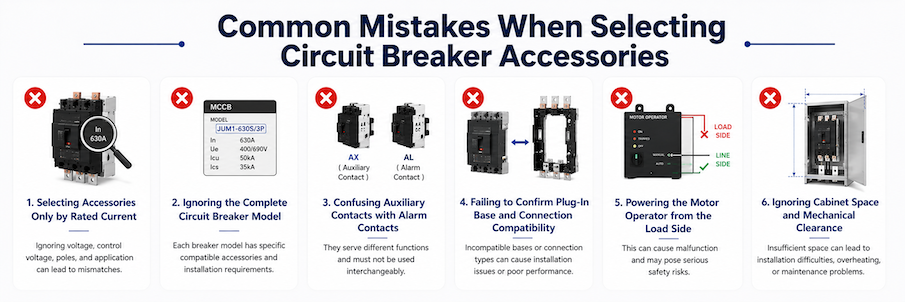
Common Mistakes When Selecting Circuit Breaker Accessories
Even experienced panel builders and project engineers can make accessory selection mistakes when the breaker model, control voltage, installation structure, or signal requirements are not fully confirmed. The following are some of the most common problems found in circuit breaker accessory selection.
1.Selecting Accessories Only by Rated Current
Circuit breaker accessories should not be selected only according to the rated current of the breaker. Two breakers with the same rated current may belong to different product series or frame sizes, and their internal structures, mounting dimensions, and accessory positions may be completely different.
How to avoid it: Always confirm the complete breaker model, product series, frame size, and number of poles.
2. Ignoring the Complete Circuit Breaker Model
Providing only information such as “250A MCCB” is usually not enough to identify the correct accessory. The complete model number may include important information about the breaker series, frame size, breaking capacity, pole configuration, and protection type.
This is especially important for residual current MCCBs, electronic MCCBs, and breakers with special internal structures.
How to avoid it: Provide the complete model number or a clear photo of the breaker nameplate.
3. Confusing Auxiliary Contacts with Alarm Contacts
Auxiliary contacts and alarm contacts both provide electrical feedback signals, but they indicate different conditions.An auxiliary contact normally indicates whether the circuit breaker is ON or OFF. An alarm contact indicates whether the breaker has tripped because of overload, short circuit, or another protection event.If the wrong contact is selected, the PLC or monitoring system may receive incorrect status information.
How to avoid it: Confirm whether the system requires position feedback or fault-trip feedback.
4.Failing to Confirm Plug-In Base and Connection Compatibility
A plug-in base must match the exact breaker series, frame size, number of poles, and connection method.Front-connected and rear-connected plug-in configurations may use different bases, terminals, connecting bars, and cabinet structures.A base selected only by rated current may not fit the breaker correctly.
How to avoid it: Confirm whether the system requires a front-connected or rear-connected plug-in configuration before ordering.
5.Powering the Motor Operator from the Load Side
If the motor operator is powered from the load side of the circuit breaker, it may lose power after the breaker opens or trips.This may prevent the breaker from being remotely closed or reset.
How to avoid it: The motor operator should normally be powered from the line side of the breaker or from an independent control power source, according to the system design.
6.Ignoring Cabinet Space and Mechanical Clearance
Even if the accessory is electrically compatible, it may still be impossible to install if the cabinet space is insufficient.Motor operators, rotary handles, plug-in bases, rear terminals, terminal covers, and cable lugs all require additional installation space.Insufficient clearance may affect wiring, cabinet door closing, operation, and future maintenance.
How to avoid it: Check the cabinet drawing, breaker dimensions, accessory dimensions, cable routing, and maintenance space before confirming the order.
Most circuit breaker accessory selection errors can be avoided by confirming the complete breaker model, control voltage, required function, internal accessory layout, installation method, and cabinet conditions before ordering.
When the accessory configuration is uncertain, provide the supplier with the breaker nameplate photo, control schematic, and cabinet drawing for compatibility verification.
Frequently Asked Questions About Circuit Breaker Accessories
Can I use JUTRION accessories as high-quality replacements or upgrades for major breaker brands?
Absolutely. At JUTRION, our complete range of internal and external accessories is custom-engineered and precision-molded to strictly match the mechanical linkage profiles and electrical specifications of standard low-voltage circuit breakers in the global market. As long as you select the verified cross-reference model from our catalog, our components deliver identical mechanical endurance and seamless integration, offering engineering teams a highly cost-effective alternative with significantly faster production lead times.
Are Circuit Breaker Accessories Universal?
No. Circuit breaker accessories are generally designed for specific product series, frame sizes, pole configurations, and internal mechanisms. Even if two circuit breakers have the same rated current, their accessories may not be interchangeable. Always confirm the complete breaker model and accessory compatibility before ordering.
What Is the Difference Between an Auxiliary Contact and an Alarm Contact?
An auxiliary contact indicates the operating position of the circuit breaker, such as ON or OFF. An alarm contact indicates that the breaker has tripped because of an overload, short circuit, earth fault, or another protection event. An auxiliary contact is used for position feedback, while an alarm contact is used for fault-trip indication.
Can I install a Shunt Trip and an Under-Voltage Release into the same breaker simultaneously?
This strictly depends on the breaker’s frame size and its internal cavity layout. In compact, lower-current devices (such as 125A frames), there is often only one physical internal slot designated for voltage-tripping coils, meaning you must choose between a shunt trip or a UVR. However, in larger frame sizes (such as 400A or 800A), multiple independent slots are typically engineered, allowing you to combine both internal accessories flawlessly. When configuring your project, our JUTRION engineering team can provide you with a precise combination layout based on your housing limits.
What is the main operational difference between a Shunt Trip and an Under-Voltage Release (UVR)?
The core difference lies in their activation logic. A Shunt Trip requires an active electrical pulse (applying voltage to the coil) to mechanically trip the breaker remotely, making it perfect for fire alarm linkages. Conversely, an Under-Voltage Release (UVR) keeps the breaker closed as long as standard grid voltage is present; it trips the breaker automatically when the control voltage drops below a safe threshold (typically between 35 percent and 70 percent of rated voltage) or completely fails. This makes the UVR ideal for protecting downstream motors from sudden grid brownouts.
How does JUTRION ensure the long-term reliability and mechanical endurance of its internal accessories over thousands of operating cycles?
Field failure is not an option when safety is on the line. At JUTRION, we treat our accessories not just as molded plastic and copper, but as the precision neural network of your power distribution system. Every batch of our shunt trips, auxiliary contacts, and motor operators undergoes rigorous, automated fatigue and dielectric testing in our compliance labs. We simulate harsh industrial environments, ensuring our micro-switches and heavy-duty coils sustain mechanical and electrical endurance ratings that fully comply with IEC standards. By engineering our components with high-grade, heat-resistant polymers and premium silver-alloy contacts, JUTRION guarantees stable signal feedback and instant remote actuation even after years of demanding operational cycles.
Circuit breaker designs vary significantly across global brands. Can JUTRION truly guarantee physical compatibility across different manufacturers?
Yes, we can. This universal adaptation capability is exactly why international clients partner with us. Over the years, JUTRION has built and continuously updated an extensive engineering database and precision matrix mold library. Today, our highly versatile internal and external accessories can seamlessly adapt to over 99 percent of low-voltage molded case circuit breakers (MCCBs) and miniature circuit breakers (MCBs) available on the global market. Whether your switchboard relies on standard European designs, traditional Asian form factors, or major mainstream multi-national brands, our engineering team can instantly match you with the precise JUTRION accessory variant designed to fit that exact internal housing and mechanical linkage profile.
Need Help Selecting Compatible Circuit Breaker Accessories?
Choosing the correct circuit breaker accessory requires more than matching the accessory name. The breaker model, frame size, control voltage, installation position, connection method, and project requirements must all be verified together.
Provide JUTRION with the following information: Complete circuit breaker model or nameplate photo Required accessory function Control voltage and AC/DC power supply type Installation method and project quantity
Our engineering team will verify accessory compatibility and recommend a suitable configuration for your electrical project.
Inhinyerong Elektrikal | Distribusyon ng Kuryenteng Mababa ang Boltahe
Kumusta, ako si Evan.
Ako ay isang electrical engineer na may 10 taong karanasan sa low-voltage electrical equipment, circuit protection, at power distribution systems. Dalubhasa ako sa pagpili ng produkto, application engineering, at teknikal na suporta para sa mga proyektong pang-industriya, pangkomersyo, at renewable-energy.
Para sa mga teknikal na katanungan, mangyaring makipag-ugnayan sa akin sa evan@jutrion.com.