

Industrial AC & DC Fuses: High-Breaking Capacity Circuit Protection
JUTRION manufactures high-breaking capacity AC and DC fuses (including NH, cylindrical, and solar PV types) in strict compliance with international IEC 60269 standards, delivering reliable short-circuit protection up to 690V AC and 1500V DC for global B2B power systems.
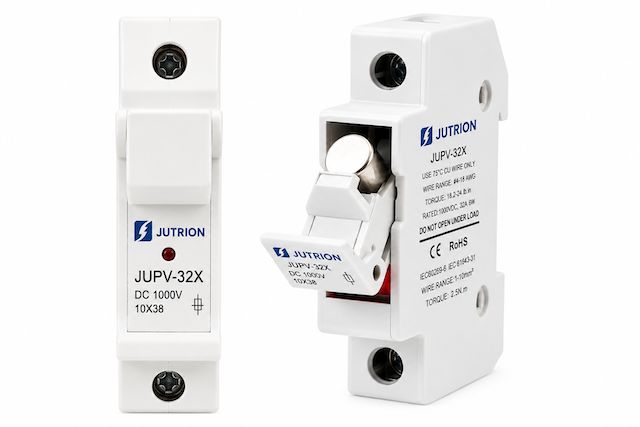
HIGH-QUALITY FUSE MANUFACTURER
Understanding Electrical Fuses
A fuse is an absolute, fail-safe circuit protection device that self-sacrifices by melting its internal element to physically interrupt the circuit during a short-circuit or severe overcurrent fault, preventing damage to downstream equipment.
Fuse Selection by System Parameters
The correct fuse should be selected according to the system voltage, operating current, prospective short-circuit current, fuse size and load characteristics. Proper selection helps prevent nuisance operation and ensures reliable circuit protection.
Coordination with Other Protective Devices
Fuses are often used together with circuit breakers, isolator switches, contactors and surge protective devices. Proper protection coordination improves fault selectivity and helps limit the affected area when an electrical fault occurs.
Safe Installation and Maintenance
Fuse holders are designed for DIN-rail installation and convenient replacement inside distribution boards, combiner boxes and control panels. The circuit must be isolated before opening the fuse holder or replacing the fuse link.
JUTRION AC & DC FUSE PRODUCT CATEGORIES
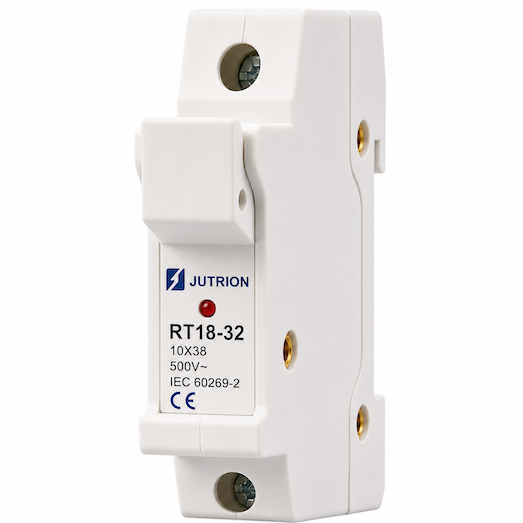
JUTRION AC Industrial Fuses
High Breaking Capacity: Engineered to safely interrupt massive short-circuit currents up to 120kA, making them ideal for heavy-duty switchgears and main power incoming panels.
Diverse Form Factors: Available in standard blade types (NH00-NH3), bolted tag types (BS88), and compact cylindrical links to fit global panel standards.
General Distribution Protection: Optimized for standard AC grids, protecting motors, transformers, industrial heaters, and general low-voltage cable networks.
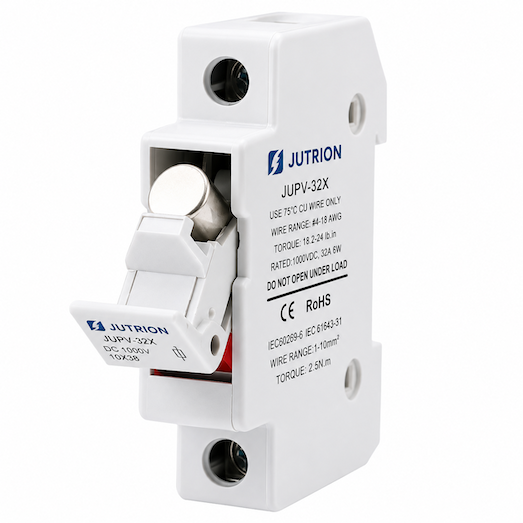
JUTRION DC Solar PV Fuses
Engineered for High Voltage: Specially designed to operate under pure continuous direct current, offering reliable isolation in high-voltage solar arrays up to 1500V DC.
Ultra-Fast Clearing Speed: Features a highly sensitive gPV characteristic to rapidly clear minor reverse currents and fault currents before damage occurs.
Extreme Environment Endurance: Built with premium ceramic bodies to withstand cyclic temperature swings and long-term harsh outdoor climates in solar projects.
RELIABLE FEATURES OF JUTRION AC & DC FUSES
Fast Overcurrent Protection
Quickly interrupts overload and short-circuit currents to help protect cables, equipment and electrical systems.
AC & DC Application Coverage
Available for low-voltage AC distribution, solar PV, energy storage and other DC electrical systems.
Reliable Arc Extinguishing
Optimized internal structure helps interrupt fault currents safely under both AC and DC operating conditions.
Flexible Product Configuration
Multiple voltage, current and fuse-holder options are available, with OEM/ODM customization for different markets.
JUTRION AC & DC Fuse Comparison
| Parameter | AC Fuse | DC Fuse |
|---|---|---|
| Current Type | Alternating Current | Direct Current |
| Typical Rated Voltage | 250V / 500V / 690V AC | 1000V / 1500V DC |
| Typical Applications | Low-voltage distribution, machinery and industrial control systems | Solar PV, energy storage and other DC systems |
| Arc Extinguishing Requirement | Lower than DC due to natural current zero crossing | Higher due to continuous DC arc |
| Common Protection Function | Overload and short-circuit protection | Overcurrent and short-circuit protection |
| Reference Standard | IEC 60269 series | IEC 60269-6 for photovoltaic applications |
FUSE LINKS AND FUSE HOLDERS
The fuse link is the replaceable protective element that interrupts overcurrent and short-circuit faults, while the fuse holder provides secure electrical connection, insulation and convenient installation. Together, they form a complete fuse protection system for distribution boards, control panels, solar combiner boxes and other electrical equipment.
| Component | Main Function | How It Works | Typical Role |
|---|---|---|---|
| Fuse Link | Provides overcurrent and short-circuit protection | The internal fuse element melts when the current exceeds the specified limit, interrupting the circuit | Protects cables, equipment and electrical systems from fault current |
| Fuse Holder | Supports, connects and insulates the fuse link | Provides secure electrical contact, mechanical mounting and safe replacement of the fuse link | Ensures reliable installation inside distribution boards, control panels and combiner boxes |
What is the difference between an AC fuse and a DC fuse?
AC and DC current behave differently when interrupted. AC voltage naturally drops to zero 100 or 120 times per second, making the resulting electrical arc much easier to extinguish. Continuous DC current does not have a natural zero-crossing, meaning the arc is highly persistent and dangerous. Therefore, DC fuses are physically longer and feature specialized internal structures and sand-filling to forcefully cool and extinguish high-voltage DC arcs. Never use an AC fuse in a pure DC application.
How to Select the Right JUTRION Fuse
Step 1. Voltage: Ensure the fuse voltage rating is higher than your system voltage. Choose AC up to 690V for industrial grids, or DC 1000V or 1500V for solar PV systems.
Step 2. Application Category: Match your load type. Choose gG for general cables and distribution, aM for industrial motor startup protection, or gPV for solar string protection.
Step 3. Current: Calculate your continuous current and add a safety margin. For general AC circuits, use 1.25 times the load current. For solar DC circuits, use 1.56 times the short circuit current to prevent heat-induced tripping.
Step 4. Mounting Style: Choose Cylindrical 10x38mm for modular DIN-rail holders, Blade NH00-NH3 for heavy-duty switch disconnectors, or Bolted Tag BS88 for high-vibration busbar connections.
Key Differences Between AC and DC Fuses
AC Fuses: Designed for alternating current where the voltage naturally drops to zero regularly, making the arc easy to extinguish. They are used for standard factory power and motors.
DC Fuses: Designed for continuous direct current where the arc does not stop naturally and is highly dangerous. They are physically longer and packed with special sand to forcefully extinguish high-voltage solar arcs.
CONTACT US FOR YOUR FUSE PROTECTION SOLUTION
Tell us your system voltage, rated current, fuse size and application requirements. JUTRION will help you select the right AC or DC fuse and fuse holder combination, providing reliable protection, competitive pricing and flexible OEM/ODM support for your project or distribution business.