

2P & 4P RCCBS FOR RESIDENTIAL, COMMERCIAL AND INDUSTRIAL SYSTEMS
JUTRION RCCBs are designed to detect residual current leakage and disconnect faulty circuits quickly, helping reduce electric shock and electrical fire risks. Available in 2P and 4P configurations with Type AC and Type A options, they are suitable for residential, commercial and industrial distribution systems.
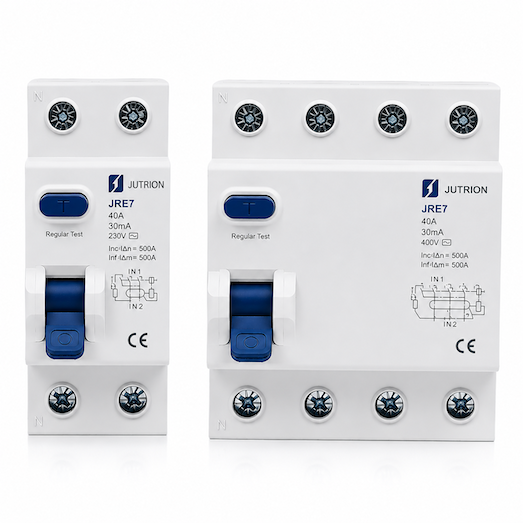
Superior Life & Fire Safety
Designed to rapidly detect low-level earth leakage currents and disconnect the circuit within milliseconds. It provides robust protection against lethal electric shocks and prevents electrical fires caused by insulation faults.
Flexible Type A & AC Options
Available in Type AC for standard AC sinusoidal leakage, and Type A to safely detect both AC and pulsating DC residual currents. This ensures comprehensive protection in modern systems filled with non-linear electronic loads.
Certified Global Standards
Manufactured in strict compliance with international IEC 60269 and IEC 61008-1 standards. Featuring CE certification and high-quality materials, JUTRION RCCBs deliver long-term reliability and stable operation in harsh environments.
JUTRION Residual Current Circuit Breaker (RCCB) Series
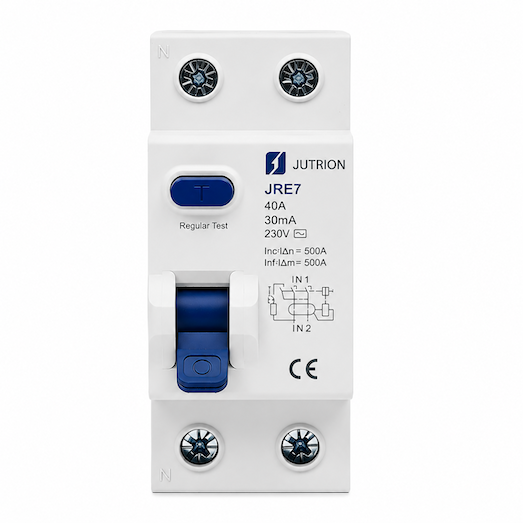
JUTRION JRE7 2-Pole Residual Current Circuit Breaker (RCCB)
Key Features
- Single-Phase Protection: Specially designed for single-phase systems (Phase + Neutral, 2P) to protect personnel from fatal electric shock and electrical fire hazards.
- Dynamic Current Selection: Available in standard tripping sensitivities: 30mA (for life safety and direct touch protection) and 100mA/300mA (for system leakage and fire prevention).
- Compact 2-Module Width: Designed with a standard width of 36mm (2 DIN modules) to maximize panel space efficiency in distribution boxes.
- Type A & AC Compliance: Optional Type AC for standard AC leakage, and Type A to detect both AC and pulsating DC residual currents common in modern household electronics.
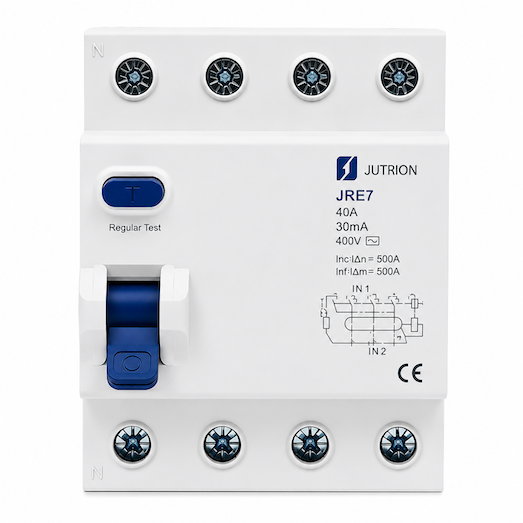
JUTRION JRE7 4-Pole Residual Current Circuit Breaker (RCCB)
Key Features
- Three-Phase Power Protection: Engineered for three-phase four-wire (4P, 3P+N) industrial, commercial, and solar PV distribution networks.
- Simultaneous Pole Disconnection: Features synchronous tripping of all 4 poles (including the neutral line) to ensure complete electrical isolation of the downstream system during earth faults.
- High Interrupting Capacity: Delivers a robust conditional short-circuit current rating (Inc/IΔc) up to 6kA/10kA, ensuring stability under transient overload currents.
- Heavy-Duty Industrial Application: Perfectly suited for protecting larger motor-driven loads, heavy HVAC equipment, and industrial workshop distribution panels.
JRE7 2P vs 4P RCCB – Key Specifications
| Parameter | JRE7 2P RCCB | JRE7 4P RCCB |
|---|---|---|
| Poles | 2P | 4P |
| Electrical System | Single-phase, two-wire | Three-phase, four-wire |
| Rated Voltage | 230V AC | 400V AC |
| Rated Current | 16–100A | 16–100A |
| Rated Residual Operating Current | 30mA / 100mA / 300mA | 30mA / 100mA / 300mA |
| Residual Current Type | Type AC / Type A | Type AC / Type A |
| Standard | IEC/EN 61008-1 | IEC/EN 61008-1 |
HOW TO CHOOSE THE RIGHT RCCB
Choose the Correct Pole Configuration
For a single-phase two-wire system, choose a 2P RCCB to disconnect both the live and neutral conductors. For a three-phase four-wire system, choose a 4P RCCB to disconnect all three phase conductors and the neutral conductor.
Typical selection:
- 2P RCCB: Residential buildings, apartments, shops and single-phase distribution boards
- 4P RCCB: Commercial buildings, industrial panels and three-phase distribution systems
Select the Appropriate Rated Current
The rated current of the RCCB should be equal to or higher than the maximum normal operating current of the circuit. Common rated currents include 16A, 25A, 40A, 63A, 80A and 100A.
The rated current must also be coordinated with the upstream MCB, MCCB or fuse. The upstream protective device should prevent the RCCB from being damaged by overload or short-circuit current.
Example:
For a circuit protected by a 40A MCB, a 40A or 63A RCCB may be selected according to the system design and manufacturer requirements.
Choose the Correct Residual Current Sensitivity
The rated residual operating current determines how sensitive the RCCB is to leakage current. The correct value should be selected according to the required protection purpose.
- 30mA: Commonly used for additional protection against electric shock in residential and final circuits
- 100mA: Suitable for equipment protection or higher-level distribution circuits
- 300mA: Commonly used to reduce electrical fire risks in main or distribution circuits
A lower residual current value provides more sensitive protection, but improper selection may increase nuisance tripping.
Choose Type AC or Type A
Type AC RCCBs detect sinusoidal alternating residual currents and are suitable for simple conventional AC loads. Type A RCCBs detect both sinusoidal AC residual currents and pulsating DC residual currents.
Type AC is commonly used for:
- Electric heaters
- Basic lighting circuits
- Conventional resistive loads
Type A is more suitable for:
- Washing machines
- Air conditioners
- Electronic power supplies
- Frequency-controlled equipment
- Household appliances containing electronic circuits
For modern residential and commercial systems with electronic equipment, Type A is generally a more comprehensive choice.
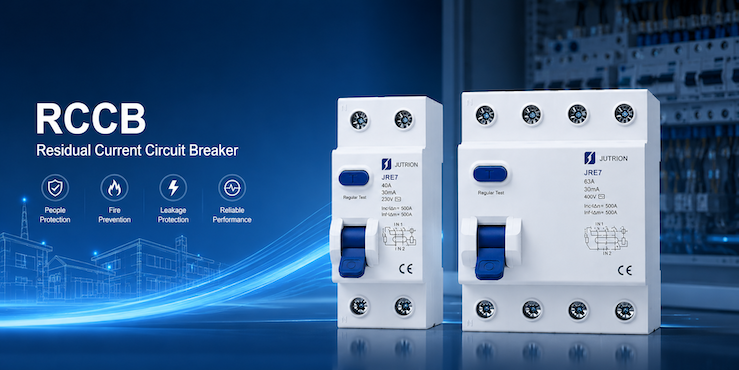
RELIABLE RCCB PROTECTION FOR SAFER POWER DISTRIBUTION
What is the difference between MCB, RCCB, and RCBO?
These three devices serve different protective functions in an electrical system. Here is a quick breakdown to help you choose:
- MCB (Miniature Circuit Breaker): Protects equipment from Overload and Short Circuits. It does not protect against earth leakage or electric shock.
- RCCB (Residual Current Circuit Breaker): Protects humans from Electric Shock and Earth Leakage. It does not protect against overloads or short circuits (it must be paired with an MCB).
- RCBO (Residual Current Breaker with Overcurrent): An all-in-one device that combines the functions of both MCB and RCCB. It protects against Overload + Short Circuit + Earth Leakage.
| Device | Overload Protection | Short Circuit Protection | Earth Leakage Protection | Primary Protection Target |
| MCB (Miniature Circuit Breaker) | YES | YES | NO | Cable & Equipment |
| RCCB (Residual Current Circuit Breaker) | NO | NO | YES | Human Life & Fire Safety |
| RCBO (Residual Current Breaker with Overcurrent) | YES | YES | YES | Complete System & Human Life |
WHY CHOOSE JUTRION RCCBS?
Stable Residual Current Performance
JUTRION RCCBs are designed for accurate leakage detection and reliable circuit disconnection, helping reduce electric shock and electrical fire risks.
Wide Current and Pole Range
Available in 2P and 4P versions with rated currents from 16A to 100A, supporting both single-phase and three-phase distribution systems.
Cost-Effective Supply Solution
Optimized production and direct supply help provide reliable RCCB products at competitive prices for distributors and project buyers.
Market-Oriented OEM Customization
JUTRION supports customized branding, labels, packaging and product specifications to help customers build differentiated products for their target markets.
JUTRION RCCBs combine reliable residual current protection, stable tripping performance, flexible OEM/ODM customization and competitive factory pricing, providing dependable and cost-effective solutions for distributors, panel builders and electrical project customers.
RCCB FAQ: Everything You Need to Know
What is an RCCB and how does it work?
An RCCB (Residual Current Circuit Breaker) is a vital safety device designed to protect people from dangerous electrical shocks and prevent electrical fires. It constantly monitors the balance of current between the phase (live) and neutral wires. If an imbalance is detected—such as when current leaks to the earth because a person touches a live wire or due to damaged wiring—the RCCB trips and cuts off the power in milliseconds.
Does an RCCB require a neutral connection to operate safely?
Yes, for both 2P and 4P RCCBs, the neutral wire must be connected. The RCCB detects leakage currents by comparing the current flowing through the phase(s) and the neutral. Without a proper neutral connection, the internal sensing circuit cannot function correctly, and the test button will not work.
What is the difference between a 2-Pole (2P) and a 4-Pole (4P) RCCB?
A 2P RCCB is designed for single-phase circuits (Phase + Neutral) and is typically used in residential and light commercial settings. A 4P RCCB is designed for three-phase four-wire systems (Three Phases + Neutral) and is standard in industrial, commercial, and large solar PV installations.
Why choose JUTRION RCCBs for your electrical and solar projects?
JUTRION is a professional manufacturer with advanced production lines based in Wenzhou, Zhejiang, bringing over a decade of low-voltage industry expertise to every product. Our JRE7 series RCCBs are engineered and tested in strict compliance with international standards like IEC 61008-1. We offer reliable Type A and AC solutions, high-grade flame-retardant materials, and robust technical support to ensure safe, stable operation for global B2B and distribution projects.
RELIABLE RCCB PROTECTION, BUILT FOR YOUR MARKET
JUTRION delivers reliable and cost-effective RCCB solutions with stable residual current protection, multiple 2P and 4P configurations, flexible OEM/ODM customization and competitive factory pricing. Designed for distributors, panel builders and project customers, our RCCBs help you meet different market requirements while maintaining consistent quality and dependable supply.