

PC Class vs CB Class Automatic Transfer Switch: Fault Handling, Standards & Selection
Under IEC 60947-6-1, the core difference between a PC-class and a CB-class automatic transfer switch (ATS) is how each device handles overloads and short circuits: a PC-class ATS uses dedicated changeover contacts with no built-in trip unit (rated for short-time withstand current, Icw, and requiring an upstream breaker or fuse), whereas a CB-class ATS pairs two interlocked circuit breakers with built-in overcurrent and short-circuit breaking capacity (Icu/Ics).
Choose a PC-class ATS when upstream protection already exists, panel space is tight, or the circuit must ride through overloads without tripping (such as fire pumps). Choose a CB-class ATS when the transfer switch sits at a standalone incomer with no upstream feeder breaker and must interrupt local faults on its own.
If you are still working through basic ATS anatomy and controller logic, start with our automatic transfer switch selection guide. Below is how to decide between PC-class and CB-class hardware when you are actually laying out a panel.
What Happens During a Short Circuit: Withstanding vs. Breaking
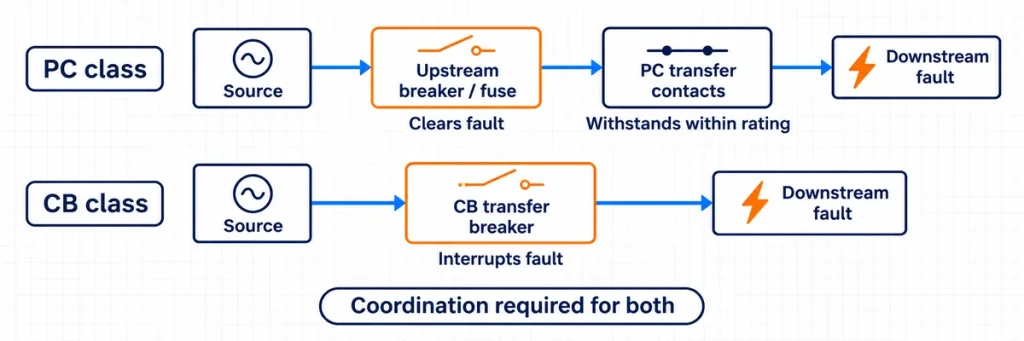
Most buyers compare PC-class and CB-class switches on unit price or switching speed. In practice, the real dividing line is fault energy. One device is engineered to survive a fault until something upstream stops it; the other is engineered to stop the fault itself.
| Factor | PC-Class ATS | CB-Class ATS |
|---|---|---|
| Internal hardware | Dedicated single-shaft or solenoid changeover contacts | Two interlocked MCCBs (or ACBs) with a motor operator |
| Overload & short-circuit trip | None; requires a separate upstream breaker or fuse | Built into the internal breaker trip units |
| Key short-circuit rating | Short-time withstand current (Icw) and making capacity (Icm) | Ultimate and service breaking capacity (Icu / Ics) |
| Downstream fault behavior | Holds closed briefly while the upstream OCPD clears the fault | Trips open locally inside the ATS to clear the fault |
| After the fault clears | Contacts remain intact (within Icw) and ready to transfer | Tripped breaker locks in TRIP state until manually reset |
| Switching endurance | Built for frequent load-transfer cycles | Follows standard MCCB mechanical/electrical endurance |
| Panel space & busbar work | Compact, single-unit footprint; often integrated load-side link | Wider/deeper; requires load-side paralleling busbars between both breakers |
Because a PC-class switch contains no thermal-magnetic or electronic trip unit, it will never nuisance-trip on a motor start or a brief overload. That freedom comes with a strict condition: if you wire a PC-class ATS straight to an unprotected busbar and a short circuit hits downstream, the fault current will exceed the switch’s Icw limit and weld the contacts shut.
Coordinating Upstream Protection for a PC-Class ATS
Choosing a PC-class ATS means handing fault interruption to the breaker or fuse upstream of it. Matching the ampere rating—putting a 250 A MCCB ahead of a 250 A PC-class ATS—is not enough. You have to check that the upstream device clears a fault before the ATS contacts take thermal or magnetic damage.
Under IEC 60947-6-1, a PC-class switch carries either a standalone short-time withstand current (Icw, typically rated for 0.05 s to 1 s) or a conditional short-circuit rating (Iq) tested alongside a specific fuse or MCCB. Check the prospective short-circuit current (Ik) at the panel, then verify that the upstream breaker’s clearing time and let-through energy (I²t) stay inside the ATS rating.
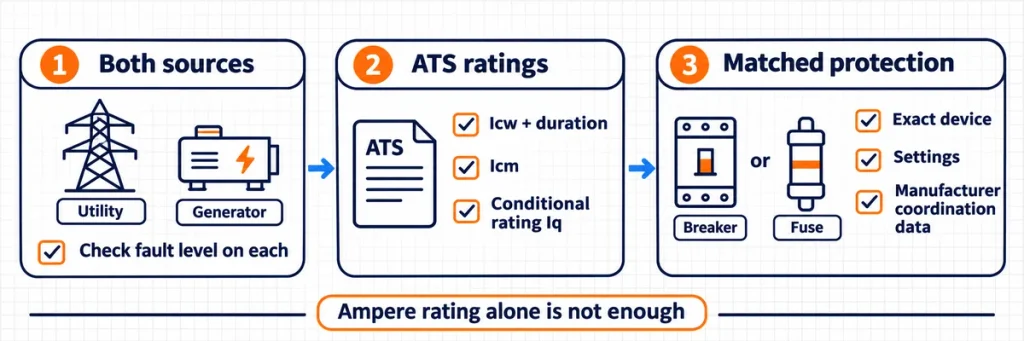
Illustrative coordination check: Suppose a 250 A distribution panel sits close to a 1000 kVA transformer, giving a prospective short-circuit current of 22 kA at the ATS terminals. A 250 A PC-class ATS rated for Icw = 10 kA (0.1 s) cannot survive 22 kA for a full 100 ms. However, if the upstream current-limiting MCCB or gG fuse clears a 22 kA fault within 10–15 ms and caps peak let-through energy below the ATS’s conditional Iq limit, the combination passes safely. Without checking that let-through curve, the 10 kA switch looks undersized on paper or gets destroyed in service if paired with a slow upstream breaker.
One detail panel builders often miss: a dual-power ATS sees two different fault levels. The utility transformer almost always delivers a much higher prospective short-circuit current than the standby diesel generator. Always run your coordination check against the utility incomer, not the generator.
Utilization Categories: Why Ampere Ratings Alone Mislead
Two 160 A PC-class switches can behave very differently depending on what they are switching. A resistive lighting feeder draws steady current; a chiller compressor pulls six times its rated current every time it starts. IEC 60947-6-1 separates ATS duty by utilization category so you do not burn out contacts prematurely:
| Category | Load characteristic | Typical circuits |
|---|---|---|
| AC-31A / AC-31B | Non-inductive or slightly inductive (cos φ ≈ 0.8) | Resistive heating, general lighting, UPS inputs |
| AC-32A / AC-32B | Mixed resistive and inductive loads with moderate overloads | Commercial floor distribution, mixed sub-panels |
| AC-33A / AC-33B | Motor loads and high inductive inrush (6× Ie making/breaking) | Fire pumps, chillers, industrial compressors, elevators |
The letter at the end marks switching frequency: A for frequent operation, B for infrequent operation. If a datasheet lists 160 A under AC-31B, do not assume it can switch a 160 A pump feeder under AC-33B without derating or stepping up a frame size. Check the exact category on the nameplate alongside the calculations in our ATS current-sizing guide.
Where Class CC and Static Transfer Switches Fit
Tender specifications sometimes mention two adjacent transfer devices alongside PC and CB classes, and mixing them up leads to bad quotes:
- Class CC (Contactor-based): Built from two mechanically and electrically interlocked electromagnetic contactors. Like PC-class, it relies on upstream short-circuit protection, and it excels at very high switching frequencies. The catch is coil power: standard AC contactors require continuous holding current to stay closed, and if control voltage dips, the contactor can chatter or drop out. Modern PC-class switches use permanent-magnet or motor-latched mechanisms that consume zero holding power once transferred.
- Static Transfer Switch (STS): Uses solid-state thyristors (SCRs) rather than moving mechanical contacts to transfer between two synchronized live sources in roughly a quarter-cycle (under 5 ms). It sits in a completely different cost bracket and is built for hyperscale IT or semiconductor tools fed by two independent UPS buses—not for standard utility-to-generator panels.
Fire Pumps and Life-Safety Feeders
In fire-fighting circuits—sprinkler pumps, smoke-extraction fans, pressurized stairwell blowers—building codes typically require an overload to trigger an alarm rather than trip the power off. Losing a fire pump to protect a motor winding during a fire is unacceptable.
A CB-class ATS built from standard thermal-magnetic MCCBs will trip open on a sustained overload and drop the pump. A PC-class ATS cannot trip on overload by design; it keeps power connected while an external current transformer and relay send an overload alarm to the fire panel. That is the main reason specifications for hospital, high-rise, and tunnel life-safety boards almost always call for PC-class transfer switches.
Mechanical Interlocking, Panel Wiring, and Manual Operation
On the shop floor, the labor difference between PC-class and CB-class assemblies is larger than the datasheet price gap suggests.
A PC-class ATS arrives as a single integrated unit. Its two input terminals and unified output terminal (often bridged internally or via a factory copper link) mean the panel builder lands three sets of power cables, connects the controller harness, and bolts the unit to the backplate. Mechanical interlocking happens inside a single rigid shaft or cam mechanism—both sources cannot close together even if a technician forces the manual handle.
A CB-class ATS puts two separate MCCBs side by side on a steel mounting plate, linked by an external mechanical interlock bar or cable and driven by a motorized operating mechanism. Because each MCCB has its own load-side terminals, the panel builder has to fabricate and insulate custom copper busbar bridges to parallel the two load sides together. Every extra bolted joint adds assembly time, increases enclosure depth, and creates another termination point to torque-check and IR-scan during commissioning.
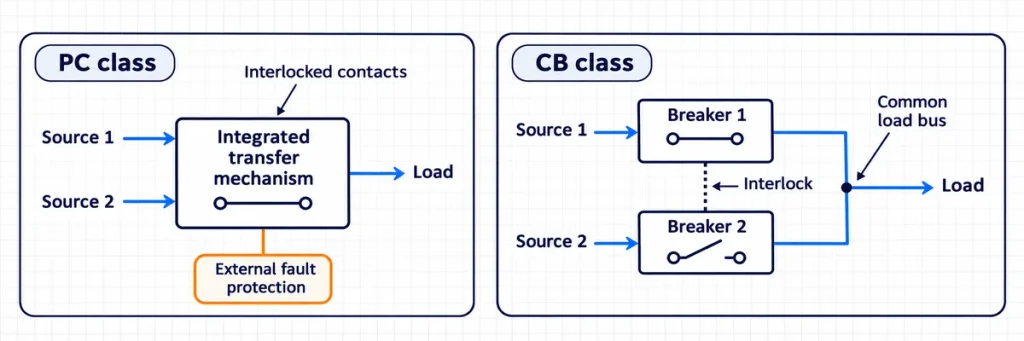
Manual emergency operation also feels different. On a single-shaft PC-class switch, inserting the emergency handle rotates both sides cleanly through an unmistakable OFF center position. On a CB-class unit, operators must understand how to disengage the motor-operator clutch before manually charging and switching the individual MCCB toggles.
Transfer Speed: Clearing Up a Common Myth
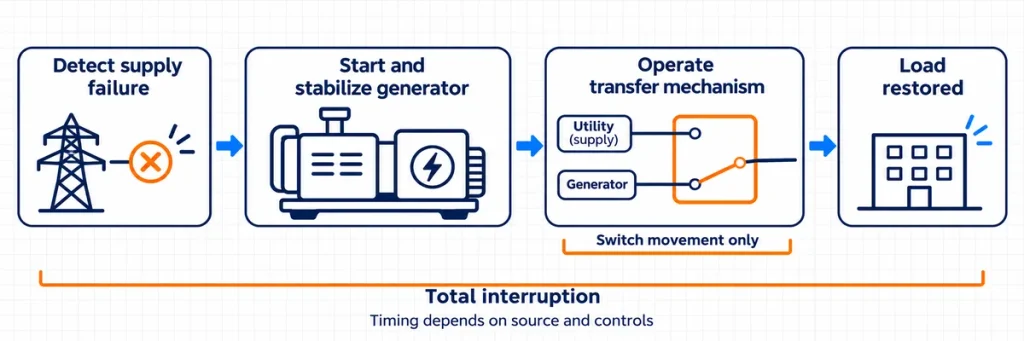
Many datasheets imply that PC-class switches are inherently faster than CB-class switches. That is only true for specific solenoid-driven PC-class designs that snap over in 50–100 ms. Motor-driven PC-class switches (for example, 0.4–0.5 s mechanisms) switch in roughly the same time window as motorized CB-class units.
Even when a solenoid PC-class switch moves in 80 ms, a stopped backup generator still needs 10–30 s to crank, stabilize, and accept load. Do not pay extra for a fast-switching class if your backup source is a cold generator. We break down the full timing chain in our ATS transfer time guide.
When a CB-Class ATS Is the Smarter Buy
If your switchboard already has incoming MCCBs on both the utility and generator lines, buying a CB-class ATS means paying twice for protection and giving up extra rail space. On the other hand, a CB-class ATS is often the most practical choice when the ATS sits directly at the incoming point of a standalone panel with no upstream feeder breakers. In that layout, the two internal MCCBs handle both changeover and local overload/short-circuit protection in one frame.
CB-class units also make sense in plants where maintenance teams already stock spare MCCBs, shunt trips, and auxiliary contacts, or where a selectivity study requires the transfer point itself to isolate downstream faults locally instead of tripping a main upstream incomer.
Two Real-World Panel Scenarios
Hospital fire-pump panel (250 A, AC-33B): Both the utility transformer feeder and the standby generator already have coordinated upstream MCCBs in the main switchboard, and local fire code forbids overload tripping on the pump circuit. Use a PC-class ATS. It fits a tighter enclosure, eliminates load-side paralleling busbars, rides through motor inrush and overloads without tripping, and relies on the upstream MCCBs only for short-circuit clearing.
Standalone workshop incomer (400 A): A remote factory sub-board takes a direct feed from a utility line and a backup diesel set with no intermediate breakers ahead of the ATS. Use a CB-class ATS. The integrated MCCBs provide the missing short-circuit breaking capacity (Icu/Ics) and overload protection in a single assembly without needing two separate upstream breaker enclosures.
Four Mistakes That Cause Field Callbacks
Most ATS specification errors happen when a buyer picks a class from a price list without checking the rest of the one-line diagram. Watch out for these four traps:
- Wiring a PC-class ATS with no upstream protection: Leaves the circuit with zero overload or short-circuit protection.
- Assuming CB-class is always safer: On critical or fire-pump feeders, an uncoordinated MCCB inside a CB-class ATS can trip prematurely on overload.
- Forgetting the TRIP lockout on CB-class units: If an internal MCCB trips on a fault, the ATS controller will not transfer to the backup source onto a live fault—someone has to walk to the panel and manually reset the tripped handle.
- Sizing by amps without checking AC-31 vs. AC-33: Putting an AC-31B resistive-rated switch on a heavy motor feeder shortens contact life and risks contact welding.
How to Lock In Your Specification
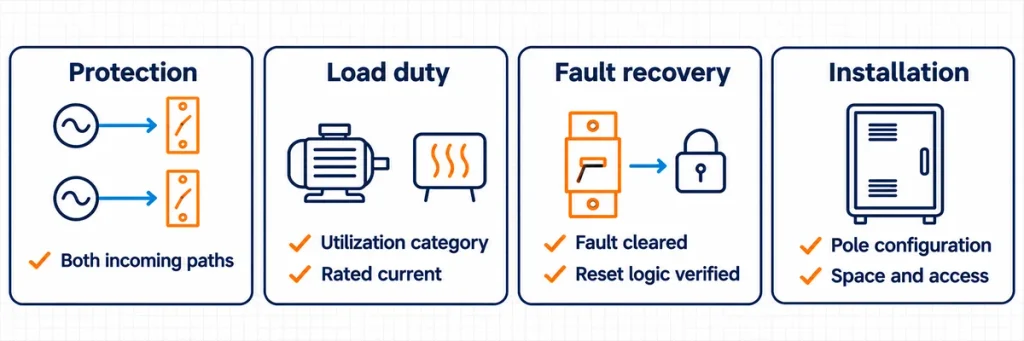
Before sending out an RFQ, confirm three points on your drawing: whether upstream breakers already protect both incoming lines (if yes, PC-class avoids duplicate trip units; if no, CB-class supplies the protection), whether the load must ride through overloads without tripping, and which pole configuration (2P, 3P, or 4P) your earthing system requires—covered in our 2P vs. 3P vs. 4P ATS selection guide.
Frequently Asked Questions
Can I install a PC-class ATS without an upstream circuit breaker?
No. A PC-class ATS has no overcurrent or short-circuit tripping mechanism. It must be backed up by an upstream breaker or fuse whose clearing time and let-through energy stay within the ATS’s rated Icw.
Which lasts longer: PC-class or CB-class ATS?
Under frequent transfer duty, purpose-built PC-class changeover contacts typically outlast standard MCCB-based CB-class units, because circuit breakers are engineered primarily for fault interruption rather than thousands of load-switching cycles.
What happens if a CB-class ATS trips on a short circuit?
The faulted internal MCCB locks in the TRIP position and opens the circuit. The controller will not transfer to the backup source until a technician clears the fault and manually resets the breaker handle.
Can I swap a CB-class ATS for a PC-class ATS inside an existing panel?
Only if you verify two things: first, that both incoming feeders already have coordinated upstream overcurrent and short-circuit protection; second, that the mounting plate holes and busbar clearances match, since a PC-class switch is usually narrower and shorter than a dual-MCCB CB-class assembly.
Are both classes available in DIN-rail and panel-mounted frames?
Yes. Compact PC-class units cover DIN-rail distribution boards (16 A–125 A) as well as heavy panel-mounted frames up to 3200 A. CB-class units are built around standard MCCB frames, typically 63 A–1600 A.
Which JUTRION series are PC-class vs. CB-class?
JUTRION builds both: the JUQ5 / JUS7 PC-class series for dedicated high-reliability changeover, and the JUQ1 CB-class series for integrated breaker protection. You can compare frame ratings and request datasheets on the JUTRION ATS product range page.
Confirming Your ATS Specification Before Ordering
Picking between PC-class and CB-class hardware comes down to where your fault protection sits in the switchboard. If your utility and generator incomers already have coordinated upstream breakers, a PC-class unit saves panel space and keeps critical loads online during overloads; if the ATS sits at an unprotected standalone incomer, a CB-class assembly gives you both changeover and local fault breaking in one frame.
Ready to finalize a panel BOM or verify upstream short-circuit coordination? Share your rated current, utilization category (AC-31 vs. AC-33), pole count, and upstream breaker rating through the JUTRION ATS product page to match the right JUQ5, JUS7, or JUQ1 model before releasing your panel drawing.
Technical References
- IEC 60947-6-1:2026 — Low-voltage switchgear and controlgear: Part 6-1: Multiple function equipment — Transfer switching equipment.
- IEC 60947-2:2024 — Low-voltage switchgear and controlgear: Part 2: Circuit-breakers.
