

Shunt Trip vs Undervoltage Release: Which MCCB Accessory Should You Choose?
A fire-alarm relay closes, a control wire breaks, or the control transformer loses power. Whether the breaker should open in each event determines the correct accessory.
Choose a shunt trip when an external system must actively command the MCCB to open. Choose an undervoltage release when loss or severe reduction of its control supply must open the MCCB and prevent it from closing again until voltage recovers. A shunt trip is therefore an energize-to-trip device; an undervoltage release is normally energized and de-energizes to trip. Neither accessory replaces the breaker’s overload and short-circuit protection, and neither one closes or resets the breaker remotely.
The most useful selection question is not “Which coil is safer?” It is: What must the breaker do if the control circuit itself fails?
Shunt Trip vs Undervoltage Release: Decide from the Failure Response
The table below starts with the event the panel must handle. It avoids a common design error: selecting an accessory by its name before defining the required behavior.
| Event or requirement | Shunt trip (MX / SHT) | Undervoltage release (MN / UVR) | Practical implication |
|---|---|---|---|
| Remote trip command is issued | Trips when the correct control voltage is applied | Trips when its continuously supplied circuit is opened or voltage falls sufficiently | Either can be part of a remote-opening circuit, but the control logic is opposite |
| Control supply fails | Cannot initiate a new trip | Trips the breaker | MX holds the existing breaker state; MN moves the system to the open state |
| Control wire breaks | The trip path can fail silently unless supervised | The breaker trips if the break removes coil supply | MN provides fail-safe behavior for that particular wire-loss condition |
| Voltage remains healthy during normal operation | Coil is normally de-energized | Coil is normally energized continuously | MN requires continuous control power and creates a holding load |
| Breaker is closed while coil supply is absent | Normally possible once the trip command is removed | Closing is blocked | MN can provide an anti-restart or close-permission function |
| Remote reclosing is required | Cannot provide it | Cannot provide it | A compatible motor operator or electrically operated breaker mechanism is also required |
This comparison describes the generic operating principle. The exact thresholds, pulse duration, duty and closing behavior belong to the ordered breaker-accessory combination. Schneider Electric’s published guidance, for example, states that its referenced MX release operates when supplied, while the MN release opens the breaker when its supply falls below its declared threshold. Those figures should not be copied automatically to another product family.
A Shunt Trip Opens the MCCB When a Command Arrives
A shunt trip is an electrically operated release connected to a separate control circuit. When the correct voltage is applied to the coil, the release acts on the breaker’s trip mechanism. The breaker mechanism then opens the main contacts and interrupts the load current.
The shunt trip does not carry or interrupt the main-circuit current. It also does not sense overload or short circuit. Those duties remain with the MCCB and its trip unit. The shunt release adds another reason for the breaker to open:
External command → shunt-trip coil energizes → breaker mechanism trips → main contacts open
Typical command sources include:
- a fire-alarm or fire-suppression relay;
- an emergency power-off circuit;
- a PLC, BMS or remote terminal output;
- a protection relay that is separate from the MCCB trip unit;
- a battery-management or process-shutdown system.
The important limitation is energy availability. If the control fuse has opened, the control transformer has failed or a conductor in the trip path has broken, a conventional shunt trip cannot create the intended opening command. For an emergency function, the control source and wiring therefore need the availability, monitoring and testing required by the project—not merely a coil with the correct voltage printed on it.
Momentary and Maintained Commands Are Not Interchangeable
Many shunt releases are intended to receive a pulse rather than remain energized indefinitely. Some breaker designs include a cut-off contact that removes coil power after the mechanism opens. Other control schemes use an auxiliary contact or relay logic for the same purpose. A maintained command applied to a momentary-duty coil can overheat or damage it.
Confirm the minimum command duration, maximum permitted energization time and any built-in cut-off function from the exact accessory documentation. Do not assume that every MX coil tolerates a latched fire-alarm output simply because both use the same nominal voltage.
An Undervoltage Release Makes Healthy Control Voltage a Closing Condition
An undervoltage release uses the opposite energy logic. Its coil is supplied during normal operation. The energized release allows the breaker to remain closed and, depending on the breaker design, allows the mechanism to close. When the coil voltage falls sufficiently or disappears, the release opens the breaker.
The operating sequence is:
Healthy coil supply → closing permitted → voltage falls or circuit opens → breaker trips → closing remains blocked until voltage recovers
This behavior makes the MN or UVR useful where loss of the control circuit must produce a defined open state. Applications include machine anti-restart arrangements, safety interlocks and systems in which a broken control conductor must not leave the breaker closed.
For products following the familiar IEC/EN 60947-2 behavior, published manufacturer documentation commonly shows an opening region between 35% and 70% of rated control voltage and allows closing again at approximately 85% of rated voltage. These percentages describe a range, not a field-adjustable universal setpoint. The actual accessory data governs the ordered product.
Instantaneous UVR Can React to a Short Voltage Dip
A motor start, source transfer or network disturbance can briefly depress control voltage. An instantaneous undervoltage release may interpret that dip as the condition it is designed to detect and trip the breaker. If the process should ride through short dips, investigate a manufacturer-approved time-delay unit or a different supervised control architecture.
A delay must not be added casually to a safety function. It changes the response time and therefore needs to be consistent with the risk assessment, machine-control design and applicable rules.
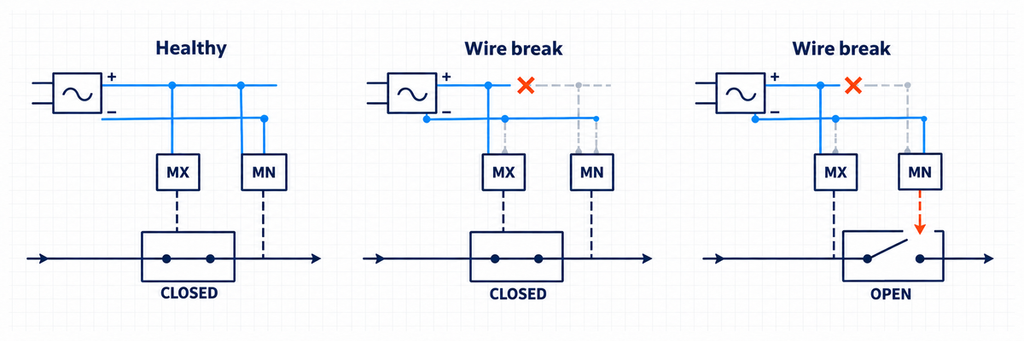
MX and MN response to a broken control wireChoose the Accessory from the Required Failure Response
Both accessories can ultimately open the same breaker, yet they allocate responsibility differently. That difference should be settled before the application name—fire system, machine, pump or critical process—is allowed to influence the choice.
With MX, the control system must prove that energy is available when a trip is demanded. The normal state consumes little or no coil power, and an unintended loss of the trip supply does not interrupt the load. This can be desirable for circuits that must not drop out merely because an auxiliary supply has failed, provided the trip path is adequately supervised where required.
With MN, the control system must continuously prove that conditions are healthy. A loss of supply opens the breaker and prevents closing. This is useful when failure of the control circuit should be visible immediately and should move the equipment to a defined state.
“Fail-safe” is not a universal label for the entire installation. An MN coil can make one control path fail safe against wire breakage, but the complete safety function still depends on the power source, contacts, wiring, breaker mechanism, reset policy and required diagnostic coverage. Likewise, using an MX does not automatically make a system unsafe; it may be the correct choice when continuity must be preserved during an auxiliary-supply failure.
Apply That Failure Response to the Actual Load
Fire-Alarm or Remote Load Shutdown
A shunt trip is often suitable when a fire-alarm relay, BMS or remote station must issue a positive command to disconnect selected loads. The designer can keep the breaker closed during normal operation and energize MX only during a shutdown request.
The exact fire strategy and permitted loads are governed by local codes and the approved cause-and-effect matrix. Some life-safety loads must continue operating during a fire condition, so “trip everything” is not an acceptable generic rule. Define which breaker opens, what supplies the coil and how the trip path is monitored and tested.
Machine Anti-Restart and Safety Interlocking
An undervoltage release can be appropriate where the machine supply should open on loss of control voltage and must not reclose merely because voltage returns. Normally closed stop or permissive contacts may be arranged in the MN supply path so that an opened contact removes coil power.
That does not, by itself, establish a compliant emergency-stop function. Machinery safety performance depends on the complete control architecture and risk assessment. The value of MN here is its operating principle: a lost conductor or lost supply does not leave the breaker closed.
Critical Load That Must Ride Through Auxiliary-Supply Failure
If loss of a small control transformer must not disconnect a critical process, an instantaneous UVR supplied by that transformer may be the wrong choice. An MX can leave the breaker in its existing state when the auxiliary source disappears. The trade-off is that the trip circuit then needs an available source when an opening command is required.
The design may instead use a monitored DC control supply, redundant supply, stored energy or another architecture. The accessory decision follows the required system response; it does not replace that system design.
Brownout Response for Motors
An undervoltage release can disconnect a motor feeder during severe loss of voltage and block reclosing until the coil supply has recovered. This can support anti-restart behavior and avoid attempting to operate equipment while control voltage is inadequate.
Do not treat the generic UVR threshold as a complete motor-protection setting. Motor thermal protection, phase-loss or unbalance protection, contactor drop-out behavior, process inertia and the acceptable ride-through time remain separate design questions.
Four-Step Selection Snapshot
| If the project requires… | Start with… | Add or verify… |
|---|---|---|
| Opening only when a deliberate external command arrives | Shunt trip (MX / SHT) | A control source that remains available when the trip is required, plus the correct pulse or cut-off arrangement |
| Opening when a control wire or control supply is lost | Undervoltage release (MN / UVR) | Continuous coil supply, acceptable dip response and the required closing-permission threshold |
| Remote reset and closing after the breaker opens | MX or MN does not provide this function | A compatible motor operator or electrically operated breaker mechanism, with permissives |
| ON/OFF confirmation or separate trip indication | MX or MN does not provide a status output | Matched auxiliary and/or alarm contacts with the required contact duty |
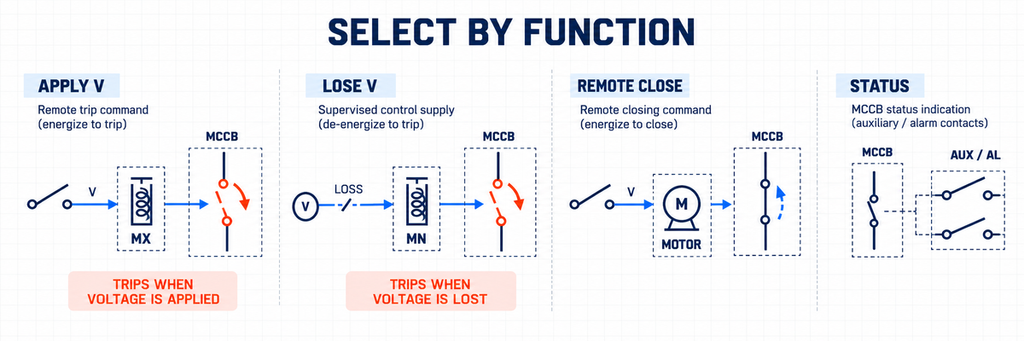
MCCB accessory selection by trip closing and status functionThis snapshot is a shortlist, not an ordering code. The next checks decide whether the selected function can actually work with the available supply and breaker platform.
Control-Supply Location Changes What the Circuit Does
The same release can behave differently depending on where its control power comes from. Document the source explicitly on the schematic.
| Control-supply source | Advantage | Design question |
|---|---|---|
| Line side of the controlled breaker | Supply remains available after the breaker opens | How is the control circuit isolated and labelled during maintenance? |
| Load side of the controlled breaker | Supply disappears when the breaker opens | Will the coil be de-energized as an intended consequence, and can the required reset/close sequence still occur? |
| Independent AC control transformer | Separates control voltage from the main circuit | What should happen if that transformer or its primary protection fails? |
| DC control supply or battery system | Can preserve control during an AC outage | Is the DC source monitored, protected and sized for pickup demand? |
For MX, locate the source so the trip remains available under the fault and outage conditions in which it will be demanded. For MN, decide whether loss of that source is intentionally one of the events that must open the breaker. A schematic that says only “230 V control” does not answer either question.
Match the Coil and Breaker as One Assembly
A request for “one 24 V shunt trip” is incomplete. Before ordering, confirm all of the following:
- Breaker manufacturer, family and complete model: the internal latch interface and mounting geometry are family-specific.
- Frame size and pole configuration: identical ampere ratings do not prove identical accessory cavities.
- Accessory function: MX/SHT and MN/UVR use opposite control logic even when their housings look similar.
- Rated control voltage: distinguish the accessory voltage from the MCCB’s main-circuit voltage.
- AC or DC supply: equal numerical voltage does not make AC and DC coils interchangeable.
- Operating-voltage range: verify pickup, drop-out and closing-permission thresholds in the current datasheet.
- Command duty: check pulse duration, continuous-duty capability and the need for a cut-off contact.
- Power demand: size the supply and conductors for pickup or inrush as well as continuous holding load.
- Available accessory slots: shunt and undervoltage releases may share a mutually exclusive position in some frames.
- Required approvals: confirm that the complete breaker-accessory combination is acceptable for the project and destination market.
A coil that fits physically but does not deliver the declared operating travel can fail to trip the mechanism reliably. Conversely, modifying the breaker case or adapting an unapproved release can affect clearances, mechanism operation and the validity of the complete assembly.
JUTRION’s MCB and MCCB accessory range includes MX shunt trips, MN undervoltage releases, auxiliary contacts, alarm contacts and motorized mechanisms for matched breaker configurations. The selection should be returned as a breaker-family-specific accessory reference rather than a generic “24 V coil.” For compatibility review, provide the breaker nameplate, complete model, frame size, required control voltage, AC/DC supply type, desired failure response and photographs of the accessory compartment.
A Real JUTRION Inquiry: Correct Model, Wrong Function
In one customer inquiry handled by JUTRION, the breaker family and accessory model information were correct, but the customer identified an undervoltage release as a shunt trip. The problem was not mechanical fit, frame size or an incorrect model code. It was a functional mismatch between two releases that can both open the breaker.
If the distinction had been missed, the control logic would have been reversed. The customer expected a device that remained idle until a trip command was applied, while the selected undervoltage release required continuous healthy voltage to permit the breaker to remain closed. The accessory could therefore appear faulty when connected according to shunt-trip logic even though it was behaving as an MN release should.
The case shows why the review sequence should begin with the required event—voltage applied to trip, or voltage lost to trip—before moving to the model, coil supply and mounting interface. A correct-looking part number does not prove that the control function is correct. The schematic behavior must be stated alongside the breaker and accessory references.
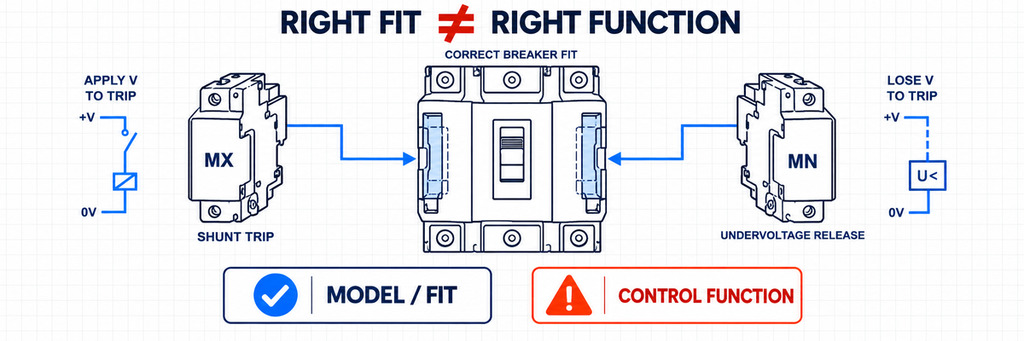
Correct MCCB accessory fit but wrong shunt trip or undervoltage release functionComplete the Function with the Required Supporting Accessories
A voltage release performs one mechanical action: it trips the breaker. A complete remote-control scheme may need several different functions.
- Auxiliary contact: confirms the breaker is open or closed and may be used in a shunt-coil cut-off circuit where the product permits.
- Alarm or trip contact: reports that the mechanism tripped rather than simply being switched OFF.
- Motorized operating mechanism: provides compatible remote opening, reset or closing functions when required.
- Interposing relay: separates a PLC or fire-panel output from a coil load when the output rating or isolation requires it.
- Time-delay unit: allows a compatible MN release to ride through defined short voltage dips.
The MCCB motorized operating mechanism guide explains why remote closing and reset are separate from voltage-release tripping. For the broader family, use the circuit breaker accessories guide to distinguish control, signalling and mechanical accessories.
Whether MX and MN can be installed together depends on the breaker platform. Some frames allocate one release position, making the two alternatives mutually exclusive. Others provide separate positions or combinations. Check the accessory-layout drawing instead of assuming that an empty-looking cavity is available.
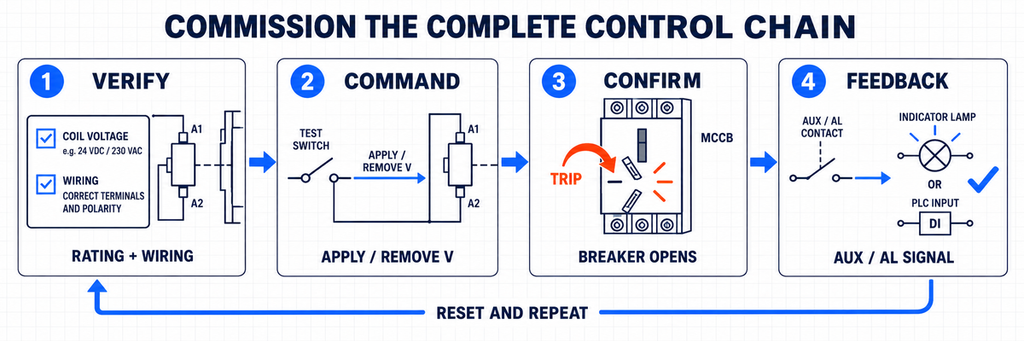
MCCB shunt trip and undervoltage release commissioning sequenceTwo Illustrative Control Cases
Case A: Fire-Alarm Command to Disconnect a Non-Essential Feeder
Assume a commercial building has an MCCB supplying a non-essential ventilation feeder. The approved fire strategy requires a relay in the fire-alarm panel to open that feeder when a defined alarm condition occurs, while a failure of the ordinary BMS supply alone should not interrupt the load.
An MX-based path is the natural starting point. The fire relay applies a trip command to the matched shunt release. The control source must remain available during the relevant fire condition, the relay output must be suitable for the coil circuit, and a cut-off arrangement may be required if the alarm command remains latched. Breaker feedback confirms opening to the monitoring system.
The case does not establish a universal fire-alarm circuit. The approved cause-and-effect schedule, local code and breaker documentation determine the final arrangement.
Case B: Conveyor That Must Not Restart After Control-Power Loss
Assume a conveyor feeder must open when the machine’s safety-control supply disappears, and the breaker must remain impossible to close until the supply and permissive chain are restored. A continuously energized MN release supports that behavior.
The UVR supply passes through the defined permissive path. If the circuit opens or control voltage falls sufficiently, MN trips the MCCB. Restoring voltage removes the closing block, but it must not automatically command the machine to restart; the machine-control reset and start sequence remain separate.
If normal motor acceleration causes control-voltage dips, the measured voltage at the MN terminals must be compared with the accessory’s operating limits. A compatible delay arrangement or improved control supply may be required rather than defeating the release.
Commission the Failure Modes, Not Only the Normal Command
A successful pushbutton test proves only one path. Commissioning should verify the conditions that drove the accessory choice.
- Confirm the accessory part number, coil rating, mounting position and terminal identification against the documentation.
- Measure control voltage at the release terminals under normal conditions and during the relevant command or disturbance.
- For MX, issue the real remote command and confirm that the breaker trips, the coil is released as intended and the monitoring system receives the correct state.
- For MN, remove or reduce the control supply using the approved test method and confirm opening plus closing inhibition.
- Simulate the intended wire-break or permissive-open condition where the safety procedure allows it.
- Verify that a trip does not produce an unauthorized automatic reclose.
- Record the result, reset sequence and expected indication for maintenance staff.
Testing and installation should be performed by qualified personnel with the main and control circuits isolated as required. A voltage-release test is not a substitute for the complete functional test of the fire, machinery or process-control system in which it operates.
Frequently Asked Questions
Is an undervoltage release the same as a shunt trip?
No. A shunt trip opens the breaker when its coil receives the specified electrical command. An undervoltage release is normally energized and opens the breaker when its supply falls sufficiently or disappears.
Which device is fail safe: MX or MN?
MN provides fail-safe behavior against loss of its own supply or a series control conductor because that loss trips the breaker. That does not make the entire installation automatically fail safe; the complete control and safety architecture still has to be assessed.
Can a shunt trip protect a motor from low voltage?
Not by itself. MX needs another device to detect the voltage condition and issue a trip command. An MN release responds directly to loss or severe reduction of its own supply, but complete motor protection may require additional devices and coordination.
Why will an MCCB with an undervoltage release not close?
The MN coil may be unpowered, supplied below its closing threshold, wired incorrectly or mechanically mismatched to the breaker. Verify the accessory rating, terminal voltage and permissive chain before treating the breaker as defective.
Can MX and MN be fitted in the same MCCB?
Only when the exact breaker family and frame provide approved positions for both. In many compact designs they use the same internal location, so one must be selected. Check the manufacturer’s accessory-layout table.
Does a shunt trip close the breaker again after an emergency?
No. A shunt trip only initiates opening. Remote reset and closing require a compatible motor operator or electrically operated mechanism plus the necessary permissives and feedback.
Specify the Required State When Control Power Disappears
If the breaker must stay in its existing state when auxiliary power is lost and open only on a deliberate command, start with a shunt trip. If loss of the control circuit must open the breaker and inhibit closing, start with an undervoltage release. Then verify the exact breaker interface, coil voltage, duty, supply topology and commissioning sequence.
Need to match an MX or MN release to an existing breaker? Send JUTRION the breaker brand and model, frame size, coil voltage, AC/DC control supply, required failure response and clear nameplate and accessory-slot photographs. The team can review the configuration and provide suitable product information or an OEM/ODM quotation.
Technical References
